During our High School days, we had a visiting Brother. He told a story and asked us to repeat the tongue twister.
“A city, which was plagued with pickpockets, asked someone to tackle the problem. The problem went away. How and Why?
When he saw a pickpocket pick the pocket of a man he picked the pocket of the pickpocket and put the pickings in the pocket of the man whose pocket the pickpocket had picked. “
Uzin Aung Chaw (Victor, C69) added :
When he saw the pickpocket picked the pocket, he picked the pocket of the pickpocket and repocket the pickings into the pocket whose pocket was picked by the pickpocket.
Ashin Pannagavesaka wrote :
The very first one I ever learnt was: She sells seashells on the seashore! Another one from our primary school days was: Peter Piper picked a peck of pickled peppers. So, if Peter Piper picked a peck of pickled 🌶 peppers, where is the peck of pickled peppers that Peter Piper picked?
Good habits allow us to perform things in auto-pilot mode.
Bad habits (e.g. addiction) are easy to develop, but difficult to quit. With patience and practice, we can modify and substitute the bad components in the habit with good ones. The triggers may remain the same, but good actions can yield satisfactory results.
My Experience
Hla Min
I spent a lot of time playing the Solitaire Card Games. I received a sense of gratification with the awards : Bronze, Silver, Gold, Diamond and Perfect.
I stopped playing Solitaire and spent more time writing and sharing my knowledge and experience via my Posts. I now receive a sense of gratification with the “kind words” by my readers.
Smoking
My uncle smoke two packs of cigarettes every day. He successfully quit smoking partly due to his doctor’s advice and partly due to his determination to live a long, healthy life. He lived to his 80s. It could have been more if he did not have a fall. There was no immediate signs of danger, but he passed away a few days later.
My teacher tried to quit smoking. His buddies and students offered him cigarettes to keep them company. He also tried the substitution method using Chewing Gums. He added one more addiction. It would take some time before he kicked both habits.
Habitual Kamma
Habitual Kamma (e.g. meditating every day) is important.
U Po Sa would recite “Mora Sutta” (Daung Min Payeik) before going for a daily morning walk along Inya Road with his close friends. Knowing U Po Sa’s habit, the kidnappers waited in the early morning and kidnapped him. U Po Sa got free. Some attributed U Po Sa’s release to Habitual Kamma (e.g. recital of the Mora Sutta).
Books
“Seven Habits of Highly Effective People” by Stephen Covey is a Best Seller.
Covey also wrote another book on the Eighth Habit.
“The Power of Habit” by Charles Duhigg is another Best Seller. Duhigg points out where to “break” the cycle in a habit.
Many books are available as e-Book and Audio book.
If one just wants to have teasers or summaries before buying a book, one can subscribe to Blinkist.com
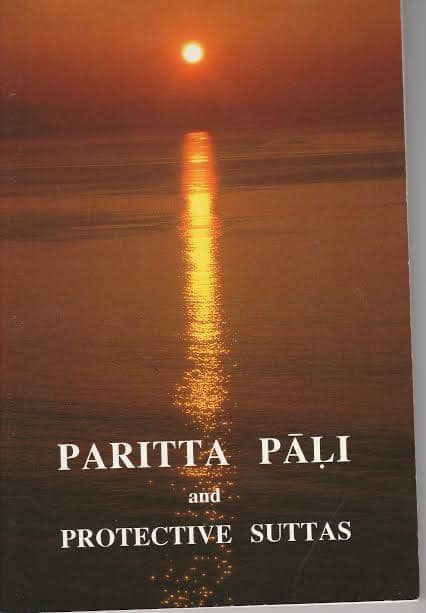
Original Publisher : Dhammachakka Meditation Center, 1991
Republished with other articles : Tathagata Meditation Center
Other articles included the book
(1) “Instructions to Meditation Practice” by Mahasi Sayadaw (2) “Benefits of Walking Meditation” by Sayadaw U Silananda (3) “Guidance for Yogis at Interview” by Sayadaw U Pandita (4) “An Interview with Mahasi Sayadaw” by Thamanaykyaw, translated by U Hla Myint
He served as a member of Executive Committee (EC), Board of Directors (BOD), Editorial Board for Dhammananda Newsletter and the publication “Homage to Sayadaw U Silananda”.
He has published four books in Myanmar (by Seik Koo Cho Cho Press).
Started by Ko Myint Pe (M72) and team with the Patronage of Saya U Khin Maung Phone Ko (“Phone Ko”, C65) and Saya U Aung Myint (“Kyant Ba Hone”, Pet69)
“Phone Ko” was known for his “Vietnam cartoon”
“Kyant Ba Hone” superficially looked like “Nick Kelly”, but the contents are different.
Maintained by three (or more) generations of Cartoon Boxers
Cartoon Box was “ordered close” after 1988
History is published in the Commemorative Issue of Swel Daw Yeik Magazine for SPZP-2012
Collection of RIT Cartoons published in time for SPZP-2012
Pamphlet of RIT Cartoons distributed at Shwe YaDu and SPZP-2016
Some (e.g. “Aw Pi Kye”) became professional cartoonists Exhibited in Myanmar and beyond (e.g. Asian Cartoon Exhibition)
Early Cartoonists
Shwe Ta Lay
U Ba Gyan
U Heng Soon
U Aung Shein
U Pe Thein
U Than Kywe
U Ba Htwe
U Kyaw San (“Ka Sa”)
Published in Burmese and English newspapers, magazines and books.
The “Cartoon Festival” was held in U Ba Gyan Street (around Tazaung Daing).
Comics
During our times, we read
Beano
Dandy
Topper
Beezer
Film Fun
Joke and Humor books D. S. Saluja collected 200 books including Annual / Special Issues
U Myo Myint (M73)
Designed covers for the RIT Annual Magazines and the commemorative Swel Daw Yeik Magazines.
Expert in “Pon Tu” (Portrait) and “Oil Paintings”.
Also draw cartoons. U Myint Pe (M72) has posted some of them.
They remind me of three female friends who were fondly known as Half Size, Full Size and Double Size.
Miscellaneous
Ko Win Thein (M67, GBNF) suggested to name RIT Main Gate as “U Lu Paw Gate”.
Ko Myint Soe (C68, GBNF) and Ko Myint Thein (M69, GBNF) are fondly called Maung Kabar (or Kabar for short)
About a decade ago, my spouse paid K10,000 for a copy of “old” cartoons published in the Rangoon Times. Some are political satire.
In 1958, there was a rift between the two factions of AFPFL. Some cartoonists took sides and a “price war” started. The cartoons, which sold for 60 pyas, were then given away at bargain prices (any where between 10 and 50 pyas).
We have seen private shops like Smart & Mookerdam gave way to the government owned stationery and book stores.
After the tragic death of Daj Hammarskjold, the United Nations Security Council selected U Thant (Permanent Representative of the Union of Burma, which co-founded the Non-aligned Movement) to succeed Hammarskjold as the Third UNSG and the first Asian UNSG.
USSR vetoed USA’s nominee for UNSG.
USA vetoed USSR’s proposal for Trioka (a three member committee from each of the Three Blocs).
U Thant retired after serving two terms as UNSG.
Post retirement
After retirement, U Thant started writing his memoirs but was interrupted by failing health.
His younger brother U Thaung was by his side in the final days, and helped bring U Thant’s body home.
The higher authorities were told explicitly or implicitly not to pay respect to U Thant’s body.
The Deputy Minister who paid respect to U Thant was dismissed effective immediately.
Most people expected a decent ceremony (if not a State Funeral befitting the Head of the World Organization), but they learned that U Thant’s body was to be placed at the Kyandaw Cemetery.
This led students to take U Thant’s body to the Main Campus and …
There were three dissenting votes by the student representatives for the higher authorities’ proposal to have U Thant buried in the Mausoleum (in Cantonment Park), and they lost by 8-3 margin.
The dark moments resulted in students being jailed or debarred, and some having to wait more months for their graduation ceremony.
One participant had already distributed invitation for the wedding, but ended with the loss of his freedom (for a few years) and his love.
Book
Htein Win Sar Pay published a book about the “U Thant Ah Yay Ah Khin”.
The book contains rare photos (most of them recovered from an archive overseas). Many photos (that were in Burma) were destroyed “out of fear” for harassment / punishment.
Met Ko Htain Win at the 5th ILF (Irrawaddy Literary Festival) in Mandalay in November, 2019. He was promoting another book 8-8-88.
U Khin Maung Zaw (EC76) wrote :
The sad thing I discovered at my last visit to Myanmar in Nov/Dec 2018 was that the tomb of U Thant has been closed and in disrepair. The entrance was padlocked, the compound was unkempt.
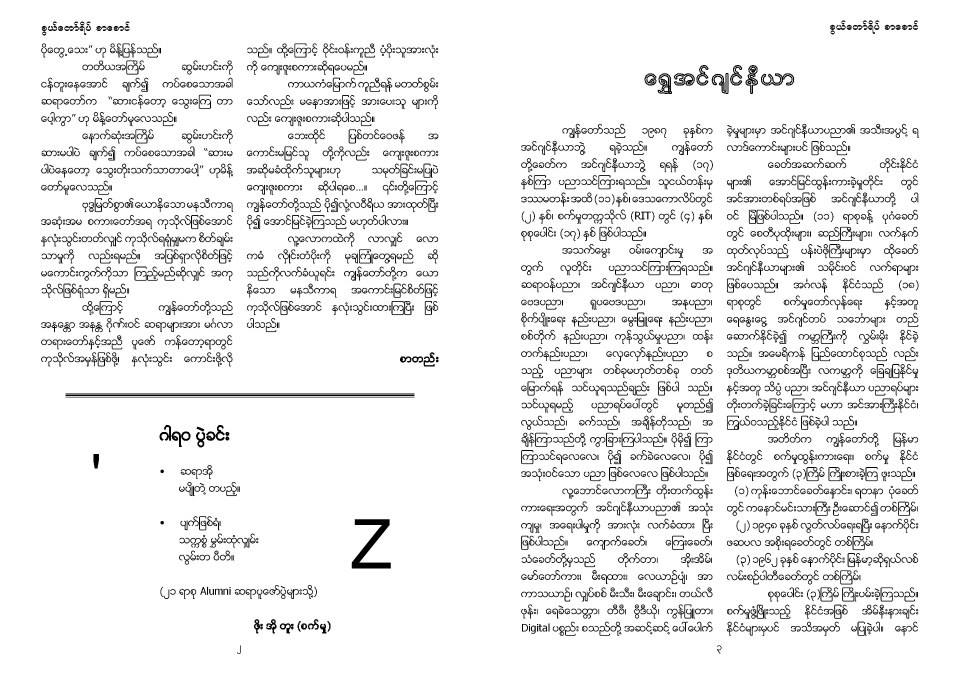
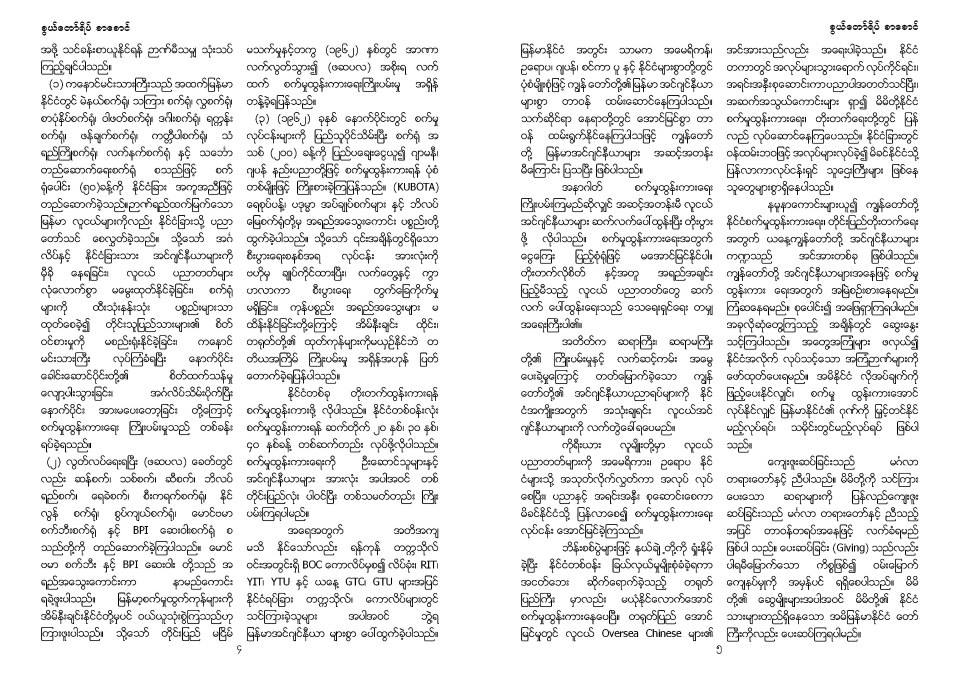
He is a founding member and President of RIT Alumni International, which hosted SPZP-2000. His classic article resulted in five Golden Sponsors for SPZP-2000.
10th Anniversay of RIT Alumni International
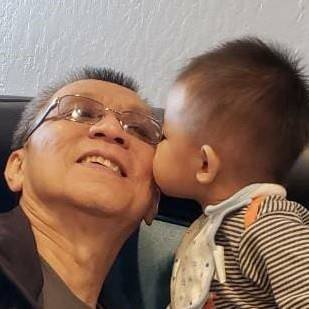
Saya’s spouse and grand children
In memory of Saya Allen, Daw Mu Mu Khin has donated Saya’s books to the YTU Library and has sponsored scholarships to eligible YTU students
Donation of Saya’s books to YTU
Donation of Saya Allen’s Books
Brother, can you afford US$ 500?
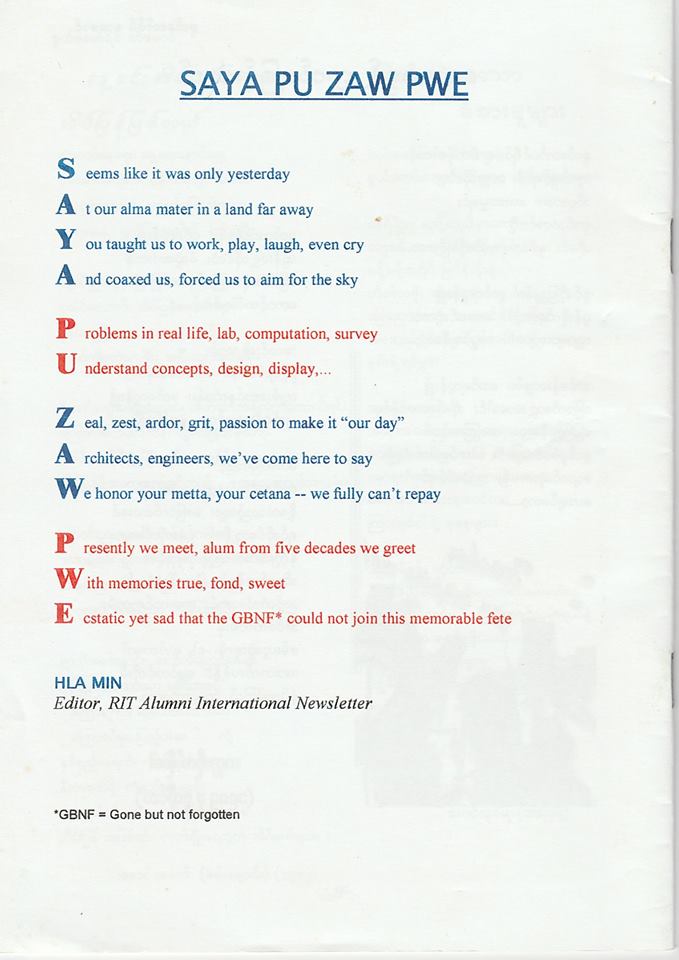
And many weekends spent away from your family as well? If you can then you probably are a member of the RIT Grand Reunion and Saya Pu Zaw Pwe organizing committee.
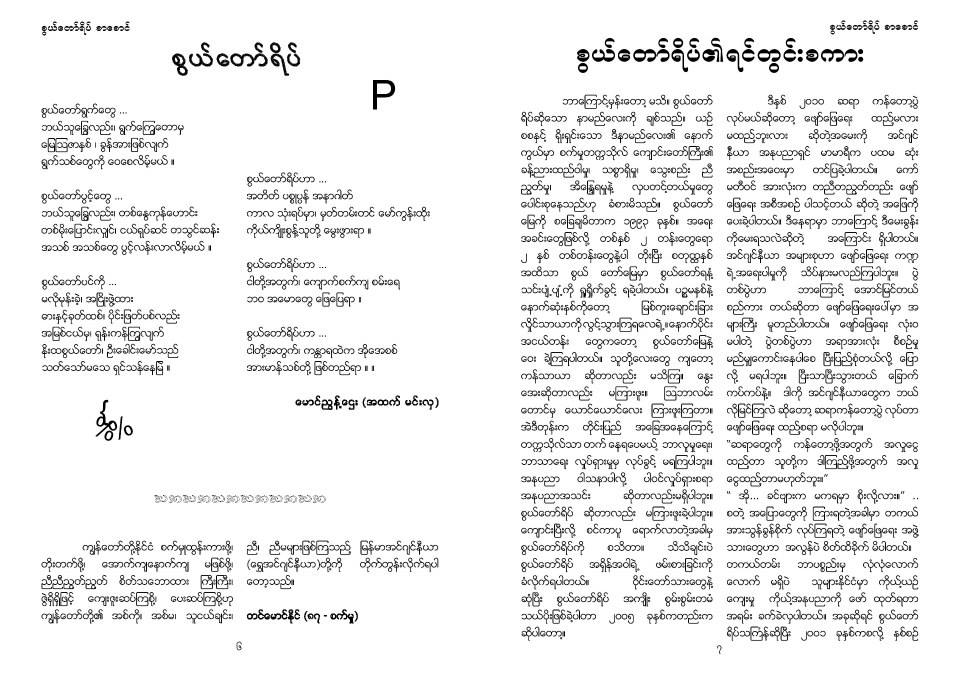
It all began one day several months ago when we met over lunch at Benny Tan‘s home in Hillsborough. Ko Hla Min and Ko Khin Maung Zaw among the lunch party had started the RIT Alumni website and were receiving enthusiastic responses. Hearing that the duo were carrying on the project all by themselves we decided to throw in our moral and financial support to assure its survival, realizing that it was providing a needed service for the RIT alumni to locate and communicate with each other. Every one present, ten of us at that time, took out our checkbooks and wrote out one hundred dollars each, with promises of more as needed. We informally called ourselves the RIT Alumni Bay Area Group. I was asked to be the group leader.
After that fateful event we continue to have regular meetings, hosted in turn at the homes of some among group members: Ko Hla Min, Maurice Chee, Ko Myat Htoo, Ko Thein Aung, and most recently Dr Nyo Win. Did I leave out any one? Ah yes! Ko Myint Swe and San San Swe. All the while the membership continues to grow and our objective keeps on changing from support of the website to some vague dream of a future RIT alumni organization on a global scale and finally settled on a plan for RIT Alumni Grand Reunion at the beginning of the 21st Century. Ko Hla Min broached the idea to include Saya Pu Zaw Pwe as part of the Grand Reunion in keeping with the Myanmar custom of honoring one’s teachers. As our plan jelled we got carried away by our own excitement and started talking about holding the reunion before the end of the Year 2000. After all, ending one millennium successfully augers well for success in the next millennium.
Before we fully realized what we were up to we have found an ideal site, the Embassy Suites Hotel conference hall near the San Francisco International Airport, and found ourselves making a commitment for a definite date, 28 October 2000 and a attendance fee of fifty dollars, a modest amount to encourage maximum number of Alumni to participate. The minimum capacity of the conference hall is 200 seats and we were required to make down payment and sign a rental and service agreement based on 200 seating. Our most optimistic estimate at the time was 100 attendees. If the attendance is low that means the Bay Area Group, as the Organizing Committee was not in force at the time, will have to make up the short fall. Which could amount to as much as five thousand dollars, or five hundred dollar from each group member. We hesitated a moment to reflect on what that means to us individually in terms of diminished spending power. But, in the end our attachment to RIT and the engineering profession, our sincere desire to meet the Sayas and class mates from whom we were separated for long over came us. We will accept the risks.
Thus was born the preparations in full swing for the Grand RIT Reunion and Saya Pu Zaw Pwe. Others must tell the rest of the story – of struggles, compromises, and elation along the way and from participants themselves what it means to be present at the defining moment in the history of RIT Alumni.
Allen Htay, RIT Alumni International – Bay Area Group RIT Grand Reunion and Saya Pu Zaw Pwe Organizing Committee