Blog

  • Encyclopedia

    Early Encyclopedias

    “Chamber’s Cyclopaedia” was one of the earliest encyclopedias. It covered 40+ subjects.

    In our younger days, we had “Pear’s Soap” and “Pear’s Cyclopaedia”. The company was probably building its brand name by supporting the publication of an encyclopedia.

    Encyclopedia Britannica

    My uncle had a set of “Encyclopedia Britannica”. It covers many topics written by SME (Subject Matter Experts). Yearly supplements were published. The final supplement came out a couple of years ago. There will no longer be printed editions. There will only be on-line subscription.

    Wikipedia

    • Wikipedia is a collection of encyclopedias in multiple languages.
    • The English edition of the Wikipedia is the largest.
    • The accuracy of the Wikipedia is comparable to that of the “Encyclopedia” thanks to the countless volunteer contributors and editors.
    • I was a volunteer to correct discrepancies (mostly entries on Burmese/Myanmar). For example, a young author wrote that St. Paul’s High School was the first among the De La Salle Schools in Burma. He was unaware that St. Patrick’s High School in Mawlamyaing was the first (and was established a few months earlier than St. Paul’s).

    No Absolute Perfection

    There is a slight chance that there are errors in an encyclopedia (or an equivalent “book of knowledge”). One author was unaware that Rajiv Gandhi was the elder son of Indira Gandhi. He was a pilot and entered politics only when his younger brother Sanjay Gandhi (touted as Indira’s confidante and successor) died in a plane crash.

    Collaboration

    The advent of Internet and the rise of “Collaborative Work” have lowered the time and cost to maintain encyclopedias.

    This image has an empty alt attribute; its file name is img_20181003_0001.jpg

    A few years back, I received a call to submit entries to “Encyclopedia of Asian American Folklore and Folklife”. I emailed to the editors that I was willing to help them on the Burmese section. They sent me four samples and asked me to send back one short article (not exceeding 500 words and with two or more references) on a chosen Head Word (e.g. Burmese American Festivals). They reviewed my article and accepted me. The remuneration was $10. I replied that I would like to have a copy of the 2-volume encyclopedia. A deal was struck. They would give me the encyclopedia if I submit at least 8 articles. Nine articles were accepted. Two articles were merged with the work of other authors. One author was a Burmese College Professor. Another was probably a graduate student, who inserted the wrong date for Martyr’s Day. The Editors promised to correct his error in another edition. I received a 3-volume encyclopedia (initially projected to be 2-volume) and an additional $10.

    Google Books

    • Some are not aware of “Google Books”.
    • If one goes to “Google Books” and search for my name, one can find the nine articles.

    Burmese Encyclopedia

    In my younger days, my parents bought me “Myanmar Swel Sone Kyan” (Burmese Encyclopedia).

    I heard that the “Myanmar Swel Sone Kyan” is under re-development with the help of SME (Subject Matter Experts).

  • Dr. Aung Gyi

    Pon Tu
    by Myat Myo Myint

    Sayagyi Dr. Aung Gyi

    Contributions by Saya

    • Brief Biography
    • Introduction to the History of University Engineering Education in Burma/Myanmar
    • Article covering
      (a) State Scholarship in the USA
      (b) Experience as Professor and Rector.
      Saya’s article was quoted in HMEE-2012
    • Key note speech at SPZP-2000 held in the USA
      Highlighted the importance of Health and Emotional Intelligence
    • Coconut Episode highlighted a student, who evolved from a “coconut thief” into a 3R volunteer teacher

    Memories

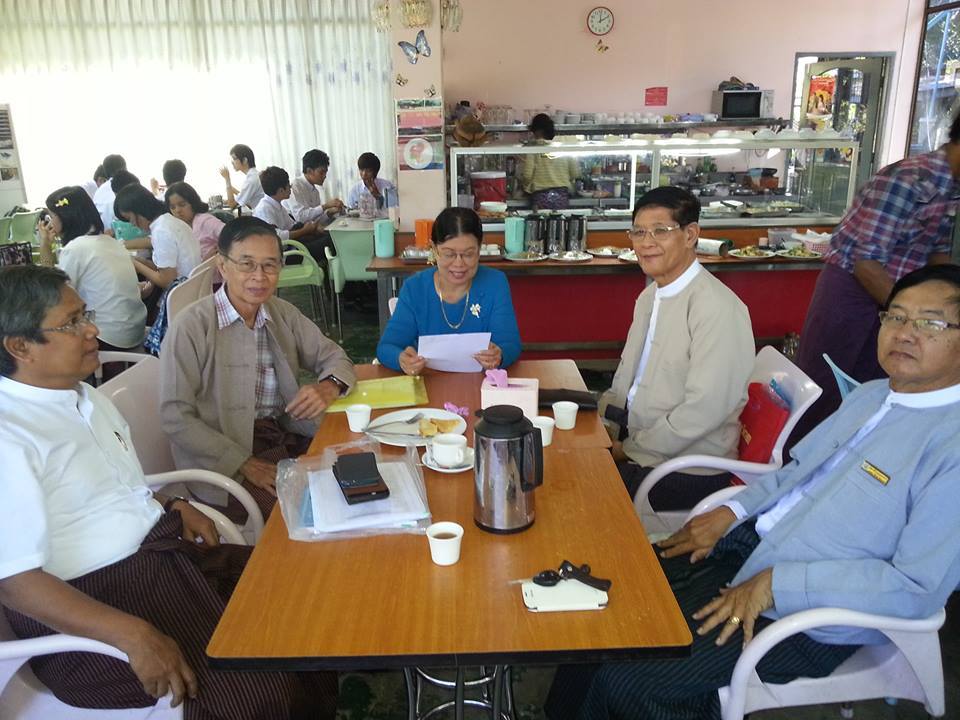
    Lunch / Dinner Gatherings

    Trip to New York

    Saya’s House in Canada

    Asian Heritage Museum, SF

    Seafood Restaurant in Daly City

  • Winner Inn

    Ma Lwin Mar Oo, co-owner of Winner Inn & daughter-in-law of Sayagyi U Ba Than, was requested by Saya U Tin Htut (M60) to ask her uncle [former saya and a successful real-estate developer] U Tin Win (M59) to come to Winner Inn.

    There was a lively conversation with U Kyaw Thein Lwin (90-year young son of Myoma Sayagyi U Ba Lwin) as the discussant, and the others filling in questions and remarks.

    The informal gathering ended when Saya Mao Toon Siong (M62) had to leave for another gathering. U Kyaw Thein Lwin briefly displayed his zero-emission car before he left for the day.

    Saya U Tin Win then took Saya U Tin Htut to the house of his younger son (who passed away a year or two ago) and then to the SAINT BAR and RESTAURANT run by his daughter-in-law.

    I have been an “Ei Myaung” for several times during this visit. Thanks to Sayagyi Dr. Aung Gyi, Sayagyi U Ba Than, Saya U Tin Htut, Saya U Tin Win and U Wai Lwin for allowing me to participate in the “Meet- Greet- Fete”.

  • Supporting Departments

    Early Days

    In the early days, students who passed the two-year Intermediate of Science classes and satisfied the eligibility requirements (e.g 50+ marks in Mathematics, Physics and Chemistry) were admitted to the four-year Engineering course.

    The engineering students had to attend Mathematics classes (e.g taught by Sayagyi U Ba Toke) in the RU Main Campus. Civil engineering students had to take Geology classes in the RU Main. It was common for the students to use bicycles to save time and energy.

    New Education System

    In November 1964, under the new Education System, matriculates were admitted to 1st BE using the controversial ILA system. Those who passed the last ever I.Sc(A) with Science option were admitted to 2nd BE based on total marks. Those who passed the last ever I.Sc(B) with Science option were admitted to 3rd BE.

    Supporting departments (with Head) were established at RIT. They include

    • Burmese (U Tein Kyi …)
    • Chemistry (U Kyaw Tun, Daw Thaung Khin …)
    • English (Daw Yin Yin Mya, Daw Sheila Saing …)
    • Mathematics (U Sein Shan, U Shwe Hlaing …)
    • Physics (Daw Nyein, Daw May Than Nwe …)

    Not sure if Geology (U Ngwe Thein, U Maung San …) was established as a supporting department or as a sub-department of an engineering department.

    Daw Myint Myint Khin was RIT Librarian.

    For some time (during the BSPP era) Political Science department (U Nyein Aung, U Tha Din …) existed.

    There were Visiting Lecturers and/or part-time sayas

    • Electrical Inspection
    • Food Technology
    • Free hand drawing
    • Industrial Management
    • Programming
    • Sociology
  • Errors

    • “To err is human. To forgive divine.”
      I like another version. “To err is human. To really goof, use a computer.”
    • I am imperfectly perfect.
      I write most of the type straight on the keyboard relying on my reasonably good memory.
      I have made intentional and unintentional errors.
      Thanks to my colleagues, friends and readers for catching and correcting them.
    • Word processors also introduce some errors by correcting legal Burmese words and names. e.g. “Nwe” becomes “New” when auto-corrected.
      A work around is to add such words to a private dictionary for use by the word processor.
    • Without analysis of context, a program cannot decide whether you meant “goal” (objective) or “gaol” (alternative spelling for jail).
      Advances in Artificial Intelligence (AI) might help with such problems.
    • Inconsistencies are not easy to detect.
      If I write about Saya U Shwe Hlaing for two posts : “Names — Shwe” and “Names — Hlaing” [at different times], the contents may not be exactly the same.
      A solution is to open multiple pages and edit them at the same time.
    • I use FaceBook for convenience (e.g. getting rapid feedback), but it is not designed for cross-referencing posts.
    • When I am not sure about an alumnus’s year of graduation or discipline, I use X for “unknown or unsure”.
      Most of the time, I get corrected by the readers.
    • There is no “hard and fast” rule for including or excluding names in my posts. The coverage may not be uniform for the names mentioned. My posts are not complete for “Who’s who in Burma and Myanmar?”
    • Have minimized the use of tags.
      Earlier, I tag Subject Matter Experts for their review and feedback.
      Dr. Thane Oke Kyaw Myint, Dr. Khin Maung U and Dr. Nyunt Wai for topics that mention Medical doctors and pioneers.
      U Khin Maung Zaw (KMZ) and Dr. Kyaw Tint for their expertise in computers, and electronics.
      Saya U Moe Aung (Tekaktho Moe War), Saya U Aung Myaing (Okpo Maung Yin Maung) and Saya U Nyunt Htay (Maung Nyunt Htay — Ah Htet Min Hla) for their expertise in Kabyar.
    • Do not know of a good way to cover variants of names.

    U Khin Maung Zaw wrote :

    One of the issues with Burmese names, is that there are more than one way to spell it in English, like Tun vs Htun. We used to have two ထြန္းေအာင္ေက်ာ္ (I left U/Ko on purpose of clarity not for the lack of respect), one of them spell his name Tun Aung Gyaw, the other Htun Aung Kyaw. Hence they are been distinguished as TAG and HAK.

    I used to have a god-grandmother here in US in the early days – she passed some years back, may her soul RIP. We, myself and U Min Maung (EP68), jokingly told her to make sure she spelled our name MAUNG in her will. Khin Mg Zaw may not be the same as Khin Maung Zaw in legalese.

  • Concepts

    ** Education = ပညာ ရေး

    Formal Education

    Information Education

    Theory & Practice

    —-

    ** Teaching = သင်ကြား

    Teacher = ဆရာ

    သင်စရာ၊ မြင်စရာ၊ ကြားစရာ

    ဝါသနာ၊ စေတနာ၊ အနစ်နာ

    (ရှေး)

    Chalk & Talk

    (နောင်)

    Development of Skills

    —-

    *** Learning = လေ့လာ

    Effective Learning / Learning how to learn

    No rote learning

    Spaced review

    Critical Thinking

    Life Long Learning

    —-

    *** Terms

    Evaluation = အကဲဖြတ်

    Discussion = ဆွေးနွေး

    Collaboration = စုပေါင်း လုပ်ဆောင်

    SME / Subject Matter Expert = ဘာသာရပ်ကျွမ်းကျင်သူ

    Target Audience = ရည်မှန်း တဲ့ ပရိသတ်

    (ဒီ Group မှာ အသက် 80ကျော် တွေ၊ ကျောင်းဆရာ တွေ၊ လူလတ်၊ လူငယ် စုံ။)

    Span of Attention = စူးစိုက် ချိန်

    (For many, Less than a minute;

    For some, less than 10 seconds)

    TL;DR = Too Long; Don’t Read

    သိပ်ရှည် လို့ မဖတ်ချင်

    Overview = မိတ်ဆက်

    Summary / Digest = အကျဉ်းချုပ်၊ အနှစ်

    —-

    *** For detailed information,

    ဆက်နွယ် Posts

    ဆက်နွယ် စာအုပ်၊ စာတန်း၊ ကျမ်းကြီး / ငယ်

    ဆက်နွယ် Websites

    Encyclopedia = စွယ်စုံကျမ်း

    (e.g Burmese and English Wikipedia,

    မြန်မာ့ စွယ်စုံကျမ်း)

    တွေ ရှိပါတယ်။

    ***

  • League

    Measure

    • The league is a measure.
    • Jules Verne’s book “20000 Leagues under the sea” was made into a movie.

    Sports leagues

    • Soccer : English Premier League
    • NFL : National Football League
    • NHL : National Hockey League
    • MLB : Major League Baseball
    • MLS : Major League Soccer

    Organizations

    After the First World War, the League of Nations was formed.
    After the Second World War, the United Nations Organization was formed. U Thant served as the Third UNSG (United Nations Secretary General).

    Anti-Fascist People’s Freedom League (AFPFL) had a major role in the struggle for Burma’s Independence.
    National League for Democracy (NLD) has a major role in the restoration of Democracy in Myanmar.

  • Color

    • There is a spectrum of colors.
    • Selected points are given labels.
    • The mnemonics “VIBGYOR” stand for the colors of a rainbow : Violet, Indigo, Blue,Green, Yellow, Orange and Red.
    • Ultra-violet and Infra-red are extensions of the visible scope.
      Special equipment is needed to see and use them.

    Traffic Lights

    • Traffic lights use three colors : Red, Yellow (or Amber) and Red.
    • A friend, who is Color Blind, drives by recognizing which position is e being On.
    • One night, with the electricity cut off, the traffic police used two colored “Ye Khe Chaung” lights. He could not decide whether to stop or go.

    Color Coding

    • The early resistors were color coded.
    • Some engineers, who are Color Blind, had to use meters to determine the values.
    • “If there is a will, there is a way.”

    Color Models

    • Using over simplification, some say “White is the presence of all colors. Black is the absence. ”
    • The early TVs and cameras use the Additive (or Positive) Color Model (also known as RGB). Red, Green and Blue are known as the Primary colors. An arbitrary color can be derived from the three Primary colors.
    • The early printing presses use the Subtractive Color Model (also known as CYMB). Cyan, Yellow, Magenta and Black are the Primary colors.
    • There are alternative ways to model color. One technique uses Hue and Saturation.

    [Per Dr. Kyaw Tint] : We use RGB sub-pixels to form a tiny pixel of flat panel display. Pixel sizes that are unresolvable by naked eyes are in the so called Retina Display screens.

  • Meals

    Meal Types

    • Breakfast
    • Lunch
    • Dinner
    • Supper

    For various reasons (religious, health), some will practice

    • Fasting
    • Intermittent Fasting
    • Eating only one meal the whole day (especially by monks who practice ekāsanika dhutanga)
    • Eating two meals per day
      Most monks take “Ah Yone Soon” after sun rise and “Nei Soon” before noon
    • Eating Brunch (Breakfast and Lunch in one go)
    • Skipping Dinner every day or some days of the week

    Ah Wa Sar (All You Can Eat)

    • During our younger days, many food shops and food stalls offer “Ah Wa Sar”.
    • My father took his assistants to an “Ah Wa Sar” shop during a trip. It was for about one kyat per person. On the return trip, the shop had “Closed for today” sign. It appeared that the assistants ate four or more bowls of rice, several helpings of “Toe Sa Ya” before finishing one or more bowls with the meat.

    Most of my elderly friends have stopped going to “Ah Wa Sar” restaurants because of a seemingly Lose-Lose situation.

    • If you cannot eat a lot, then you lose your money.
    • If you eat a lot, you might not feel good for a few days. You may lose your health.

    Dhutanga

    There are 13 Dhutangas. Two of them are related to eating.

    Dr. Nyunt Wai wrote :

    My one and only temporary monk hood was also with Taung-pu-Lu Sayadaw while he was residing in AD road, Yangon. That time we had to eat one meal and had to mix everything in the bowl. This mixing, if I remember correctly Is called ဘတ္ဒပိုင္ (bud-da-pine) practice and may not be a dhutanga. We also had to stay and sleep under trees (not under roofs) in chairs (not beds) telling us these were dhutangas.

    Dr. Khin Maung U (SPHS63) wrote :

    I think the Dhutangas related to eating needs to be clarified further (about which I learned and practised at Taung-Pu-Lu where I became a temporary monk 5 times in Myanmar in the 1980s):

    (1) ekāsanika dhutanga : a single meal – means one eats at one sitting only once in that day. It does not matter whether there are more than one containers/plates. However, once that person changes position and/or stands up, or declines any more food that is offered (e.g., by a disciple), the person cannot continue eating anymore for that day or the dhutanga is broken.

    (2) pattapiṇḍika dhutanga: everything for eating must be within one bowl – means putting all that will be eaten in one bowl or plate (does not necessarily have to MIX them together before eating – a common misconception). In this case no second bowl or plate is allowed apart from a cup of water (NOT soup, juice, etc.) placed by the bowl. Here again, if that person reaches for food in another plate (e.g., when offered inadvertently by a disciple), this dhutanga is broken.

    A more serious and difficult dhutanga practice is to observe BOTH of these ekāsanika and pattapindika dhutangas together – i.e., eating a meal in one container at one sitting for that day.

    • Dhutangas are ascetic practices consisting of 13 types.
    • The two dhutangas related to eating are the only ones which lay persons can undertake to practice.
    • The other 11 dhutangas (as well as these two related to eating) are for bhikkhus or monks to practice.

    I learned and practised all 13 Dhutangas during the 5 episodes of becoming a monk at Taung-Pu-Lu, one of them at AD Road in Yangon. These include:
    1. paṃsukūla : using only abandoned robes
    2. tecīvarika : using only three robes
    3. piṇḍapāta : collecting food by means of one’s bowl
    4. sapadānacārika : food collection without skipping houses
    5. ekāsanika : a single meal at one sitting
    6. pattapiṇḍika : everything within a single bowl (sometimes confused as mixing everything whereas it is more important to restrict to one bowl or plate)
    7. khalupacchābhattika : no longer accepting any extra food after having started to take the meal
    8. āraññika : to reside in the forest or a kyaung in the forest
    9. rukkhamūla : to remain beneath a tree
    10. abbhokāsika : to remain on the bare earth without shelter
    11. susānika : to remain in a cemetery overnight
    12. yathāsantatika : to sleep or stay at the spot allotted to you
    13. nesajjika : to renounce supine posture (i.e., maintain sitting or standing posture without lying down to sleep; can sleep in chair)

  • RIT English Sayas

    Scrabble

    • Saya Des and Saya U Khin were Scrabble Champions at the tournaments held at Guardian premises, YMCA and RIT.
    • Many sayas from the English Department and Civil Department are Scrabble enthusiasts
    • Chambers Dictionary and Jones Pronouncing Dictionary were used to confirm/deny the word challenges.
      They were always present on Saya U Khin’s desk.

    Champions

    • Saya U Win Mra was Burma’s Pole Vault Champion before he was asked to “retire” by the doctors. Saya U Win Mra and Saya Des are excellent guitarists and singers. Saya joined the Foregin Service. He was Myanmar’s Ambassador to the United Nations. He is Chair of the Myanmar Human Rights Commission.
    • Saya Joe Ba Maung was Burma’s Tennis Champion in Singles and Doubles (with U Than Lwin). Saya joined Burma Railways and managed the Burma Railways Sports program. He was a casualy of the 8-8-88 movement.

    Other Sayas

    • Saya Sao Kangyi (Tony) wrote articles with the pen name Khemarat.
      He is GBNF.
    • Saya U Kyaw Lwin Hla transferred to UNDP.

    Other Sayamas

    • Sayama Terry migrated to Australia.
      She was a Beauty Queen in her college days.
    • Sayama Charity retired as Professor and Head of the RIT English Department.
      Met her briefly at SPZP-2012.
    • Sayama Muriel and Saya U Aung (Alphoso, son of H.E. U Than Aung) worked in Thailand.
      They visited Saya U Tin Maung Nyunt in Milpitas, California a few years back.
      We had lunch gatherings.
    • Sayama Toni is a cousin of Ko Thet Tun (Henry, M 75).
      Their aunt Dr. Khin Kyi Nyunt is the spouse of my cousin Saya U Tin U.
      Sayama is a Khamee Khamet of Saya U Win Mra.
      Met her at SPZP-2012 and at the Reunion and Acariya Pu Zaw Pwe hosted by Steeve Kay.
      Last met her in December 2019 at the funeral service of Dr. Khin Kyi Nyunt.
    • Sayama Daw Khin Saw Tint
      Bilingual author
      Published several books/booklets
      Donated some of the earnings from the books to YTU.
      Parents : ICS U Ba Tint, Daw Khin Saw Mu (Burmese Poetry)
      Wrote an article about her mother and two aunts :
      Daw Khin Mya Mu (Kyauk sar, spouse of Professor U E Maung) and
      Daw Tin Saw Mu (English)