Blog

  • Color

    • There is a spectrum of colors.
    • Selected points are given labels.
    • The mnemonics “VIBGYOR” stand for the colors of a rainbow : Violet, Indigo, Blue,Green, Yellow, Orange and Red.
    • Ultra-violet and Infra-red are extensions of the visible scope.
      Special equipment is needed to see and use them.

    Traffic Lights

    • Traffic lights use three colors : Red, Yellow (or Amber) and Red.
    • A friend, who is Color Blind, drives by recognizing which position is e being On.
    • One night, with the electricity cut off, the traffic police used two colored “Ye Khe Chaung” lights. He could not decide whether to stop or go.

    Color Coding

    • The early resistors were color coded.
    • Some engineers, who are Color Blind, had to use meters to determine the values.
    • “If there is a will, there is a way.”

    Color Models

    • Using over simplification, some say “White is the presence of all colors. Black is the absence. ”
    • The early TVs and cameras use the Additive (or Positive) Color Model (also known as RGB). Red, Green and Blue are known as the Primary colors. An arbitrary color can be derived from the three Primary colors.
    • The early printing presses use the Subtractive Color Model (also known as CYMB). Cyan, Yellow, Magenta and Black are the Primary colors.
    • There are alternative ways to model color. One technique uses Hue and Saturation.

    [Per Dr. Kyaw Tint] : We use RGB sub-pixels to form a tiny pixel of flat panel display. Pixel sizes that are unresolvable by naked eyes are in the so called Retina Display screens.

  • Meals

    Meal Types

    • Breakfast
    • Lunch
    • Dinner
    • Supper

    For various reasons (religious, health), some will practice

    • Fasting
    • Intermittent Fasting
    • Eating only one meal the whole day (especially by monks who practice ekāsanika dhutanga)
    • Eating two meals per day
      Most monks take “Ah Yone Soon” after sun rise and “Nei Soon” before noon
    • Eating Brunch (Breakfast and Lunch in one go)
    • Skipping Dinner every day or some days of the week

    Ah Wa Sar (All You Can Eat)

    • During our younger days, many food shops and food stalls offer “Ah Wa Sar”.
    • My father took his assistants to an “Ah Wa Sar” shop during a trip. It was for about one kyat per person. On the return trip, the shop had “Closed for today” sign. It appeared that the assistants ate four or more bowls of rice, several helpings of “Toe Sa Ya” before finishing one or more bowls with the meat.

    Most of my elderly friends have stopped going to “Ah Wa Sar” restaurants because of a seemingly Lose-Lose situation.

    • If you cannot eat a lot, then you lose your money.
    • If you eat a lot, you might not feel good for a few days. You may lose your health.

    Dhutanga

    There are 13 Dhutangas. Two of them are related to eating.

    Dr. Nyunt Wai wrote :

    My one and only temporary monk hood was also with Taung-pu-Lu Sayadaw while he was residing in AD road, Yangon. That time we had to eat one meal and had to mix everything in the bowl. This mixing, if I remember correctly Is called ဘတ္ဒပိုင္ (bud-da-pine) practice and may not be a dhutanga. We also had to stay and sleep under trees (not under roofs) in chairs (not beds) telling us these were dhutangas.

    Dr. Khin Maung U (SPHS63) wrote :

    I think the Dhutangas related to eating needs to be clarified further (about which I learned and practised at Taung-Pu-Lu where I became a temporary monk 5 times in Myanmar in the 1980s):

    (1) ekāsanika dhutanga : a single meal – means one eats at one sitting only once in that day. It does not matter whether there are more than one containers/plates. However, once that person changes position and/or stands up, or declines any more food that is offered (e.g., by a disciple), the person cannot continue eating anymore for that day or the dhutanga is broken.

    (2) pattapiṇḍika dhutanga: everything for eating must be within one bowl – means putting all that will be eaten in one bowl or plate (does not necessarily have to MIX them together before eating – a common misconception). In this case no second bowl or plate is allowed apart from a cup of water (NOT soup, juice, etc.) placed by the bowl. Here again, if that person reaches for food in another plate (e.g., when offered inadvertently by a disciple), this dhutanga is broken.

    A more serious and difficult dhutanga practice is to observe BOTH of these ekāsanika and pattapindika dhutangas together – i.e., eating a meal in one container at one sitting for that day.

    • Dhutangas are ascetic practices consisting of 13 types.
    • The two dhutangas related to eating are the only ones which lay persons can undertake to practice.
    • The other 11 dhutangas (as well as these two related to eating) are for bhikkhus or monks to practice.

    I learned and practised all 13 Dhutangas during the 5 episodes of becoming a monk at Taung-Pu-Lu, one of them at AD Road in Yangon. These include:
    1. paṃsukūla : using only abandoned robes
    2. tecīvarika : using only three robes
    3. piṇḍapāta : collecting food by means of one’s bowl
    4. sapadānacārika : food collection without skipping houses
    5. ekāsanika : a single meal at one sitting
    6. pattapiṇḍika : everything within a single bowl (sometimes confused as mixing everything whereas it is more important to restrict to one bowl or plate)
    7. khalupacchābhattika : no longer accepting any extra food after having started to take the meal
    8. āraññika : to reside in the forest or a kyaung in the forest
    9. rukkhamūla : to remain beneath a tree
    10. abbhokāsika : to remain on the bare earth without shelter
    11. susānika : to remain in a cemetery overnight
    12. yathāsantatika : to sleep or stay at the spot allotted to you
    13. nesajjika : to renounce supine posture (i.e., maintain sitting or standing posture without lying down to sleep; can sleep in chair)

  • RIT English Sayas

    Scrabble

    • Saya Des and Saya U Khin were Scrabble Champions at the tournaments held at Guardian premises, YMCA and RIT.
    • Many sayas from the English Department and Civil Department are Scrabble enthusiasts
    • Chambers Dictionary and Jones Pronouncing Dictionary were used to confirm/deny the word challenges.
      They were always present on Saya U Khin’s desk.

    Champions

    • Saya U Win Mra was Burma’s Pole Vault Champion before he was asked to “retire” by the doctors. Saya U Win Mra and Saya Des are excellent guitarists and singers. Saya joined the Foregin Service. He was Myanmar’s Ambassador to the United Nations. He is Chair of the Myanmar Human Rights Commission.
    • Saya Joe Ba Maung was Burma’s Tennis Champion in Singles and Doubles (with U Than Lwin). Saya joined Burma Railways and managed the Burma Railways Sports program. He was a casualy of the 8-8-88 movement.

    Other Sayas

    • Saya Sao Kangyi (Tony) wrote articles with the pen name Khemarat.
      He is GBNF.
    • Saya U Kyaw Lwin Hla transferred to UNDP.

    Other Sayamas

    • Sayama Terry migrated to Australia.
      She was a Beauty Queen in her college days.
    • Sayama Charity retired as Professor and Head of the RIT English Department.
      Met her briefly at SPZP-2012.
    • Sayama Muriel and Saya U Aung (Alphoso, son of H.E. U Than Aung) worked in Thailand.
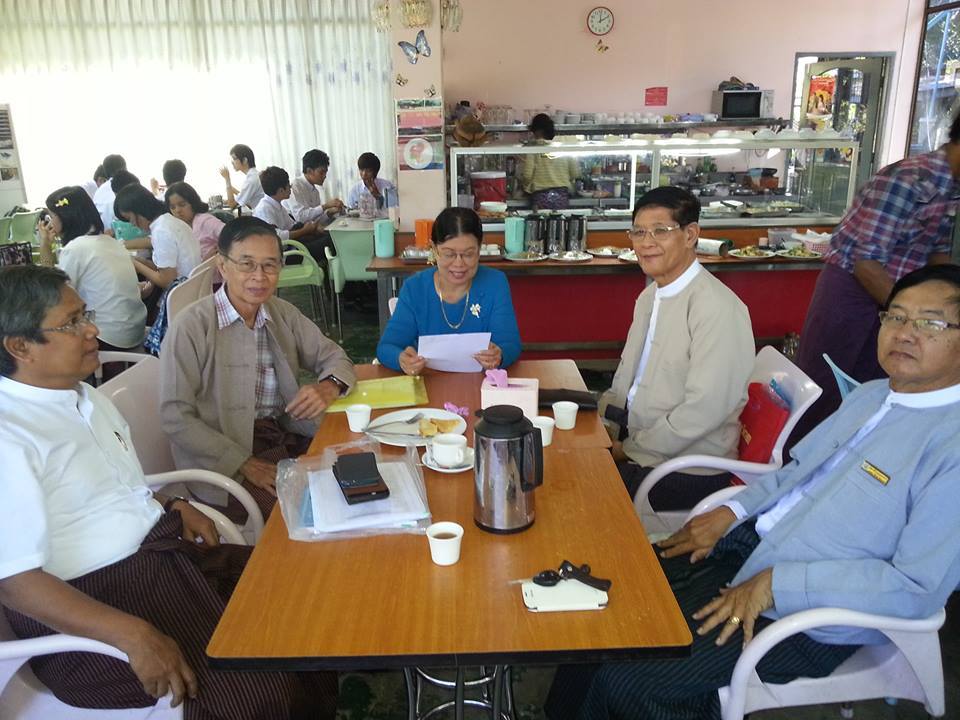
      They visited Saya U Tin Maung Nyunt in Milpitas, California a few years back.
      We had lunch gatherings.
    • Sayama Toni is a cousin of Ko Thet Tun (Henry, M 75).
      Their aunt Dr. Khin Kyi Nyunt is the spouse of my cousin Saya U Tin U.
      Sayama is a Khamee Khamet of Saya U Win Mra.
      Met her at SPZP-2012 and at the Reunion and Acariya Pu Zaw Pwe hosted by Steeve Kay.
      Last met her in December 2019 at the funeral service of Dr. Khin Kyi Nyunt.
    • Sayama Daw Khin Saw Tint
      Bilingual author
      Published several books/booklets
      Donated some of the earnings from the books to YTU.
      Parents : ICS U Ba Tint, Daw Khin Saw Mu (Burmese Poetry)
      Wrote an article about her mother and two aunts :
      Daw Khin Mya Mu (Kyauk sar, spouse of Professor U E Maung) and
      Daw Tin Saw Mu (English)
  • Registrar

    Rangoon University

    • U Htin Si
    • U Yu Khin (father of Dr. Marie Yu Khin and Dr. Richard Yu Khin) : founded IFL (Institute of Foreign Languages), which later became YUFL (Yangon University of Foreign Languages)
    • Daw Sein Sein (spouse of Pali Professor U Tin Lwin) : transferred to Department of Higher Education

    Engineering Institutes

    • U Sein Hla (BIT) : graduated from MIT
    • U Soe Thein (RIT) : former Ba Ka Tha Leader; transferred to DHE
    • U Hla (RIT)
    • U Thet Lwin (RIT) : author, composer and pianist

    Others

    • U Kyaw Khin (IM 1) : became Deputy Minister
    • Daw Nyunt Nyunt Win (RASU) : taught at Physics; spouse of U Ko Lay (RUBC Gold, Chief Editor of WPD)
    • U Khin Nyo (Moulmein) : taught at the Institute of Economics; managed the Rowing team
  • Brothers

    Brother Clementian

    Brother Clementian was loved by his former students. When he passed away, the cortege left from SPHS (St. Paul’s High School) to the Tamwe Christian Cemetery. When the cars arrived at the Cemetery for the Burial Service, many cars were still leaving SPHS.

    His younger brother had a couple of Doctorates, but his teaching was not valued as highly as that of Brother Clementian, who did not have a Doctorate.

    Brother Clementian was a Brother Director. He retired from being a Brother Director, but he did not retire from his love of teaching.

    It was customary for Brother Directors to go round and inspect the classes. Brother Clementian would not allow the Brother Director or the Assistant Director to come near his class.

    Brother Clementian did not know or care if a student is a son of the Prime Minister, Minister or a high ranking official. He treats every student fairly.

    He taught High School Mathematics. He had several texts and reference books. He would teach a topic and ask one or more students to go onto the blackboard to show what they have learned and to solve selected problems. He reminded students not to impose unnecessary “restrictions”. For example, if he asked a student to draw a triangle, it should be an arbitrary one (not restricted as an isosceles or equilateral) and it could/should be labeled differently from the one used in his example.

    Sad to hear that some present day students do not get marks if they deviate from “rote learning”.

    Every student would have two (or more) exercise books, so that he can collect and grade the homework. Every week, he would give a test of three questions to be answered in one hour. This training prepared many students to complete six questions in the Matriculation examination much earlier than the allotted three hours and score Distinctions.

    He acknowledges that some students (e.g. Min Oo) are gifted and have learned beyond High School Mathematics.

    Many remember his smile, and a few remember the strong finger that he used for poking at “badly behaving” students.

    Dr. Thane Oke Kyaw Myint (SPHS60) wrote :

    I have forgotten the name of the maths textbook. It was a govt prescribed one. There was another book to used in college. Brother Clementian finished was the first book but blithely went in with the book for Inter A during our matrix class. It made the questions in additional maths easier for us because of this.

    There was only one person who could beat Brother. Often when a maths problem has been solved by himself, Myo Myint (your brother in law) would shout that he could work out the solution using less number of steps. And he was always correct. Do Si at the end of his working out each tine, he would turn to Myo Myint and asked “Can you do better?” which Myo Myint often could.

    Dr. Nyan Taw (SPHS63) wrote :

    Brother Clementian taught us mathematics in high school. Seem we were the last lucky group (A&B) he taught before he retired. Min Oo was in A whereas I was in B class. The best maths teacher ever !!!

    U Than Win (SPHS63, RIT69er) wrote :

    Whenever I find “Sequence Geometry “in the old stock of books I always remember our great Maths teacher. We love and revered but sometime we feel somewhat frightened whenever we lack preparation. The most remembered word in this geometry book is QED (which is to be proved) because he always stare at us and stressed the word whenever the problem is solved.

    Gone, gone
    But still in our heart.

  • Dr. Julie Han (T61)

    • Sayama was among the pioneer female engineering students in Burma/Myanmar.
    • Her contemporaries include Sayama Daw Tin Tin Ohn (Amy Thwin, T61), Daw Yin Yin Kyi (T61), and Ms. Pauline Reynolds (ChE61).
    • Served as the Vice President of Theravada Buddhist Association of America (TBSA)
    • Headed the fund raising for the first Dhammananda Vihara in Daly City, Northern California.
    • Passed away several years ago, Saya U Htin Paw (EE 58, Past President of TBSA, GBNF) donated to the new Dhammananda Vihar in Half Moon Bay in memory of Sayama Julie.

    The following is what she wrote for SPZP-2000.


    Sayama Julie Han
    

    Here is a brief description of my years after leaving RIT.

    I spent 6 years at Clemson University, Clemson, South Carolina, getting a M.S. degree in Textile Chemistry and Ph. D. in Materials Science.

    The companies that I worked for in chronological order are:
    Burlington Industries, CIBA-GEIGY, Sears Roebuck, Levi-Strauss, Raychem Corp, Tacan Corp, Johnson Matthey Inc, Xytronyx Corporation.

    At present I am working as a sales manager for an optoelectronic company IPITEK, which is a division of Tacan Corp. Since 1980 I left the field of textile engineering and have been working in opto-electronic field.

    Look forward to seeing you at the Reunion.
    Best regards.
    Julie

  • U Tin Maung Nyunt’s Donation

    Saya U Tin Maung Nyunt’s birthday is December 30. He usually celebrates his birthdays by taking eight precepts and practicing vipassana meditation.

    Saya is one day older than Saya Allen Htay (GBNF). They came back together from the US on the same ocean liner. Since it was a long trip, they usually play Bridge with Saya U Soe Paing and Saya U Ko Ko Lay (GBNF).

    Update

    Saya’s height has shrunk 1 or 2 inches, but he does not mind. He is fond of the saying “All great men are short.”

    Saya stays in shape by hiking, stationary biking and practicing meditation. He invites his dhamma friends to his house to take part in the meditation sessions.

    Donation

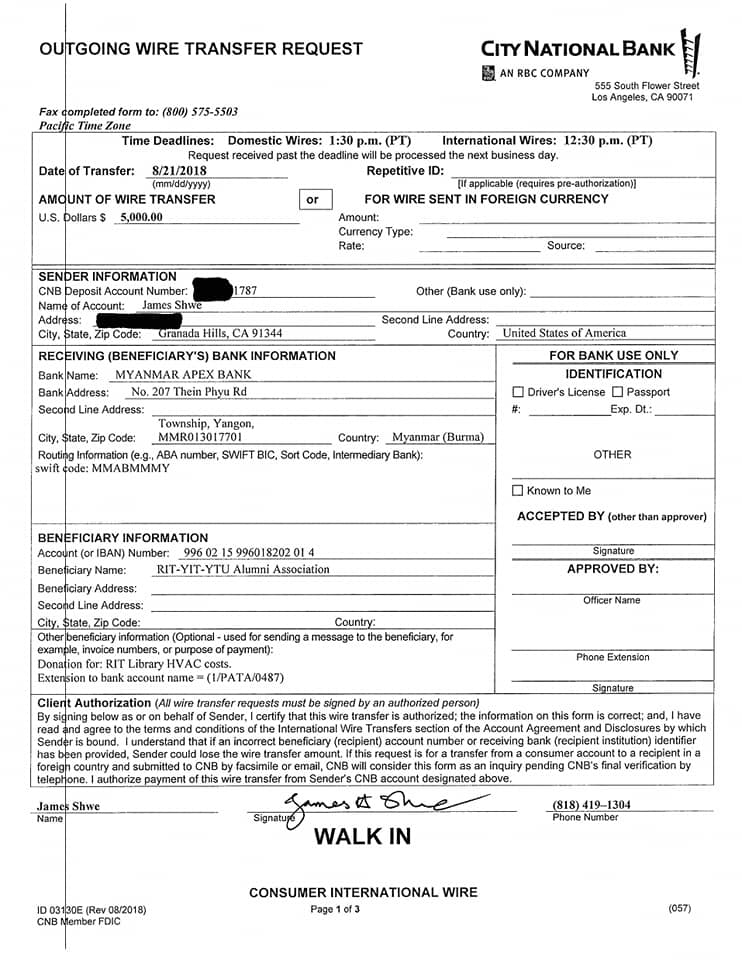
    Saya donated $500 to the “Staff Training Component” of the YTU Library Modernization Project via Northern California RIT Alumni Association.

    U Myint Swe (EP74, Secretary) presented the donation receipt and the Appreciation Award to Saya.

    Saya also took care of selected old friends in Myanmar. Saya also donated to selected monasteries and meditation centers in Myanmar.

  • Ethics and Education

    • In primary school at PPBRS (Private Primary Boundary Road School). we had to study “Mingalar Kabyar ” by Dagon U Tun Myint.
      I received a Thermos Flask for successfully reciting the Kabyar.
    • During our middle and high school days at SPHS (St. Paul’s High School), there was a class period when Catholic students take Catechism or go to the Chapel to pray.
    • Students, who profess other religions, study “Morals and Manners”, “Sar Nar Kya Ni Ti” and other texts.
    • In some classes we also studied Hygiene and “Pyi Thu Ni Ti”.
    • A good education system does not promote “rote learning” or the idea that “some professions are above others”.
    • Many students who stood Top in the Matriculation examination pursued their interests (e.g. Physics, Chemistry, Mathematics, Engineering, Medicine).
    • A good system leads students to be “life long learners” and “ethical citizens”.
    • In the early days, students from neighboring countries came to study at Rangoon University.
    • RU undergraduate and graduate students excelled in their studies abroad.
    • The students were good not only in academics but in other areas (sports, fine arts, …)
    • Sad to see the decline of education and the destruction of values.
    • Destroying the revered Students Union on July 8, 1962 is incomprehensible.
    • Destroying a working education system is unbearable.
    • Destroying the good will and ethics of people is lamentable.
  • Sayas in US and Canada

    The following Sayas and Sayamas are/were living in the United States and Canada.

    ARCHITECTURE

    • U Myo Myint Sein (Southern California)
    • U Bilal Raschid (East Coast)

    BURMESE

    • U Saw Tun (Illinois)
    • U Kyaw Hlaing (Southern California)

    CHEMICAL

    • U Myat Thwin (Keusan Lin) (Texas)
    • U Maung Maung (George Chan) (Northern California)
    • U Htun Aung Kyaw (East Coast)
    • Dr. Min Kwan Tham (U Kyaw Than)
    • Dr. Kuo C. Chiu (U Tin Aung) (Southern California)
    • Dr. Chwan Peng Kyan (U Maung Maung Chwan, ChE ) resides in (Florida/New Jersey)

    CHEMISTRY

    • Daw Rosie

    CIVIL

    • Dr Aung Gyi (Canada)
    • Dr. San Hla Aung (Louisiana/Myanmar)
    • Dr. Aung Soe (Illinois)
    • Dr Ohn Myint (Washington, DC)
    • U Myat Htoo (Northern California)
    • U Samual Ne Than
    • U Aung Myint (New York)
    • Dr. Ye Myint (Southern California?)
    • U Leu Swe San
    • U Kyi Kong Tham (U Kyi, Northern California),
    • U Douglas Kaung (U Kaung, Washington)

    ELECTRICAL

    • Dr. Christopher Lee (L. Tin Tun, Southern California)

    ENGLISH

    • Daw Khin Khin Chit Maung (Northern California)
    • U Des Rodgers (Canada)

    MECHANICAL

    • U Aung Khin (Canada)
    • U San Tun (Sain Fone Wong, Northern California)
    • U Tin Htut (Southern California)
    • U Tin Maung Nyunt (Northern California)
    • Dr. Tin Win (Southern California)
    • Dr. Nyo Win (K H Chen, Taiwan & Northern California)
    • U Tin Maung Oo (Southern Californiam GBNF)
    • Dr. Daw Jessie Htwe
    • U Mao Toon Siong (Northern California)
    • U Kyaw Myint (Northern California)

    METALLURGY

    • U Thein Aung (Northern California)
    • U Than Tin (Southern California)

    PETROLEUM

    • U Aung Than (Ohio)

    PHYSICS

    • Dr. Maung Maung Gyi (Canada)

    TEXTILE

    • U Kyaw Myint (Canada)
  • SPHS VIIIA (1960 – 61)

    A part of the Group Photo was posted by Dr. Nyunt Wai (SPHS63).

    First Row (Sitting) :
    Brother Felix served as Brother Director. After nationalization, he moved back to Germany.
    Saya U Nyunt Maung taught Burmese
    Saya Beatson taught Physics. He was Scout Master.
    Brother Anthony was Class Teacher. He taught Mathematics.

    Second Row (Standing) :
    Herbert KCL (Khai Chin Liang) was a member of the Band.
    Kok Leong became a doctor).
    Brownie Way (Aung Thu Yein, EC69, GBNF) stood 13th in the Matriculation of 1963. He worked for MOC and Schlumberger.
    Tommy Aung attended RASU.

    Third Row (Standing) :
    Aung Chaw (Victor, C69) studied Civil Engineering. After retirement, he became a monk. He is known as Sayadaw U Okkantha. He resided at Sagaing Hills before moving to Thonegwa.
    Maung Maung Kyi (Dip Ing) is Full Green at RUBC (Rangoon University Boat Club). He studied Pulp and Paper for his ChE at Dresden University. Hw worked for Sittaung Paper Mill and PpIC. He is now enjoying retirement in Wales, UK.
    There were two Than Win. One is also known as Henry Wong.
    Nay Lin is a buddy of Than Win (Henry).
    Eddie Nyunt was a member of the SPHS football team.

    Fourth Row (Standing) :
    Win Maung was boarder and a member of the Band. He studied Medicine.
    Than Htay is a cousin of Win Maung, He studied Engineering.
    Edwin David (GBNF) became Priest of St. Mary’s Cathedral.
    Orlando Thein was Boarder and a member of the Band. He studied Medicine.
    Jerry Hin Hwa (Htin Paw) was Captain of the football team. He became an Editor. He was also a member of the Band.