Blog

  • Civil Engineering Education

    By Saya U Min Wun: March 12, 2012

    Dr. Aung Gyi’s article about the history of Engineering Education reminds me of my 31 years of tenure as a teacher at RIT. I’ll try to describe some achievements in rendering Civil Engineering education, as far as my memory would carry me through by recollecting events of the past 55 years. I’ll try to supplement some of my recollections to his excellent account of engineering education in Myanmar.

    Abroad for further studies

    Dr. Aung Gyi and I had similar academic journey at the University of Rangoon, starting from admission to Intermediate of Science class to the day when we left Myanmar to pursue further studies abroad, until we graduated from MIT earning B.S. in Civil Engineering.

    On September 19, 1952 three 2nd Year students [namely, Aung Gyi, Maung Maung Than, and Kyit In (aka) Min Wun] of BOC College were sent off at the Mingaladon Airport by a large group of classmates. It was such a wonderful event and surprisingly good news that three of us, the engineering students from B.O.C. College, were to be sent abroad to study engineering on State Scholarship.

    U Maung Maung Than went to Falls River to study Textile Engineering. Dr. Aung Gyi and I flew to Boston to study at M.I.T. which is situated in Cambridge on the opposite bank of Charles River from Boston. When we arrived at the Logan Airport in Boston, Freddie Ba Hli, who was a post graduate student at M.I.T. , came to welcome us and helped us to get accommodated in the dormitory. He also took us to buy slide rule and advised us to learn how to use it before the classes.

    As soon as the 1st assignment was given I really came to appreciate Freddie’s advice. Slide rule was an essential tool for calculation at that time. As we were admitted to the 2nd Year [sophomore] class we found Physics a bit tough for us. Freddie willingly came to our help again.

    Before I was sent abroad to study engineering I was informed that I’ll be assigned to come back home to teach. I, therefore, paid special attention to the engineering education curriculum and collected all my class notes and assignments. Between school years I went to get practical training in structural engineering, both in design and construction, by working with the same company for three summers. In my final year I have to compile a Thesis, doing a Bascule Bridge Design, as part of the requirement.

    After graduation from MIT in June 1955 Dr. Aung Gyi continued graduate studies in Transportation Engineering at M.I.T. However, I transferred to Cornell University to study Geodesy and Photogrammetry, as directed by Ministry of Education, because MIT did not offer this course at that time. I chose Structural Engineering as Minor option. I got M.S. degree in June 1956.

    A Burmese State Scholar’s monthly allowance for boarding was $140. As I needed extra pocket money I worked for Professor Dr. Belcher doing aerial interpretation of terrain geology for real estate development. Dr. Belcher later came to Myanmar to train surveyors in the Department of Survey, under the Ministry of Forest and Agriculture.

    I also worked part time for Professor Dr. Winter, doing bamboo-reinforced concrete design and testing. Dr. Winter sponsored me to continue with post graduate study in structural engineering. However, I was not granted extension of stay. The directive from Ministry of Education was to extend my stay for one more year to work and gain practical experience in Geodesy and Photogrammetry. I got a job with Hycon Aerial Surveys Company in Pasadena, California, where I gained practical experience in Aerial Mapping and Terrain Interpretation to select corridors for highways, power transmission lines, and oil pipe lines.

    Beginning of teaching career

    In June 1957 I flew back to Yangon and reported for duty at the Faculty of Engineering. I was appointed as Assistant Lecturer in the Department of Civil Engineering, Faculty of Engineering of the University of Rangoon. This is the beginning of my teaching career as a young engineer freshly out of college with only a limited practical experience.

    Three major Departments of Engineering [namely, Civil, Mechanical, and Electrical] of B.O.C. College were relocated in the new buildings along Prome Road. The turtle-shaped dome [Leik Khone] was a beautiful wooden folded plate structure and it served as an assembly hall. Dr. Aung Gyi and I were later promoted as Lecturers in 1958, and in 1960 the late U Mya Han was appointed as Professor and Head in our Department. But he did not stay long enough and I did not have a chance to get acquainted with him. He later worked for Louis Berger Construction Company to design Rangoon Mandalay Highway and as Dr. San Lin has recounted, U Mya Han employed some Civil Engineering graduates with higher pay to work for him.

    In 1958 I was appointed as warden for the new Pagan Hall for engineering students. Pagan Hall was a new building situated in the same compound as Prome Hall and Tagaung Hall. At that time all the hostels were managed by a warden and an assistant warden. Instead of assistant warden, I requested U Yu Khin, registrar of the University of Rangoon, to allow me to appoint three tutors to help manage hostel matters, especially to help students in their studies. Three tutors were U Tun Shwe and U Ko Ko Gyi [Johnny King] of Mechanical Engineering Department, and U Ko Ko Lay of Chemical Engineering Department. I managed the hostel together with the three tutors, and EC members of the Students’ Welfare Committee. Procurement matters were jointly handled by us in consultation with U Aung Sein, the chief cook. We purchased rice, cooking oil, salts, etc at whole-sale prices and thus could save for messing. Packing materials were carefully salvaged and later sold back to the vendors and the proceeds were distributed to the hostel staff as annual bonus. The quality of meals became greatly improved so that the students could enjoy plentiful and better meals.

    When we moved to Gyogone Campus in 1961 Saya U Kyaw Tun of Electrical Engineering was appointed as warden of three hostels [Block A, B, and C] and I continued as warden for three hostels [Block D, E, and F]. Our quality of meals was so well known that U Yu Khin interviewed me as to how we could provide batter and plentiful meals. I could still remember the first grand dinner held on the lawn in front of the hostel buildings. When new rules of a two-year term limit for a warden were set I resigned from the warden post.

    Curriculum Development

    When B.I.T. [later renamed as R.I.T.] became a separate institute the first thing I noticed was that the curriculum for the first two years were developed with emphasis toward technology. The curricula for Civil Engineering were also revised based upon our academic and practical training abroad.

    One requirement for undergraduate study was to prepare a Thesis in the Final Year. All the staff was assigned as supervisors, thus creating an opportunity for the staff to work more closely with the students.

    Graduate courses leading to Master Degree were also offered in [a] Structural Engineering, [b] Water Resources Engineering, and [c] Surveying and Photogrammetry. A Diploma Course was also offered in Water Supply and Sanitation Engineering.

    Upgrading Laboratory Facilities

    In an effort to upgrade laboratory facilities we have achieved to set up several up-to-date laboratories through foreign aids. Some equipment were also acquired through government funding.

    1. Structural Testing Laboratory was established with the aid from German Government and Dr. Roberts of Tulane University came to teach Structural Engineering for one year.

    2. Hydraulics Laboratory was aided by the British Colombo Plan.

    3. A Photogrammetry Laboratory was also acquired through the British Colombo Plan Aid. Mr. Heathcoat from Great Britain came to teach Photogrammetry for one year. A Russian Professor came to the Department to teach Photogrammetry also. He delivered lecture through an interpreter. Through UNESCO aid the Department of Archeology, under the Ministry of Cultures, a Terrestrial Photogrammetric Plotter was acquired and it was set up in the Photogrammetry Laboratory. This plotter was later used to map ancient monuments of Pagan.

    4. Materials Testing Laboratory was also expanded with equipment for testing soils as well as bitumen.

    5. For Survey Laboratory modern Theodolites, such as Wild T-1, T-2, and T-3 and Zeiss Automatic Levels, and Invar Tapes for precise distance measurement were acquired.
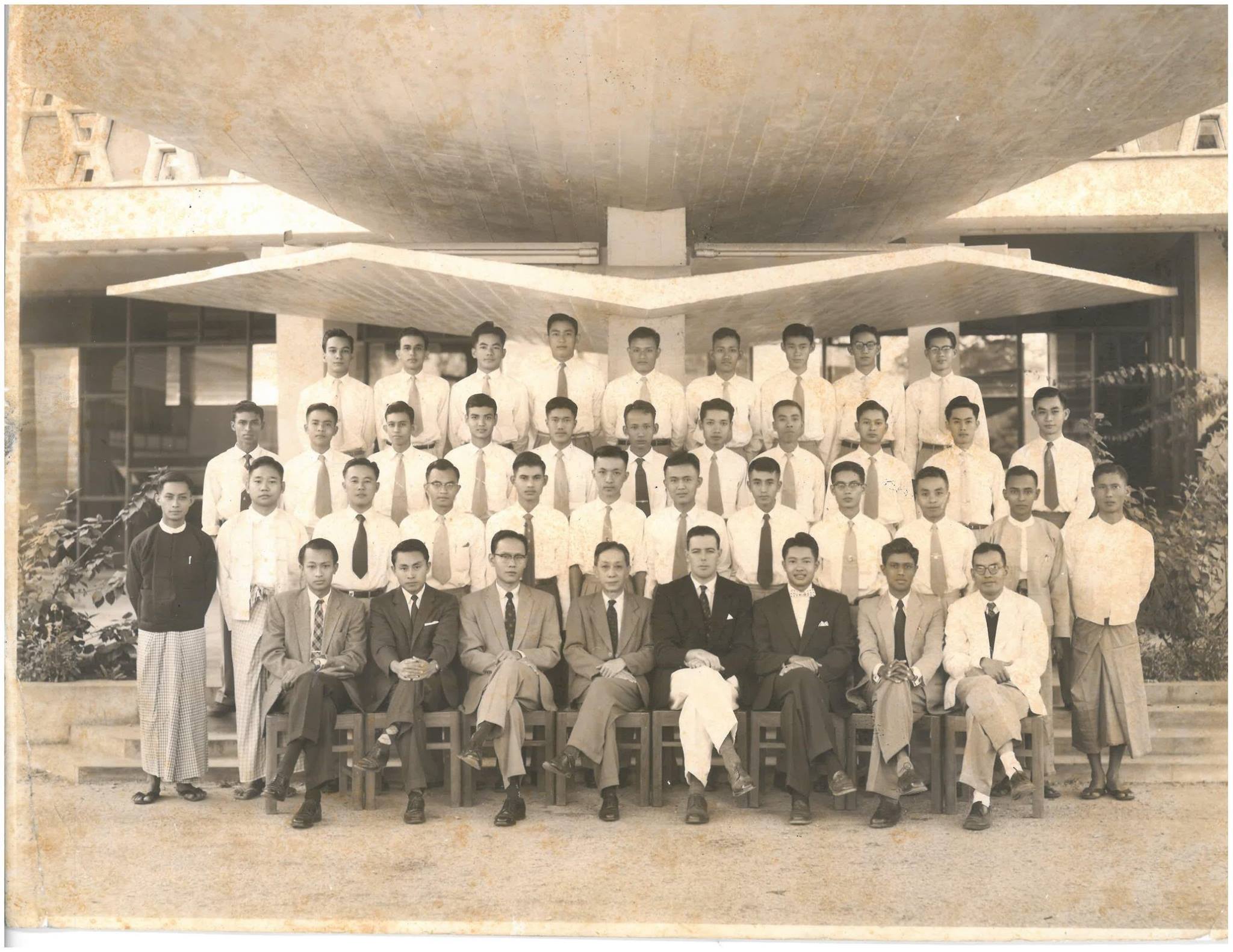
    Saya U Min Wun and C58

    Staff Development

    To fulfill staff requirement for the graduate courses Civil Engineering staffs were encouraged to attend graduate courses for Master Degree. Many were also sent abroad for further studies. The following list indicates that almost all the staff were trained abroad or locally to pursue graduate studies.

    1. Structural Engineering staff

    Dr. Aung Gyi was sent to Canada to pursue post graduate studies in Structural Engineering.

    The late Saya U Kyaw Thein transferred to R.I.T. from Construction Corporation.

    Dr. San Hla Aung was sent to M.I.T. to study Structural Engineering. He was also sent to Germany for training in Structural Laboratory Techniques.

    U Tin Maung, U Nyi Hla Nge, U Khin Maung Tint, U Aung, and U Aung Kyaw Myat attended M.S. Course in Structural Engineering at R.I.T.

    Dr. Myo Khin was sent to Japan to study Building Construction Technology, one of the Engineering electives for Regional Colleges.

    2. Soil Mechanics and Geotechnical Engineering

    Saya H. Num Kock was sent to England for to study Soil Mechanics Laboratory Techniques.

    U Allen Htay was sent to the United States of America, and Dr. Aung Shein was sent to England to study Soil Mechanics and Geotechnical Engineering.

    3. Water Resources Engineering

    Dr. Win Thein was sent to Russia, U Thein Tan was sent to England, Dr. Daw Khin Ni Ni Thein, and Dr. Daw Nilar Win were sent to Netherlands, and Dr. Htin Aung and Dr Khin Maung Win were sent to the United States of America to pursue post graduate studies in Water Resources Engineering.

    4. Surveying and Photogrammetry

    I was sent to England to do research in Photogrammetry at University College, London. I collaborated with a post graduate student to do research on measurement of deflection patterns of a typical Railway Bridge by Terrestrial Photogrammetric method.

    Dr. Aung Soe was sent to East Germany to study modern Surveying Techniques.

    U Khin Maung Phone Ko was sent to the University College, London to specialize in Photogrammetry. He pursued graduate studies at the University of Glasgow.

    U Aye Win Kyaw was sent to Paris to train in Terrestrial Photogrammetry.

    U Ye Myint and U Khin Maung Maung were sent to the Netherlands to study Photogrammetry and Aerial Photo Interpretation.

    5. Sanitary Engineering

    Saw Christopher Maung, U Kyaw Win, U Khin Aung Han, the late Daw Yin Yin Myaing were sent to Netherlands.

    6. Others

    Saya U Myat Htoo , U Thein Kyaw, U Tauk Lin, U Samual Nay Than, U Kaung, and Tan Kyi Kong were some staffs who left the Department to go abroad. Daw Kyi Ngwe, Daw Yin Tint, and Daw Cho Cho pursued graduate studies at R.I.T.

    Practical Training

    Summer training program was coordinated with various Government Departments, such as Construction Corporation, Department of Irrigation, Department of Water Ways, etc and in some departments students were also paid.

    Summer Surveying Training was part of the requirement for 4th Year Civil Engineering students. The first survey practical training was held during the summer of 1961 in Maymyo [PyinOo Lwin]. The Department of Survey, under the Ministry of Forest and Agriculture allowed us to establish the Survey Camp in one of their Office Buildings, where there were big office rooms for evening classes and for students to do survey data compilation, checking and calculations, and also to draw a topographic map. The training lasted four weeks and it was a good opportunity for the staff to get more acquainted with the students, thus creating a lasting and intimate relationship between the staff and the students.

    On-the-job Training with CECC

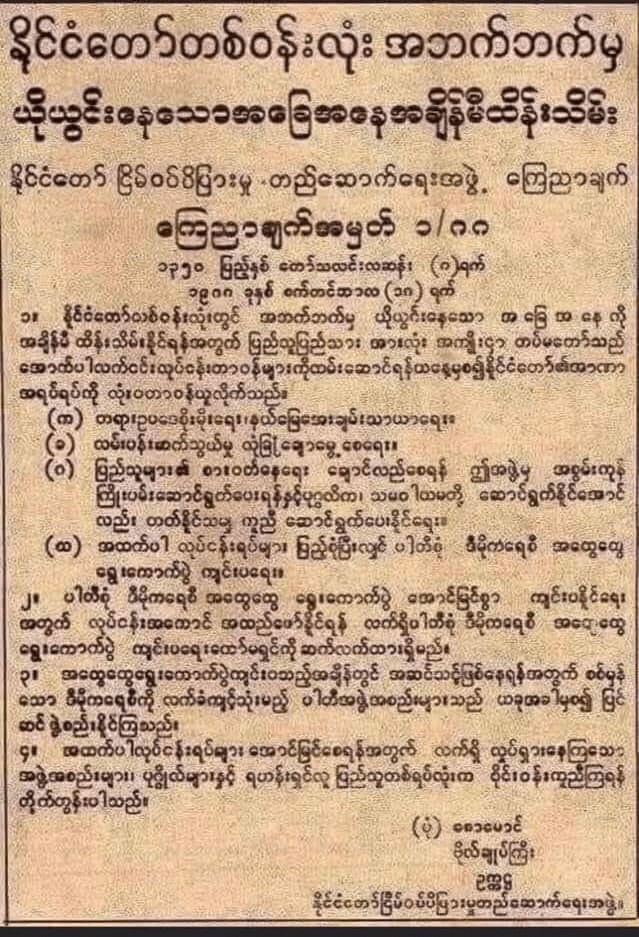
    In September 1976 Civil Engineering Construction Cooperative [CECC] was organized to create job opportunity for Civil Engineering graduates. I was assigned to lead as chairman with Sayas U Tin Maung and U Thein Tan as vice-chairmen, and student members were U Toe Maung as secretary with U Tin Ohn and U Myo Thant as executive members. Retired Charter Account U Ba Win was employed to supervise budgeting and accounts branch. U Mya Than, a retired Superintending Engineer of Construction Corporation, was also employed to supervise design branch. With the permission of Department of Higher Education laboratory technicians were also employed part-time to use the laboratory facilities to help CECC.

    All the members were assigned to rotate on-the-job training through design branch, construction branch, procurement branch, etc. The purpose of the rotation program was to train all the members to be ready to assume any assignments and to be able to take charge of a project independently. CECC is still a strong and active construction cooperative. Many ex-CECC members are working abroad, especially in Singapore, as construction engineers.

    In the beginning we started to work for free until we were awarded contracts to earn profits. With the support of the Ministry of Cooperatives CECC was awarded contracts to do the following:

    1. Site development project for 100-ton rice mills.

    2. Kyaik Hti Yo development project. My article “Kyaik Hti Yo Development Project 1979” was published at the www.ex-rit.org

    3. Micro hydro power project for Tachilaik Township.

    4. Township market building project.

    5. Aerial Mapping project for Bassein-Monywa highway.

    6. Terrestrial Photogrammetric mapping of ancient monument [stupas, pagodas, etc] in Pagan

    7. Exhibition Stalls construction project for 12 Divisions and 12 States during Union Day Celebration event, etc.

    Special Assignments

    I came back from London on July 4th 1975. Pagan earthquake of July 8th 1975 destroyed the once awe-inspiring panorama of Pagan. Almost all the monuments were affected to a greater or lesser extent. The beautiful silhouettes of giant monuments, Thatbyinnyu, Ananda, Gawdawpalin, etc changed within a split second into ugly heaps of debris.

    On July 9th 1975 a National Commission for Restoration of Pagan Monuments was duly formed, headed by the Deputy Minister of the Ministry of Construction. The Commission comprised of expertise from the Department of Archaeology, Universities and Institutes under the Department of Higher Education, and the Construction Corporation. Dr. Aung Gyi, U Myo Myint Sein, and I were also members of the Commission. I was with the Commission until I retired in December 1988.

    From 1981 to 1988 I was assigned to become a member of the National Calendar Committee [Naing Gan Daw Pyeikkadaindaw Set Ah Phew]. Sayadaw U Thilasara of Patheingyi Kyaung of Mandalay was the chairman. Well known astrologers from Upper Myanmar and Lower Myanmar were appointed as members. Annual Myanmar Lunar Calendar was compiled and I also participated in computing planetary positions to determine Thinn Gyan duration and to fix the Myanmar New Year Day. It involved many hours of hand calculations based upon Surya-Siddhanta, Myanmar version of the archeo-astronomy. A Fortran Program was introduced to help the hand calculations and save time. Comparative studies on (a) Myanmar Almanac and Nautical Almanac, (b) Myanmar traditional methods of calculations for Solar eclipse and Lunar eclipse, (c) Identification of 27 Asterisms (Nakshatra) on a Star Chart based upon visual observation as shown by Sayadaw U Thilasara, etc were also presented to the NCC.

    When Regional Colleges were established I was assigned in 1981 to work as National Counterpart with UNESCO expert, Mr. Harris. We were involved to help establish institution buildings for 20 Regional Colleges, curriculum development and reviews, staff development, etc.

    In May 1981 a group of staff from Universities and Institutes under the Department of Higher Education took part in the inspection tour of the Industries on the West bank of Irrawaddy River. The tour began from Yangon to Bassein to inspect the Glass Manufacturing Factory. The entourage of motor vehicles continued with the inspection of the Bassein-Monywa road, Heavy Industries in Sin Te, and inspection of the Ngawin Dam.

    The group presented reports at the end of the tour. My presentations were (1) How to prevent bullock cart tracks on the slopes of the earth embankments of Basssein-Monywa road, and (2) Justifications not to cover up the upstream embankment of Ngawin Earth Dam with concrete blanket to prevent seepage. I was glad that my presentations were accepted and the proposal for the concrete blanket was reversed.

    Conclusion

    The above recount of the History of Civil Engineering during my tenure at R.I.T. is compiled as far as I could recall. I’m sure there are some omissions, errors, or mistakes. Please help to correct them to be incorporated in the final edition.

    I would like to say in conclusion that my 31 years of teaching career was not only a rewarding experience but also an opportunity to contribute toward upgrading the standard of Civil Engineering education in my motherland. I’m proud to say that R.I.T. graduate engineers are well qualified to assume responsibilities at home and abroad.
  • RIT Days (Intro)

    by U Zaw Min (EP70) and U Ohn Khine (M70)
    Edited by U Hla Min
    (EC69)

    Note : Ko and U, Ma and Daw are used in the articles. The prefixes may sometimes be omitted.

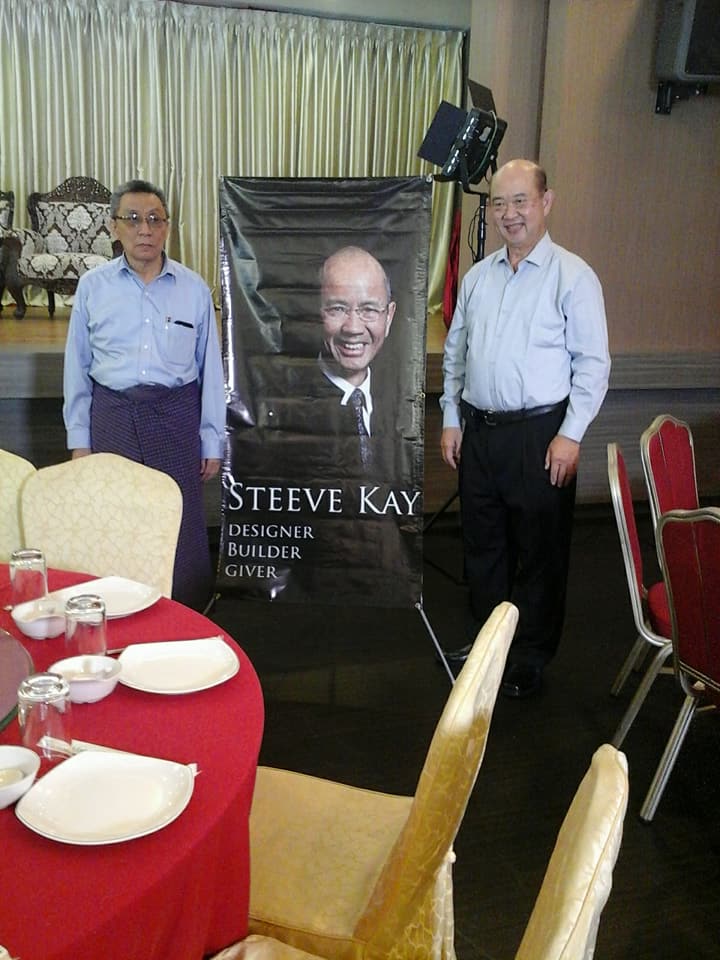
    Hla Min (EC69) and Benny (M70) beside picture of Steeve (EC70)

    Introduction

    Authors

    • U Zaw Min (EP70) matriculated from St, Albert’s High School, Maymyo in 1964.
    • Had a very high ILA (Intelligence Level Aggregate) and was admitted to the first ever 1st BE as Roll Number One.
    • Selected RIT Luyechun for the 1965 Summer Camp at Inlay.
      His outspoken remarks about the Camp drew the ire of higher authorities.
    • Graduated with EP (Electrical Power) in 1970.
    • After working in the industry, he moved to the USA.
    • Studied Electronics in the USA
    • Added “Nawaday” to his name.
    • Several years ago, he shared his memories of RIT to the Google group of “the Combined Intake of 1st BE for 1964 and 1965”.
    • U Ohn Khine (M70) matriculated from St. Peter’s High School, Mandalay in 1964.
    • Took a combination of Science and Arts subjects and had good ILA score to be admitted to RIT.
    • Graduated with Mechanical Engineering in 1970
    • Worked for HI (Heavy Industries).
    • Created and maintained the the Google group of “the Combined Intake of 1st BE for 1964 and 1965”.
    • Volunteered for SPZP-2012 and SPZP-2016, HMEE-2012 and HMEE-2018, Swel Daw Yeik Foundation and several RIT-related activities.
    • Gave me rides during my visits to Yangon.
    • Filled the “missing pieces” in U Zaw Min’s accounts.

    Editor

    • U Hla Min matriculated from St. Paul’s High School.
      Received Collegiate Scholarship for standing 7th in the whole of Burma.
    • Finished top in the Science Option of I.Sc.(A) examination
    • Admitted to the first ever 2nd BE in November 1964 as Roll Number One.
    • Selected Luyechun for the Inlay Khaung Daing Camp.
    • Graduated with Electrical Communications in 1969.
    • Started the “RIT Alumni International Newsletter” in 1989 and have maintained it for 22 years.
    • Administrator or Moderator of selected Facebook pages.
    • Personal website : hlamin.com
    • Edited the draft versions “Memories by Ko Zaw Min Nawaday (EP70) and Ko Ohn Khine (M70)”, which was first posted as Google Docs for the Combined 1st BE Intake of 64 and 65.
    • Published the edited document as a series of articles in “RIT Alumni International Newsletter and Updates”.

    Three Intakes in 1964

    There were three intakes at the Rangoon Institute of Technology (RIT) when the new education system started in 1964. Eligible students were admitted to the first ever 1st BE, 2nd BE and 3rd BE classes. They are also known as

    • Class of 70 (1st BE Intake in 1964)
      Matriculates were admitted using the ILA
    • Class of 69 (2nd BE Intake in 1964)
      Those who had passed I.Sc.(A) with Science Option were admitted in order of merit
    • Class of 68 (3rd BE Intake in 1964)
      Those who had passed I.Sc.(B) with Science Option were admitted in order of merit

    The RIT Rector was U Yone Mo and the Registrar was U Soe Thein.

    Class of 70

    The Class of ‘70 comprised of the first year intake students in 1964. There were 494 registered students, of which 67 were female. Most graduated in 1970. Some took sabbatical for a year or two. A few left RIT before graduation.

    The GBNF (Gone But Not Forgotten) reached 111 in September 2021.

    The matriculates entered the first ever 1st BE classes. The controversial ILA (Intelligence Level Aggregate) was used for the vetting of applicants. In the system, a score of 1 to 10 was assigned to “map” the marks for each subject. The ILA score (rather than the”raw” marks) was used to determine the eligibility of the students admitted to an institute.

    Under the old education system, the matriculates had to attend I.Sc. (A) classes. There were restrictions on the subjects taken at Inter classes to be eligible for Faculty of Engineering, Faculty of Medicine, etc. For example, one must pass the I.Sc. with at least 50 marks in Mathematics, Physics and Chemistry to attend the 1st Year Engineering Classes (3rd BE in the new system).

    Under the new education system, there were no restrictions on the subjects taken in Matriculation exam. As such, many students who passed Matriculation with combined Science and Arts subjects and even those with pure Arts subjects were able to attend RIT. For example, Ko Ohn Khine passed the Matriculation examination with an odd combination of Mathematics, Chemistry and Geography.

    First BE (1964 – 65)

    The first year students were divided into four sections : A, B, C and D. The majority of students of Sections A and B had passed matriculation with pure science subjects. Most of the students of Sections C & D had passed with either Science and Arts Combination or pure Arts. There were some late joiners to RIT.

    Male students from districts and states were boarded in hostels, in the ground floor rooms of B, D and E Blocks and “Inlay Hall” in Thamaing.

    A building named “G Hall” was assigned to board female students from districts and states. Local female students who applied were also allowed to board in G Hall.

    Engineering was not considered appropriate livelihood for women hence there were only a few female students studying Engineering before our 1964 intakes. With the new system, there was an influx of girls. It was quite a pleasant feast to the seniors who were not used to seeing those many female students. So when our ‘64 intake started attending classes, it was a thrill for the senior students to watch a great number of female students strolling in the corridors, coming in and out of class rooms,in canteen, in the food shops, in the library and everywhere on the campus grounds. We were also thrilled to get in company with a lot of female classmates. (It was exciting for me to have female classmates as I [Ohn Khine] was sent to all boys school, St. Peter’s High School in Mandalay since Kindergarten till I matriculated in 1964.) It is fair to note that the girls were somewhat intimidated and somewhat amused by the loud remarks of a few rowdy students or even feeling stared at while having to move from one classroom to another. Girls spent time during breaks in an area of a corridor surrounded by shaded blinds which was known as LCR (Ladies’ Common Room) where the day students usually ate home-brought snacks and rest. Ladies residing at G Hall would have lunch at the canteen and were able to rest in their rooms. The first LCR was a little room on the third floor before a section of the corridor on the third floor was made as the LCR before the start of our 2nd year at RIT. When the bell rang for the next class, it was customary to peek through the blinds to check whether the boys had gone inside the theatre for the timid girls to come out of the LCR.

    Outstanding athletes from our class

    The list was compiled by Ko Ohn Khine.
    Comments were provided by Ko Zaw Min Nawaday.
    Organization / presentation (with corrections) was done by Ko Hla Min

    Badminton

    • Tommy Shwe
    • Kyi Kyi Sein

    Basketball

    • Tin Aung (E)
    • Tin Aye (M)
    • Kevin Law
    • Soe Aung (Auto)

    Body Building / Weightlifting

    • Than Htike (M)

    Boxing

    • Maung Maung Thaw (E)

    Chinlon

    • Soe Tint (C)
    • Mya Daung (M) GBNF

    Football / Soccer

    • Sai Thein Maung (C)
    • Khin Maung Lay (Mutu, M)
    • Win Zaw (A)
    • Myint Sein (Ja Pu Sein, GBNF)
    • Kenneth (Khin Maung Shwe, GBNF)
    • Htun Myint (M)
    • Hla Kyi
    • Sai Aung San (Met)

    Judo / Aikido

    • Sein Myo (C)
    • Kyaw Soe Win
    • Soe Aung (Auto)
    • Thaung Lwin (M)
    • Soe Myint (Agri)
    • Sai Loke Khan (Mn)

    Rowing

    • Htein Win (M)
    • Aung Lwin (Jasper Wu) (C)

    Swimming / Water Polo

    • Peter Pe GNBF
    • Htein Win (M)
    • Win Aung (M)
    • Mg Mg Swe (M)
    • Tin Tin Myint (Ch)

    Tennis

    • Aung Kyaw Soe (James Than) (Ep)
    • Khin Mg Shwe (Ep)
    • Wai Lwin (Agri)
    • Rosie Tin Maung (Ch)

    Track and Field

    • Sai Thein Maung (C)
    • Shein Kee Gae (GBNF)
    • Saw Mg Mg Htwe
    • Oo Myint (Mn)
    • Win Naing
    • Lei Lei Chit (Ch)
    • Nan Kham Ing (A)
    • Maung Maung Thaw (E)

    UTC Marksman

    • Tan Yu Beng (Benny) (M) Let Pyaunk Tat Thar, twice, both UTC 1st & 2nd yr.

    Volleyball

    • Kyaw Sein (M)
    • Salai Myo Myint (C)

    Additional Information by Ko Zaw Min Nawaday

    Sai Thein Maung (C), was a great RIT goalkeeper for 6 years. He also won gold medals in 100 meters and Hop Step and Jump in the Inter Institute track and field competition almost every year.

    Tin Tin Myint (Emma) (Ch) bravely competed in the inter-institute swimming meet. I believe she also practiced throwing the Javelin and played volleyball.

    Khin Mg Shwe (Ep), won the”Novice” tennis competition at RIT. He represented RIT in the 2nd year and we cheered him as he played a nationally known played from RASU (at the courts across from the Universities football field) during our 2nd yr at RIT.

    My good friend Tan Yu Beng (Benny, M) took the best marksman trophy at both 1st and 2nd yr UTC camps. He competed against not only RIT but UTC students from RASU, Institute of Medicine, and Institute of Economics.

    Hla Kyi (nickname Sut Kaw) played center right back for RIT selected football team. Most RIT students that watched the game between RIT and Loke Thar during our first year will remember the flying kick he took at the head of the left winger of Loke Thar when Ko Myint Sein (M) GBNF and that left winger got into a fracas. The Universities team coach Saya Nyein, who was the referee for this game, promptly told Ko Hla Kyi to leave the field.

    There were also unsung heroes (e.g. The RIT B football team). I did not know about them until the third year, when Sai Aung San, my room mate for that year, told me about it. He was the goalkeeper, Yan Shin played in the back line and Kyaw Min Aung was the reserve goalkeeper.

    Ah Nu Pyinnya Shins from our class

    • Myint Swe Win (M) Mandolin virtuoso, vocalist. Participated in every concert.and pwe
    • Mo Mo Yi (E) Announcer
    • Tin Tin Myint (Emma Myint) (Ch) Myanmar Dance
    • Tin Myint Oo (Rosie Tin Maung) (Ch) acted as “Tha Gyar Min” in the musical performance of the song “Sanda Kein Da Yi”. Vocalist and instrument (Don Minn) by Ko Yu Swan (M 68).
    • George Ko Ko Gyi (Ch) played the part of Ten Headed Ogre (Dat Tha Gi Ri) in the short opera of Chasing the Deer (Rammayana play)
    • Ko Win (Milton Win Pe) (M) Myanmar Drum (Chauk Lone Putt)
    • Than Myint (M) Vocalist & All-round instrument player
    • Soe Aung (Auto) Clarinet
    • Tin Win (Tex) Burmese Harp (Don Minn)
    • Aung Myint (a) “Thaman Kyar” Ko Myint (Mn) co-starred in the movie “Thaman Kyar”
    • Than Win (Tex) wrote the script of “Thaman Kyar”.

    Universities’ Training Corps (UTC)

    • Some of us entered the UTC.
    • We had two camps the first year we were at RIT :
    • Summer camp at KyeDaw, Toungoo
    • October camp at Meikthila.

    First UTC Camp

    At the Toungoo camp, our platoon was the only RIT platoon stationed with RASU students. So we were 30 or so RIT students among 500 plus RASU students at the 10th Buregt. The main body of RIT students were at a little school. They were the lucky ones. They had the instructors from UTC in charge while we at the 10th Buregt. were assigned a grouchy sadistic corporal from the regular infantry to drive us. He has a mustache so we nicknamed him “Nga Khu”. Ko Win Htut (C), Ko Khin Mg Lay (M), Ahmed Soorma (Ch), Ko Kyaw Min Aung, John Krasu, Ko Htwe Myint (C), Ko Htain Win (M, Chauk Pe) were among those in this platoon.

    It was here that Ko Htwe Myint got his nickname “Bo Hmu” because of the military bags he had on him.

    We slept on a long bamboo platform, next to each other. We had to stand guard duty at night, one hour each and sign off on the duty sheet. If our duty hour fell on 8pm-9pm, it was great. If it were from 1pm to 2pm, it was the graveyard hour. One time, my duty was from 1pm to 2pm, Ko Khin Mg Lay (M), who slept next to me was from 12-1pm. He tried to wake me up to give the duty sheet but I refused to get up since I was so sleepy. He finally said “Min Tar Wun You Mea So Yin Ngar Ate Pi”. I finally got up and took over the duty sheet. Standing guard duty during graveyard hours had its benefits. I saw the Big Dipper, Khun Na Sin Kyea, turn and point its tail upwards. (Khun Na Sin Kyea Pyong ah mee thoung, than goun chain tho youk.)

    We had to get up at 5pm and run PT, guzzle a cup of tea and swallow down bein moun at 6.30am. At 7am, we were on the parade ground doing marching drills. One time, our sadistic corporal made us run for 45 minutes with our rifles in our hands because he was unhappy with our performance. That event also brought out the best in the RASU students. When the whistle blew for a 10 minute break, in a rare display of camaraderie, some RASU students came over with water for us to drink.

    Lunch was a little meat dish and great Pe Hin.

    In the afternoons, we had to go to a Phone Gyi Kyaung about half a mile away so that we can sit in the shade while we were taught small arms. We were not allowed to use the water in the well at the Kyaung, so four persons from each platoon had to take 2 Ye Oes full of water. Although it meant carrying the heavy Ye Oe, in addition to my rifle, I always volunteered for that duty since we got to leave about 20 minutes earlier for the Phone Gyi Kyaung. That way, we got to rest and enjoy the tranquility of the Kyaung Win before the rest of the students arrived and the lessons started. I remember laying under the trees while waiting for the rest to come over, looking at the Toddy (Htan) trees and wondering if King Tabinshwethi had one time spent his days near this place drinking Htan Ye .

    I remember the incident about Ko Win Htut being punished harshly one time. I don’t remember exactly what it was about. We all know that Ko Win Htut liked to have fun and his happy go lucky come attitude got him into trouble with our party pooper instructor Nga Khu. He was ordered to jump from a squatting position while having his rifle held above his head until he fell exhausted. After 3 weeks, training was ending and we decided to give the Corporal a longyi as present and all of us Ka Daw to him. For the first time, tears rolled down this tough Corporal’s cheeks.

    The next day was the graduation parade. It was a proud moment for all RIT students when Tan Yu Beng (Benny) (M), stepped up to receive the award for Let Pyaunt Tat Thar, standing first in marksmanship among 800 UTC students from all Institutes and RASU.

    Second UTC Camp

    To attend the second UTC camp, we left for Meikthila on the 3rd week of September. The train travel ed at night, but we had trouble sleeping on the train. We were sent to the 3rd BATD. Beautiful barracks with wood flooring. But horror of horrors. Hundreds of bed bugs came out from between the wooden planks. That night, there was no way I could sleep with the bugs biting me. so, even though there was a slight drizzle of rain falling, I decided to sleep on the ground outside. Since I did not get any sleep the night before, I slept through the morning PT before waking up. Ko Khin Mg Lay told me that the instructor came to kick me while I was sleeping in the morning, but I just kept on sleeping. The instructor was overheard saying something like “Mway Pauk Tay Mae” before walking away. My official place in the barracks was next to Ko Sein Win (EC). Ko Sein Win was very neat and had the best prepped bed for daily inspection. Next to him, mine looked like crap. Points were given daily for how good you had prepared your bed. Ko Sein Win always got the best comments and mine was in the pits. Actually I did not sleep a single night in my bed place. I used my blanket as a cot by tying it to two posts out in the veranda and slept there.

    Life at Meikthila camp was more pleasant than Toungoo camp. For one thing, all of us RIT 1st year students were in one company. We had our share of funny incidents. One day, the RSM of UTC chided all of us for soiling the side of the toilet holes in the outhouses. His words were, “Nya Kya Ah Pauk Te Te Ko Min Doe Win Aung Htet Naing Dae. De Louk Ah Pauk Gyi Kya Win Aung Ma Par Naing Bu.”

    As it happened, that evening, the RSM was kicking the ball to the goal and it went wide. Bohmu Htwe Myint shouted “De Louk Gyi Dae Ah Pouk Win Aung Ma Kan Naing Bu Lar?” The RSM walked away with his head bowed.

    Sometimes, we drove the instructors hopping mad. One time the instructor told us “Ngar So Dar Lite So”. In one voice, we all shouted “Ngar So Dar Lite So”.

    After two weeks, we were told to give our kit bags to be taken by truck to Taung Pulu, while we would have to march 18 miles to that place the next day. Without a kit bag, no blanket to make my cot, I spent the night just walking around in the veranda since it was raining outside and there was no way I could sleep inside with the bed bugs. The next day we marched to Taung Pulu, carrying our rifles. It was tough for me since I did not sleep a wink the night before. The sun was beating down on us the whole day. Where was the rain when we needed it? Worse was the rocky road made of Gawoon rocks. It made the nails in my boots hurt my feet. I must have pulled out over half a dozen nails from each boot.

    We finally made it to Taung Pulu in the evening. We were given rice to cook for ourselves and were assigned 4 persons to a tent. That night, there was a tremendous storm. Water gushed into the tents. The next day, someone told me that everyone was sitting in their tents except me. He said I was asleep with my head in the mud. I did remember waking up during the storm, looking up at my tent mates who were sitting, and going back to sleep.The next day, we were told to move into a Zayat on a hill. It was so crowded in the Zayat, I refused to sleep there. Instead, I went up the Phaya Yin Pyin and slept alone on the brickwork with a blanket tucked around my body to prevent the winds from blowing it away.

    Time came for graduation and our Tan Yu Beng (Benny, M) again got the Let Pyaunk Tat Tar award.

    Ko Win Htut, I and others that I don’t remember, took a bus to Mandalay from Meikthila. We arrived in Mandalay, near 33rd and Zeygyo (84th) around 6 pm. Ko Win Htut was home since his house was around the corner. For myself and a couple of others, we just kept on walking towards the direction of the clock tower, hoping we would run into something. It was seeming more and more likely we might have to sleep on someone else’S doorstep.

    Then, we saw a jeep come down 84th street and stop. It was a MMTA taxi with Saw Mg Mg Htwe sitting in the front seat! (MMTA stood for Maymyo-Mandalay Taxi Association).

    He told us that he figured there might still be some UTC students that wanted to go to Maymyo coming this way and had asked the taxi driver to drive along 84th street before turning towards “A” road to take the car out of Mandalay to the Maymyo road.

  • HMEE-2012 Section 2 (4)

    History of Myanmar Engineering Education
    by U Ohn Khine (M 70)

    Implementation to improve Engineering Education

    To improve the university education as a whole, including engineering, the government laid down plans for the enhancement of engineering education. The Burmese government approached Technical Co-operation Administration (TCA) of the United States of America (USA) in the 50’s to get aid for the development of engineering education.

    At the same time, efforts were made to offer more engineering disciplines at the faculty, to have more local qualified teachers, to have more buildings to accommodate the increasing number of students, and to get up to date and complete machinery and equipment for the test laboratories. Most of the teaching staff at that time were British and contract lecturers from India.

    After Burma gained independence, Professor Davies who was Dean and other foreign teaching staffs left the Faculty in 1950. U Ba Hli, Principal of Insein Government Technical Institute (GTI), was appointed as the first local Dean of the Faculty. U Ba Hli, a far-sighted educator, did a lot to develop the engineering education during his tenure as Dean from 1950 to 1958.

    The program to increase the teaching staff at the Faculty of Engineering started in 1952. Under the twinning program with TCA, two visiting professors from Massachusetts Institute of Technology (MIT) arrived in 1952. They were later followed by others. At the same time, to have more qualified local teaching staff, outstanding students from the 2nd year engineering class were selected and sent to MIT, Lehigh University, etc., for further studies to attain Masters degrees. Those selected were to be appointed as assistant lecturers when they came back.

    Furthermore those who graduated from the Faculty with flying colors were also appointed as teachers. There were instances of appointing some locals who had graduated from foreign universities.

    Requirement of teaching staff at the Faculty during 1952 to 1959 was fulfilled by the visiting professors and lecturers from UK and USA under TCA program and by hiring Indian nationals from India on contract basis as teaching staff.

    Nurturing of Local Teaching Staff with Post-graduate Degrees

    When the Rangoon University Engineering Department opened, there were very few teaching staff and the department had to be run with British and Indian teachers. This situation continued up till the Second World War, when the department had to close down.

    When the department reopened after the war in 1947, the situation at first was the same as in pre-war era. After the Independence, teaching staff from UK and India, including Dean Prof. D. Pindri Davies went back in 1950.

    U Ba Hli, Principal of Insein GTI, became Dean of the Faculty of Engineering in 1950. As he was a far–sighted person, he laid down plans to improve the quality of engineering education. One of the plans was a twinning program under TCA to get more teaching staff. He contacted UK universities and MIT to get help for the recruitment of qualified teaching staff. At the same time, some outstanding students were sent abroad for further studies with the aim of appointing them as teaching staff upon their return. Dean U Ba Hli jointly acted as Professor of Civil Engineering and taught Sanitary Engineering.

    Sayagyi U Ba Hli played a major part in the offering of more engineering disciplines besides the existing civil, electrical and mechanical engineering. From the 1953-54 academic year, Mining, Chemical, Metallurgy and Textile engineering courses could be offered. Architecture was offered later. Sending student scholars to UK and USA was also a part of U Ba Hli’s plans to recruit qualified teaching staff. We had to acknowledge and record these efforts of our Sayagyi to develop and improve the engineering education system in Burma.

    According to the photo in the 1951-52 academic year RUESU Annual Magazine, there were about 200 students from 1st to 4th year. There were 63, 55, 44 and 34 students in the 1st, 2nd, 3rd and 4th year respectively. Number of teaching staff including Dean was 11. (Appendix 2 F), with 5 Indian and 6 (including Workshop Superintendent) local staff members. The ratio of student to staff was 18:1 at that time. In 1952-53 academic year, the number of students was 163 and teaching staff was 12. Among the teaching staff, five were local staff. There was a workshop superintendent, four Indian lecturers, and two visiting professors from MIT. The student teacher ratio was 13.6 :1. It can be seen that there were not enough teachers. The ratio of local to foreign teachers was nearly one.

    Ko Aung Gyi, a second year student was awarded a scholarship in June 1953, and went to MIT in September 1953 to get graduate as well as post graduate studies in Civil Engineering. Ko Kyit In (later named U Min Wun) was also sent to MIT with Ko Aung Gyi to study Civil Engineering. Ko Maung Maung Than was sent to Lowell University to study Textile Engineering. They were allowed to work one year after graduation so as to have exposure and experience, before coming back and joining the Faculty as Assistant Lecturers. U Freddie Ba Hli, son of Dean U Ba Hli was in MIT for his doctorate in Electrical Engineering when Ko Aung Gyi and other scholars arrived there. Because of his generous help, the newcomers could study at MIT without any inconveniences. Ko Khin Aung Kyi (Chemical), Ko Sein Hlaing (Electrical) were sent to MIT also. The other scholars who studied later at MIT were Ko Percy Lau, Ko Win Htein, Ko Kyaw Min, Ko Kyaw Thein, Ko Aung Kywe and Ko Sein Hla.

    U Win Htein, U Kyaw Min both architects were part-time lecturers at Architecture department of RIT. U Kyaw Thein worked as an engineer at Construction Corporation after obtaining the masters degree and later transferred to Civil Engineering department at RIT as a lecturer. U Sein Hla joined CC and later became Registrar of RIT during the time when U Yone Moe was Rector.

    Two visiting professors from MIT, Mr. Daniel D.Streeter Jr., S.B., S.M., (MIT) for Mechanical Engineering department and Dr. Murray P. Horwood, Director, MIT Education Project, Professor of Sanitary Engineering, arrived in 1952-53 to help solve the shortage of teachers at the Faculty. Dean U Ba Hli put his utmost efforts to achieve Education Project aids and resulted in the arrival of two visiting professors. More visiting professors and lecturers came in the following years.

    At the same time graduates from the Faculty were also recruited as teaching staff. U Sein Hlaing was the first to be appointed. As there were plans to offer more engineering disciplines in the near future, some outstanding students sent to MIT and Lehigh University for further studies. The aim was to appoint these scholars as teaching staff at the Faculty when they come back, thus fulfilling the requirement of local teaching staffs.

    Ko Aung Khin a mechanical engineering student was sent to Lehigh in 1951. Ko Aung Gyi and Ko Kyit In both civil engineering students were sent to MIT and Ko Maung Maung Than was sent to Lowell University in 1952.

    The standard of engineering education at that time was quite high and was recognized by MIT.

    Following is an excerpt from Dr. Aung Gyi’s article

    I am describing all these things to point out the fact that the standard of engineering education in Burma at that time was quite good. None of us had to go through the entrance examination to get into MIT. They trusted our grades and our education standard. Maybe the visiting Professor Horwood from MIT was quite impressed with the Faculty of Engineering and put a good word for us to the MIT admission authorities.

    Ko Thit, a second year student was also sent to Lehigh University in US to study Metallurgy Engineering. U Tin Swe, assistant lecturer at the Faculty was sent to Michigan University for a masters degree in electrical engineering.

    Mining, Chemical, Metallurgy, Textile Engineering and Architecture departments were opened at the Faculty in 1953, 1954 and 1955. The number of engineering students increased substantially during these years. There were more than 400 first year engineering students in 1955-56 academic year. Due to these increase in students, it was inevitable to have more teaching staffs. To solve this, teaching staff from India were hired on contract basis. Visiting professors and lecturers from US and UK were called in to help solve this shortage. Even those who obtained degrees from abroad on their own were also appointed.

    According to the photos of the 1956-57 annual magazine, there were 29 teaching staff at the Faculty. Among them 14 were Indian nationals, and 6 locals who obtained their degrees from abroad. They were U Ba Than (Mechanical), U Kyaw Tun (Electrical), U Soon Sein (Mining), U Percy Lau (Civil), and U Ngwe Thein (Geology). U Than Tin (Metallurgy) and U Win Kyaing (Mining) were appointed after 1958.

    Visiting lecturers from UK and US at that time were Mr. R.D.Neale (B.E., M.I.e.E. (Men), A.I.E.E., M.N.Z.I.E., Senior lecturer Electrical ), Mr. Redpath ( B.Sc. (Engg) (London). A.M.I.Mech.E. Senior lecturer in Mechanical), Mr. G.H. Calder (B.S. M.B.A. Harvard, D.C.S., D.B.A. India) Visiting professor in Business administration. Mr. Skelton (Mech) and Mr. Johnson (Architect) also joined as visiting lecturers later.

    U Aung Khin, U Sein Hlaing and U Tin Swe came back in 1956 and were appointed as assistant lecturers. U Aung Gyi, U Min Wun (U Kyit In), U Khin Aung Kyi, U Maung Maung Than and U Thit came back in 1957 and joined the Faculty as assistant lecturers. All of them except U Thit were promoted to lecturers in 1958.

    A considerable number of B.Sc.(Engg.) graduates were appointed as assistant lecturers starting from the end of 1959.. State scholars under Colombo Plan were also sent abroad for further studies up till 1964. U Ba Than (Mech) to UK, U Thit (Met) to Australia, U San Hla Aung (Civil) to MIT, U Tin Hlaing (Mech) to US, U Mung Maung Win (Chem) to US, U Allen Htay (Civil) to US, U Soe Paing (Elec) to US and Daw Julie Han (Tex) to US. U Aung Gyi went to Alberta University, Canada, for his doctorate in Civil Engineering.

    When the new Burma Institute of Technology was opened at Gyogone campus in 1961, visiting professors and lecturers from USSR came and helped the teaching at most of the departments lasting about two to three years.

    There were a total of 55 teaching staff at the Faculty according to the list published by the Education department in September 1964. (Appendix 2-G)

    Editor’s notes:

    With the support of Sayagyi U Ba Than and Saya U Thaw Kaung, Chief Librarian of the Rangoon University Central Library, Saya U Soe Paing compiled materials. Most articles and correspondences from the early periods were in English. Based on Saya U Soe Paing’s work, the editorial team headed by Saya U Aung Hla Tun, former Editor-in-chief of RIT Annual Magazines and also a National Literary Award winner, wrote the book in Myanmar/Burmese.
    U Ohn Khine and I prepared the companion CD for the book. It included photos (too many to be incorporated into the book), bio of Sayas and sayamas, articles for the SPZPs, and excerpts from my Updates.

  • Coup d’etat

    • Soft coup in 1958
      In the guise of “Ain Saunt Ah Soe Ya” (Caretaker Taker Government)
      Initially requested 6 months to hold free and fair elections
      Actually, took 18 months (first of many broken promises by the Armed Forces)
    • First hard coup on March 2, 1962
      By the 17-man Revolutionary Council (headed by Bo Ne Win)
      Arrested President, Prime Minister & Cabinet Ministers
      Later arrested Chief Justice, Senior Police Officers, Politicians
    • Second coup on September 18, 1988
      By SLORC (State Law and Order Restoration Council) headed by Bo Saw Maung
      Crushed the 8-8-88 movement
    Proclamation in September 1988
  • Memories of Dr. Aung Gyi (2)

    By Dr. Aung Gyi

    After attending the 2nd year engineering class from June 1952 to September 1952, I went straight to MIT on a state scholarship to continue my studies. Saya U Min Wun and I went together to MIT and joined the academic session, starting from September 1952. We met Dr Freddie Ba Hli at MIT, who was already studying for his Ph.D in electronics or electrical engineering. He was one of the nicest and helpful persons that I have ever met in my life. He gave us briefings and guidance so that we were able to assimilate into the American education system and American way of life without any difficulty He also helped us with our home works when we had some difficulties in the beginning. I am forever grateful to him for his kind help. I am sure U Min Wun feels the same. Saya U Khin Aung Kyi, Saya U Sein Hlaing, U Percy Lao, U Win Htein, U Kyaw Min, Robin Aw, U Kyaw Thein, U Aung Kywe, U Aung Myint and U Sein Hla came to MIT for further studies at a later date. U Percy Lao later became Rangoon City Engineer (water and sanitation), U Win Htein who is an architect became a Rangoon City Building Engineer, and the late U Kyaw Min became a free lance architect [and also taught part-time at the Architecture department for some time]. All these three professionals taught some time at RIT. I do not know what happened to Robin Aw. The late U Kyaw Thein was an engineer at the Construction Corporation and later became a lecturer at the Civil Engineering Department at RIT. U Aung Kywe was a Director (water and sanitation) at the Construction Corporation. U Aung Myint became the Chief Architect at the Construction Corporation. U Sein Hla was an engineer at the Construction Corporation and later became the Registrar at RIT under Rector U Yone Moe. Later more batches of Burmese students came to MIT when I was no longer there. I am describing all these things to point out the fact that the standard of engineering education in Burma at that time was quite good. None of us had to go through the entrance examination to get into MIT. They trusted our grades and our education standard. Maybe the visiting Professor Horwood from MIT was quite impressed with the Faculty of Engineering and put a good word for us to the MIT admission authorities.

    I will not go into details of the activities of all the various students’ associations, societies and clubs, as there were so many of them. But I would like to mention briefly about the hostel life, that I had experienced at that time. Every hostel had what we called a social and reading club . There was an adequate room reserved for this club at the ground floor of the hostel. In general, newspapers, popular magazines, a chess board, a carom board and a table tennis were provided so that the hostel students could read, play chess, play carom board, and play table tennis and socialize to get to know each other well. Even without the social and reading club, all the hostel students ended up knowing each other well sooner or later, as they met each other almost everyday at the hostel and at the dining hall. The hostel students were in general well behaved. I hardly saw the Warden or Hall Tutors at Ava Hall and Prome Hall, as there were very few student problems which needed attention of the Warden or Hall Tutors.

    Based upon my experience, I feel that these extra-curricular activities and hostel life gave the opportunities to the students to broaden the knowledge of the different parts of Myanmar; and they also created a better understanding of the different culture, food, habit, dresses, dialects etc of the country. Most of the students developed life-long friendships through these activities which contributed to well-beings of these students throughout their lives. Sport activities also taught the students about hard work, cooperation, team work, competition, winning and losing. The extra-curricular activities also triggered, developed and enhanced the hidden talents of some of the students. These activities therefore formed part of the University education of the students, in addition to the education that they received from the classrooms. Another benefit of these activities was the bonding and a better understanding, which developed between the students and the teachers who were involved in these activities.After getting my Bachelor degree in Civil Engineering in 1955 and my Master degree in Civil Engineering in 1956 from MIT, I worked for Engineering Companies for a year, which involved both design and fieldwork in engineering construction projects. I then came back to Rangoon in 1957 to join the Civil Engineering Department as an Assistant Lecturer. I was promoted to become a Lecturer in 1958 and became also more or less Head of the Civil Engineering Department. The policy in place at the University of Rangoon under the Ministry of Education at that time stated that a teacher/ any person could become a lecturer / professor only if he/ she had a post graduate degree. Sayagyi U Ba Hli was the Professor of Civil Engineering and Dean of the Faculty at the same time. U Aung Khin was Head of the Mechanical Engineering Department, U Sein Hlaing was Head of the Electrical Engineering Department, U Khin Aung Kyi was Head of the Chemical Engineering Department, U Soon Sein was Head of the Mining Engineering Department, U Thit was Head of the Metallurgy Department, and U Maung Maung Than was Head of the Textile Engineering Department. I think Mr Johnson was Head of the Architecture Department. I do not remember who was the Workshop Superintendent at that time. We were quite happy as we had new facilities near the Prome road in addition to the B.O.C College of Engineering building. These new facilities comprised of a tall administrative building (with offices, conference/meeting rooms, library), classrooms, lecture theaters, laboratories , offices for the teaching staff and a small assembly place under the copper dome roof in the corner of the campus. The dome roof looked like a turtle back, and pretty soon this new campus became known as “turtle dome /leik khone” campus. After our arrival from USA, UK etc, the foreign teachers under contract were let go, as we gradually replaced them, except for a few teachers from UK or USA. I could recall Prof. Neale? in Electrical Engineering Department, Mr Redpath and Mr Skelton in Mechanical Engineering Department and Mr Johnson and Mr Nagler in Architecture Department.

    As a young teacher I was surprised and pleased to see a few pioneering female engineering students (not more than ten) at the Leik Khone campus. They and their parents overcame the social uneasiness and they decided to study engineering/architecture to become lady engineers /architects. I do not know exactly when they first joined the 1st year engineering class; but It was one of the important turning points in the history of engineering education.As young teachers, most of us were struggling to learn how to teach effectively at the beginning. I noticed that we were teaching about 15 to 20 hours per week which included lectures, laboratory and drawing classes. The contact hours of learning for the students remained the same as the time when I was an engineering student i.e. about 30 hours per week. The passing grade for the students also remained the same. i.e. 40% for each subject and 50% average for all the subjects combined. The medium of teaching was still in English. The laboratory and workshop facilities were quite good and adequate for the student population that we had. But the library looked quite small when I compared it with the library that they had in MIT, although it had a few good engineering books and journals. I felt that it needed a lot of investment to become a top notch engineering library.It was with enthusiasm and hope that most of us were busy trying to build up our respective departments and trying to improve the engineering education in general. While we were busy, Professor and Dean U Ba Hli retired some time around 1961, and in place of U Ba Hli we had a succession of temporary Deans, Professor of Chemistry U Po Tha, Professor of Geology Dr Tha Hla, and Professor of Physics Dr Maung Maung Kha for about 6 months. The Faculty of Engineering also had to move to a new campus in Gyogone in 1961. Before our relocation to Gyogone, the Faculty of Engineering was one of the Faculties of the University of Rangoon. The academic and administrative related policy decisions were made by the Senate and Administrative Council of the University of Rangoon respectively so as to maintain and improve the standard of education of all its Faculties, including the Faculty of Engineering.

    As you all know, Gyogone campus was built with the aid of Russia; and I understood that the Government of Burma paid back the cost in rice. I do not know whether it was true or not. In any case it was and still is an impressive looking campus. The buildings accommodated classrooms, laboratories and workshop, big assembly hall with a movie projector, library, offices for the administrative and teaching staff,and student hostels. There were also houses for all the staff, dining and kitchen facilities, small medical clinic, and open space for sport activities. All the buildings, houses etc occupied and still occupy a large area in a compound.

  • First BE (1964 – 65)

    by U Zaw Min Nawaday (EP70) and U Ohn Khine (M70)

    The first year students were divided into four sections : A,B,C and D. The majority of students of Sections A and B had passed matriculation with pure science subjects. Most of the students of Sections C & D had passed with either Science and Arts Combination or pure Arts. There were some late joiners to RIT.

    Male students from districts and states were boarded in hostels, in the ground floor rooms of B, D and E Blocks and “Inlay Hall” in Thamaing.

    A building named “G Hall” was assigned to board female students from districts and states. Local female students who applied were also allowed to board in G Hall.

    Engineering was not considered appropriate livelihood for women hence there were only a few female students studying Engineering before our 1964 intakes. With the new system, there was an influx of girls. It was quite a pleasant feast to the seniors who were not used to seeing those many female students. So when our ‘64 intake started attending classes, it was a thrill for the senior students to watch a great number of female students strolling in the corridors, coming in and out of class rooms,in canteen, in the food shops, in the library and everywhere on the campus grounds. We were also thrilled to get in company with a lot of female classmates. (It was exciting for me to have female classmates as I [Ohn Khine] was sent to all boys school, St. Peter’s High School in Mandalay since Kindergarten till I matriculated in 1964.) It is fair to note that the girls were somewhat intimidated and somewhat amused by the loud remarks of a few rowdy students or even feeling stared at while having to move from one classroom to another. Girls spent time during breaks in an area of a corridor surrounded by shaded blinds which was known as LCR (Ladies’ Common Room) where the day students usually ate home-brought snacks and rest. Ladies residing at G Hall would have lunch at the canteen and were able to rest in their rooms. The first LCR was a little room on the third floor before a section of the corridor on the third floor was made as the LCR before the start of our 2nd year at RIT. When the bell rang for the next class, it was customary to peek through the blinds to check whether the boys had gone inside the theatre for the timid girls to come out of the LCR.

    Outstanding athletes from our class

    The list was compiled by Ko Ohn Khine.
    Comments are provided by Ko Zaw Min Nawaday.
    Organization / presentation (with corrections) was done by Ko Hla Min

    Badminton

    • Tommy Shwe
    • Kyi Kyi Sein

    Basketball

    • Ko Tin Aung (E)
    • Ko Tin Aye (M)
    • Kevin Law
    • Ko Soe Aung (Auto)

    Body Building / Weightlifting

    • Than Htike (M)

    Boxing

    • Maung Maung Thaw (E)

    Chinlon

    • Soe Tint (C)
    • Mya Daung (M) GBNF

    Football / Soccer

    • Sai Thein Maung (C)
    • Khin Maung Lay (Mutu, M)
    • Win Zaw (A)
    • Myint Sein (Ja Pu Sein, GBNF)
    • Kenneth (Khin Maung Shwe, GBNF)
    • Htun Myint (M)
    • Hla Kyi
    • Sai Aung San (Met)

    Judo / Aikido

    • Ko Sein Myo (C)
    • Ko Kyaw Soe Win
    • Ko Soe Aung (Auto)
    • Ko Thaung Lwin (M)
    • Ko Soe Myint (Agri)
    • Sai Loke Khan (Mn)

    Rowing

    • Htein Win (M)
    • Aung Lwin (Jaspar Wu) (C)

    Swimming / Water Polo

    • Peter Pe GNBF
    • Htein Win (M)
    • Win Aung (M)
    • Mg Mg Swe (M) (5)
    • Ma Tin Tin Myint (Ch)

    Tennis

    • Aung Kyaw Soe (James Than) (Ep)
    • Ko Khin Mg Shwe (Ep)
    • Ko Wai Lwin (Agri)
    • Rosie Tin Maung (Ch)

    Track and Field

    • Sai Thein Maung (C)
    • Shein Kee Gae (GBNF)
    • Saw Mg Mg Htwe
    • Oo Myint (Mn)
    • Win Naing
    • Ma Lei Lei Chit (Ch)
    • Ma Nan Kham Ing (A)
    • Maung Maung Thaw (E)

    UTC Marksman

    • Tan Yu Beng (Benny) (M) Let Pyaunk Tat Thar, twice, both UTC 1st & 2nd yr.

    Volleyball

    • Kyaw Sein (M)
    • Salai Myo Myint (C)

    Additional Information by Ko Zaw Min Nawaday

    Sai Thein Maung (C), was a great RIT goalkeeper for 6 years. He also won gold medals in 100 meters and Hop Step and Jump in the Inter Institute track and field competition almost every year.

    Daw Tin Tin Myint (Emma) (Ch) bravely competed in the inter-institute swimming meet. I believe she also practiced throwing the Javelin and played volleyball.

    Ko Khin Mg Shwe (Ep), won the”Novice” tennis competition at RIT. He represented RIT in the 2nd year and we cheered him as he played a nationally known played from RASU (at the courts across from the Universities football field) during our 2nd yr at RIT.

    My good friend Tan Yu Beng (Benny, M) took the best marksman trophy at both 1st and 2nd yr UTC camps. He competed against not only RIT but UTC students from RASU, Institute of Medicine, and Institute of Economics.

    Ko Hla Kyi (nickname Sut Kaw) played center right back for RIT selected football team. Most RIT students that watched the game between RIT and Loke Thar during our first year will remember the flying kick he took at the head of the left winger of Loke Thar when Ko Myint Sein (M) GBNF and that left winger got into a fracas. The Universities team coach Saya Nyein, who was the referee for this game, promptly told Ko Hla Kyi to leave the field.

    There were also unsung heroes (e.g. The RIT B football team). I did not know about them until the third year, when Sai Aung San, my room mate for that year, told me about it. He was the goalkeeper, Ko Yan Shin played in the back line and Ko Kyaw Min Aung was the reserve goalkeeper.

    Ah Nu Pyinnya Shins from our class

    • Ko Myint Swe Win (M) Mandolin virtuoso, vocalist. Participated in every concert.and pwe
    • Ma Mo Mo Yi (E) Announcer
    • Ma Tin Tin Myint (Emma Myint) (Ch) Myanmar Dance
    • Ma Tin Myint Oo (Rosie Tin Maung) (Ch) acted as “Tha Gyar Min” in the musical performance of the song “Sanda Kein Da Yi”. Vocalist and instrument (Don Minn) by Ko Yu Swan (M 68).
    • George Ko Ko Gyi (Ch) played the part of Ten Headed Ogre (Dat Tha Gi Ri) in the short opera of Chasing the Deer (Rammayana play)
    • Ko Win (Milton Win Pe) (M) Myanmar Drum (Chauk Lone Putt)
    • Ko Than Myint (M) Vocalist & All-round instrument player
    • Ko Soe Aung (Auto) Clarinet
    • Ko Tin Win (Texile) Burmese Harp (Don Minn)
    • Ko Aung Myint (a) “Thaman Kyar” Ko Myint (Mn) co-starred in the movie “Thaman Kyar”
    • Ko Than Win (Tex), spouse of Ko Myint’s cousin, wrote the script of “Thaman Kyar”.

    UTC (Universities’ Training Corps)

    • Some of us entered the UTC.
    • We had two camps the first year we were at RIT :
    • Summer camp at KyeDaw, Toungoo
    • October camp at Meikthila.

    First UTC Camp

    At the Toungoo camp, our platoon was the only RIT platoon stationed with RASU students. So we were 30 or so RIT students among 500 plus RASU students at the 10th Buregt. The main body of RIT students were at a little school. They were the lucky ones. They had the instructors from UTC in charge while we at the 10th Buregt. were assigned a grouchy sadistic corporal from the regular infantry to drive us. He has a mustache so we nicknamed him “Nga Khu”. Ko Win Htut (C), Ko Khin Mg Lay (M), Ahmed Soorma (Ch), Ko Kyaw Min Aung, John Krasu, Ko Htwe Myint (C), Ko Htain Win (M, Chauk Pe) were among those in this platoon.

    It was here that Ko Htwe Myint got his nickname “Bo Hmu” because of the military bags he had on him.

    We slept on a long bamboo platform, next to each other. We had to stand guard duty at night, one hour each and sign off on the duty sheet. If our duty hour fell on 8pm-9pm, it was great. If it were from 1pm to 2pm, it was the graveyard hour. One time, my duty was from 1pm to 2pm, Ko Khin Mg Lay (M), who slept next to me was from 12-1pm. He tried to wake me up to give the duty sheet but I refused to get up since I was so sleepy. He finally said “Min Tar Wun You Mea So Yin Ngar Ate Pi”. I finally got up and took over the duty sheet. Standing guard duty during graveyard hours had its benefits. I saw the Big Dipper, Khun Na Sin Kyea, turn and point its tail upwards. (Khun Na Sin Kyea Pyong ah mee thoung, than goun chain tho youk.)

    We had to get up at 5pm and run PT, guzzle a cup of tea and swallow down bein moun at 6.30am. At 7am, we were on the parade ground doing marching drills. One time, our sadistic corporal made us run for 45 minutes with our rifles in our hands because he was unhappy with our performance. That event also brought out the best in the RASU students. When the whistle blew for a 10 minute break, in a rare display of camaraderie, some RASU students came over with water for us to drink.

    Lunch was a little meat dish and great Pe Hin.

    In the afternoons, we had to go to a Phone Gyi Kyaung about half a mile away so that we can sit in the shade while we were taught small arms. We were not allowed to use the water in the well at the Kyaung, so four persons from each platoon had to take 2 Ye Oes full of water. Although it meant carrying the heavy Ye Oe, in addition to my rifle, I always volunteered for that duty since we got to leave about 20 minutes earlier for the Phone Gyi Kyaung. That way, we got to rest and enjoy the tranquility of the Kyaung Win before the rest of the students arrived and the lessons started. I remember laying under the trees while waiting for the rest to come over, looking at the Toddy (Htan) trees and wondering if King Tabinshwethi had one time spent his days near this place drinking Htan Ye .

    I remember the incident about Ko Win Htut being punished harshly one time. I don’t remember exactly what it was about. We all know that Ko Win Htut liked to have fun and his happy go lucky come attitude got him into trouble with our party pooper instructor Nga Khu. He was ordered to jump from a squatting position while having his rifle held above his head until he fell exhausted. After 3 weeks, training was ending and we decided to give the Corporal a longyi as present and all of us Ka Daw to him. For the first time, tears rolled down this tough Corporal’s cheeks.

    The next day was the graduation parade. It was a proud moment for all RIT students when Tan Yu Beng (Benny) (M), stepped up to receive the award for Let Pyaunt Tat Thar, standing first in marksmanship among 800 UTC students from all Institutes and RASU.

    Second UTC Camp

    To attend the second UTC camp, we left for Meikthila on the 3rd week of September. The train travel ed at night, but we had trouble sleeping on the train. We were sent to the 3rd BATD. Beautiful barracks with wood flooring. But horror of horrors. Hundreds of bed bugs came out from between the wooden planks. That night, there was no way I could sleep with the bugs biting me. so, even though there was a slight drizzle of rain falling, I decided to sleep on the ground outside. Since I did not get any sleep the night before, I slept through the morning PT before waking up. Ko Khin Mg Lay told me that the instructor came to kick me while I was sleeping in the morning, but I just kept on sleeping. The instructor was overheard saying something like “Mway Pauk Tay Mae” before walking away. My official place in the barracks was next to Ko Sein Win (EC). Ko Sein Win was very neat and had the best prepped bed for daily inspection. Next to him, mine looked like crap. Points were given daily for how good you had prepared your bed. Ko Sein Win always got the best comments and mine was in the pits. Actually I did not sleep a single night in my bed place. I used my blanket as a cot by tying it to two posts out in the veranda and slept there.

    Life at Meikthila camp was more pleasant than Toungoo camp. For one thing, all of us RIT 1st year students were in one company. We had our share of funny incidents. One day, the RSM of UTC chided all of us for soiling the side of the toilet holes in the outhouses. His words were, “Nya Kya Ah Pauk Te Te Ko Min Doe Win Aung Htet Naing Dae. De Louk Ah Pauk Gyi Kya Win Aung Ma Par Naing Bu.”

    As it happened, that evening, the RSM was kicking the ball to the goal and it went wide. Bohmu Htwe Myint shouted “De Louk Gyi Dae Ah Pouk Win Aung Ma Kan Naing Bu Lar?” The RSM walked away with his head bowed.

    Sometimes, we drove the instructors hopping mad. One time the instructor told us “Ngar So Dar Lite So”. In one voice, we all shouted “Ngar So Dar Lite So”.

    After two weeks, we were told to give our kit bags to be taken by truck to Taung Pulu, while we would have to march 18 miles to that place the next day. Without a kit bag, no blanket to make my cot, I spent the night just walking around in the veranda since it was raining outside and there was no way I could sleep inside with the bed bugs. The next day we marched to Taung Pulu, carrying our rifles. It was tough for me since I did not sleep a wink the night before. The sun was beating down on us the whole day. Where was the rain when we needed it? Worse was the rocky road made of Gawoon rocks. It made the nails in my boots hurt my feet. I must have pulled out over half a dozen nails from each boot.

    We finally made it to Taung Pulu in the evening. We were given rice to cook for ourselves and were assigned 4 persons to a tent. That night, there was a tremendous storm. Water gushed into the tents. The next day, someone told me that everyone was sitting in their tents except me. He said I was asleep with my head in the mud. I did remember waking up during the storm, looking up at my tent mates who were sitting, and going back to sleep.The next day, we were told to move into a Zayat on a hill. It was so crowded in the Zayat, I refused to sleep there. Instead, I went up the Phaya Yin Pyin and slept alone on the brickwork with a blanket tucked around my body to prevent the winds from blowing it away.

    Time came for graduation and our Tan Yu Beng (Benny, M) again got the Let Pyaunk Tat Tar award.

    Ko Win Htut, I and others that I don’t remember, took a bus to Mandalay from Meikthila. We arrived in Mandalay, near 33rd and Zeygyo (84th) around 6 pm. Ko Win Htut was home since his house was around the corner. For myself and a couple of others, we just kept on walking towards the direction of the clock tower, hoping we would run into something. It was seeming more and more likely we might have to sleep on someone else’S doorstep.

    Then, we saw a jeep come down 84th street and stop. It was a MMTA taxi with Saw Mg Mg Htwe sitting in the front seat! (MMTA stood for Maymyo-Mandalay Taxi Association).

    He told us that he figured there might still be some UTC students that wanted to go to Maymyo coming this way and had asked the taxi driver to drive along 84th street before turning towards “A” road to take the car out of Mandalay to the Maymyo road.

  • Books (3)

    • Process of Consciousness and Matter
    • The Buddha’s Prescription
    • Emptying the Apple Rose Seat
    • Nyaung Kan Aye
    • Settling Back Into The Moment
    • What the Buddha Taught
    • The Buddha And His Teachings
    • Buddhism in a Nutshell
    • The Triple Gem
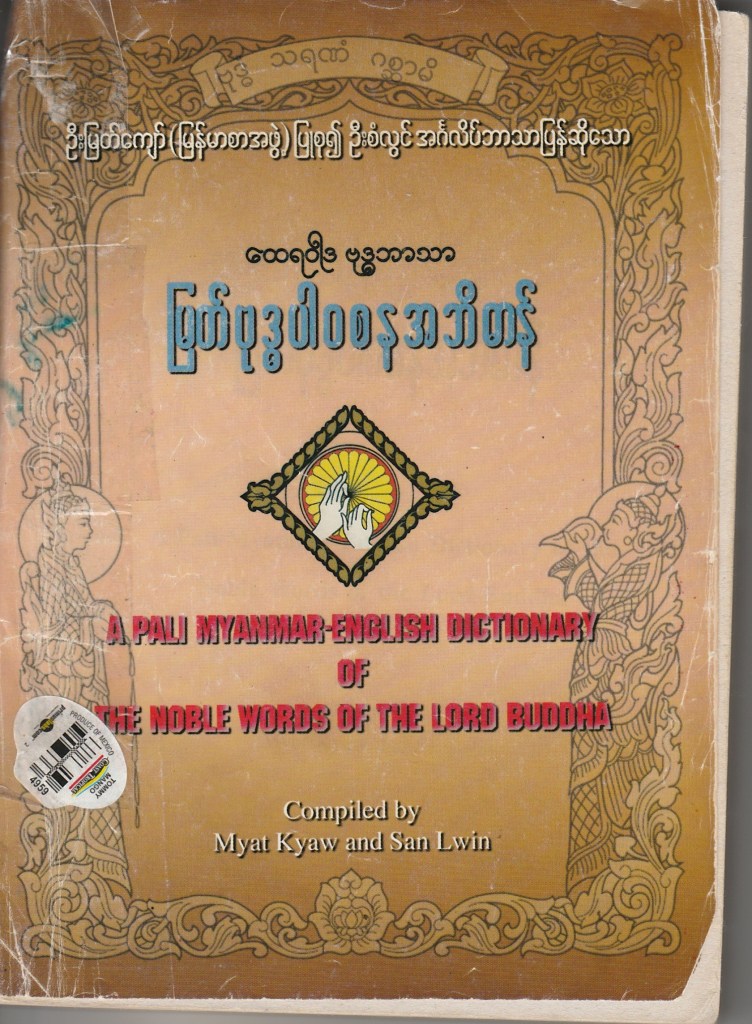
    • A Pali-Myanmar English Dictionary of the Noble Words of the Lord Buddha

    Process of Consciousness and Matter

    This image has an empty alt attribute; its file name is rewata-1.jpg

    Process of Consciousness and Matter
    Subtitle : The Philosophical Psychology of Buddhism
    By Sayadaw Rewata Dhamma
    Completed : 2004
    Last book by Sayadaw
    Publisher: Triple Gems Publication

    The book is intended for all serious students of the Abhidhamma.

    It serves as supplement to Bhikkhu Bodhi’s book “A Comprehensive Manual of Abhidhamma”, and treats various important aspect in more detail – in articular the process of consciousness and matter.

    Preface by Sayadaw U Silanandabhivama, Rector of the International Theravada Buddhist Missionary University, Yangon

    Acknowledgement by Sayadaw Dr. Ottaranyana, Birmingham Buddhist Vihara, UK

    Introduction

    Chapter I : CONSCIOUSNESS AND ITS FACTORS

    CHAPTER II : PROCESS CONSCIOUSNESS (CITTA VITHI)

    CHAPTER III : MIND-DOOR COGNITIVE PROCESS (MANODVARA VITHI)

    CHAPTER IV : ABSORPTION JAVANA IN THE MIND-DOOR PROCESS (APPANA JAVANAVARA MANODVARA VITHI)

    CHAPTER V : PROCESS OF MATTER

    The Buddha’s Prescription

    • A Selection of Dhamma Talks by Dr. Rewata Dhamma
    • Editor : Yann Lovelock
    • Dhamma dana : Triple Gem Publications
    • Three sections
    • Section 1 : Historical Perspectives
    • Emperor Asoka
    • Arahanat Upagutta
    • The Contribution of Buddhism to the World of Art & Architecture
    • Buddhism in Myanmar Today
    • Sangha & State
    • Section 2 : Active Buddhism
    • Monastic and Lay Buddhism
    • Teaching for the Many
    • Transferring Merit for the Dead
    • The Buddhist Concept of Loving Kindness
    • The Fundamental Forces of the Mind
    • The Human & Environmental Crisis
    • Bliss through Buddhism
    • Social Change and Individual Change
    • The Buddha’s Prescription
    • Buddhism and Social Justice
    • Section 3 : Interfaith Dialogue
    • Traditional Wisdom and Modern Knowledge
    • What I Expect of Friendship with Christians
    • Sunyata and Kenosis
    • Bibliography
    • Myanmar Monasteries

    Emptying the Rose-apple Seat

    • Subtitle : A day-to-day guide to Buddhist meditation methods as taught by a renowned meditation master
    • Author : Aggamahapandita Bhaddanta Dr. Rewata Dhamma
    • Foreword by Joseph Goldstein
    • Dhamma Dana by Triple Gems Publication
    • Aspiring to the Practice
    • Aspiration
    • The First Step
    • The Refuges
    • Eradicating the Defilements
    • Offerings
    • The Time of your Life
    • Meditation Practices
    • 1. An Overview
    • The Forty Meditation Objects
    • 2. Basic Factors
    • Signs
    • Temperament
    • Hindrances
    • Three Stages of Development
    • Absorption
    • Five kinds of Ability
    • Higher Knowledge
    • 3. Concentration Practices
    • Getting Started
    • Sitting Position
    • Walking
    • 4. Concentration Subjects
    • The Kasinas
    • The Recollections
    • a) Awareness of Respiration
    • b) Recollection of the Virtues of the Buddha
    • c) Mindfulness of Death
    • e) Meditation on the Impurities
    • f) Meditation on the Four Elements
    • g) Developing the Four Illimitables
    • A Ten Day Course in Insight Meditation
    • First 9 days
    • Instruction
    • Dhamma Talk
    • Day Ten
    • Instruction
    • Meditation : Developing Loving Kindness
    • Pali Glossary
    • Bibliography
    • Abbreviations

    Nyaung Kan Aye

    The Message of Satipatthana

    Author : Nyaung Kan Aye Sayadaw Ashin Eindaka
    Distributor : Nyaung Kan Aye Sasana Yeiktha, 2000

    Contents

    • PART I
    • The First Discourse on the Life of the Late Ven. Mahasi Sayadaw
    • The Historic Life of Mahasi Sayadaw and Vipassana Method Expounded in Satipatthana Sutta Part (2)
    • Meditate the Satipatthana as in Kuru Country
    • The Message of Sattipattana
    • PART II
    • Satipatthana Sermon for Overcoming Defilements (1)
    • Satipatthana Sermon for Overcoming Defilements (2)
    • Satipatthana Sermon for Overcoming Grief (1)
    • Satipatthana Sermon for Overcoming Grief (2)
    • PART III
    • Okasa Supplication Which is the A, B, C of Buddhism And Keeping the Precepts
    • Satipatthana to Free from Lamentation (1)
    • Satipatthana to Free from Lamentation (2)
    • Satipatthana to Free from Lamentation (3)
    • PART IV
    • Discourse on Satipatthana for the Extinction of Suffering (1)
    • Satipatthana for the Extinction of Suffering (2)
    • Satipatthana for the Extinction of Mental Suffering (1)
    • Satipatthana for the Extinction of Mental Suffering (2)
    • PART V
    • How to win Magga Nana Citta by Satipatthana (1)
    • How to win Magga Nana Citta by Satipatthana (2)
    • How to attain Nibbana by Satipatthana (1)
    • How to attain Nibbana by Satipatthana (2)

    Settling Back Into The Moment

    A meditator’s inspirational guide

    Selected text from THE EXPERIENCE OF INSIGHT, Joseph Goldstein

    First Edition : 1991
    Pocket Edition : 1995
    Revised Edition : 2002

    Samples

    • Most people are circling around, driven by ignorance and desire, unaware of the possibility of getting off this wheel of samasaras, the wheel of greed and hatred.
    • When we learn to let go, the lighter the mind becomes.
    • The whole development of awareness comes from experiencing things with a silent mind, not with our thoughts and concepts about them.

    What the Buddha Taught

    By Dr. Walpole Rahula

    • First published in 1959
    • by [Rev. Dr.] Walpola Rahula
    • Foreword by [Professor] Paul Demieville
    • Eight Chapters
      1. The Buddhist Attitude of Mind
      2. The First Noble Truth : Dukkha
      3. The Second Noble Truth : Samudiya : ‘The Arising of Dukkha”
      4. The Third Noble Truth : Nirodha : ‘The Cessation of Dukkha”
      5. The Fourth Noble Truth : Magga : ‘The Path”
      6. The Doctrine of No-Soul : Anatta
      7. ‘Meditation’ or Mental Culture : Bhavana
      8. What the Buddha taught and the World Today
    • Selected Texts
    • Abbreviations
    • Selected Bibliography
    • Glossary

    The book has been translated into several languages including Myanmar.

    The Buddha And His Teachings

    • Author : NARADA MAHA THERA
    • VAIJIRARAMA, COLOMBO
    • First Edition : 1964
    • 4th Enlarged Edition : 1980
    • Introduction
    • Part I : THE BUDDHA
    • 14 Chapters
    • 1. The Buddha — From Birth to Reunciation
    • 2. His Struggle for Enlightenment
    • 3. The Buddhahood
    • 4. After the Enlightenment
    • 5. The Invitation to Expound the Dhamma
    • 12. The Buddha’s Ministry
    • 13. The Buddha’s Daily Routine
    • 14. The Buddha’s Parinibbana (Death)
    • Part II : THE DHAMMA
    • THE TEACHINGS OF THE DHAMMA
    • Chapters 15 – 44
    • 15. What is Buddhism?
    • 16. Some Salient Characteristics of Buddhism
    • 17. The Four Noble Truths
    • 18. Kamma
    • 35. The Way to Nibbana (I) — Morality
    • 36. The Way to Nibbana (II) — Concentration
    • 37. Nivarana or Hindrances
    • 38. The Way to Nibbana (III) — Insight
    • 39. The State of an Arahant
    • 40. The Boddhistta Ideal
    • 41. Parami — Perfections
    • 42. Brahmavihara — The Sublime States
    • 43. The Eight Worldly Conditions (Atthalokadhamma)
    • 44. The Problems of Life

    Buddhism in a Nutshell

    • Narada Thera (Vaijarma, Colombo, Sri Lanka) published the book in 1933.
    • In 1970, Sayadaw published a revised edition.
    • Sayadaw full permission to Sayagyi U Hla Maung of the Buddhist Sasana Council to reprint ALL his publications reserving the copyright.
    • There are 11 (short) chapters and an appendix.

    The Triple Gem

    • The Triple Gem
    • by Venerable U Pyinnathiha
    • wrote the book in London, UK, 1988
    • revised the book in New Jersey, US, 2002
    • Contents
    • Foreword by Ven. Dr. Hammalaa Saddhatissa
    • The Three Main Views
    • What is Buddhism?
    • Who is the Buddha?
    • The Attributes of the Buddha
    • Dhamma (The Teachings of the Buddha)
    • The Attributes of the Dhamma
    • The Sangha (The Community of Noble Disciples)
    • The Attributes of the Sangha

    Note :

    The Dhamma dana distribution by Triple Gems Publication includes “The Triple Gem” and “The Way to Social Harmony”.

    A Pali-Myanmar English Dictionary of the Noble Words of the Lord Buddha

    Compilers:

    Burmese entries: U Myat Kyaw

    English entries: translated from Burmese by U San Lwin

    Publisher : Myanmar Sar Ah Phwe

    Excerpts

    katayuga – n. first of the four ages into which a world era is divided; age of filial piety and justice. See also yuga.

    kalasampatti – n. golden age; good times.

    This image has an empty alt attribute; its file name is img_20190910_0001.jpg
  • RIT Belles

    By Mai Khin Nyunt (Rosie, ChE71) and Ma Tin Aye (C73)

    Dear Ko Hla Min,

    May I present the names of TWO photos of RIT ladies.

    First photo :

    Right – Ma Sandi Hlaing — Ch 66 intake
    2nd from Right Mai Khin Nyunt (Rosie Gyi) — Ch 65 intake
    3rd. — Ma Nila Mya Aung — M 64 intake
    4th Ma Jessie Htwe — M 66 intake
    5th Ma Annie Ba Htaw — Tex65 intake
    6th Ma Aye Aye Than (Pauk Pauk, Emma’s cousin) Ch 66 intake (UK)
    7th Ma Tin Tin Myint (Emma Myint) — Ch 64 intake (Singapore)
    8th Ma Than Than Yi (GBNF) Tex 65 intake (my best friend who passed away
    in Sept 2013, USA)
    9th Ma Phyu Phyu Latt (Christine Latt) — Ar – 64 intake (Australia)
    10th Ma Min Thet Mon (Pamela Myo Min) — Ar -64 intake

    We all served as ushers at the Graduation Dinner in late 1966. Graduation took place at RIT as well as the Dinner, at “Aw Bar Lann” area.

    Second photo by Ma Tin Aye (C73 Volleyball) :

    As far as I remember, those were:

    Right …. Ma Aye Aye Than (Pauk Pauk, Emma’s cousin) — (Ch 66-72, UK)

    2nd from Right Ma Tin Tin Myint (Emma Myint) — Ch 64-70, Singapore)

    3rd Ma Hla Hla Aye (She was a cover girl of the “Shay Tho Sar Saung”. Inside the Sar Saung had an article about RIT activities with photos. I kept that Sar Saung, but unfortunately (after so many years) now I only have a page left with a photo taken at the Chemistry lab, which included Ma Khin Myat Swe (spouse of Saya U Moe Aung), Henry Koe, my spouse Ko Khin Mg Myint and myself).

    4th Ma Tin Aye (C )

    5th Ma Nelly Khin Myo Win (GBNF) (Ch 65-71, Mandalay)

    6th I guess it could be Ma Margaret Yi (Ch 65).

    All are from G -Hall at one of the Tha Din Gyut or Da Saung Taing Pwe at Shwe Dagon Pagoda, organized by G -Hall.

    Regards,
    Rosie (Ch 65-71)

    Editor’s Notes:

    • There were 45 (or so) female students in the first 1st BE intake in 1964.
    • There may be a little bit more in the 1st BE intake in 1965.
  • Non-Burmese Names

    Examples

    • Ann, Anne, Annie
    • Archie
    • Art, Arthur
    • Baby
    • Bob, Bobby
    • Bruce
    • Carol, Caroline
    • Charles, Charlie
    • Cindy
    • Dave, David, Davinder
    • Dick, Dickie, Dicky
    • Don, Donald
    • Eric, Erica
    • Ernest, Ernie
    • Errol
    • Frank, Frankie, Franklin
    • Fred, Freddie, Freddy, Frederick
    • Fey
    • Gavin
    • George, Georgia, Georgie
    • Gerald, Geraldine, Gerry
    • Harold
    • Henri, Henry
    • Hugh
    • Ingrid
    • Irene, Irina
    • Iris
    • * Jack, Jackie, Jacqueline
    • * Joe, Joseph, Josephine
    • * Jon, Jonathan, John, Johnson
    • Katherine, Kathleen, Katie, Kathy
    • Ken, Kenneth, Kenny
    • Kim, Kimberly
    • Larry
    • Leonard
    • Lily
    • Marie, Mary
    • Margaret, Margie
    • Mona
    • Nelson
    • Newt, Newton
    • Noyce
    • Oliver, Olivia
    • Oprah
    • Orwell
    • Pam, Pamela
    • Percy
    • Phillip
    • Quarry
    • Quebec
    • Quincy
    • Roland
    • Rob, Robbie, Robert
    • Ron, Ronald, Ronnie
    • Sam, Samuel, Samuelson
    • Sylvester
    • Sylvia
    • Tina, Tiny
    • Thomas, Thompson, Tom, Tommy
    • Tim, Timmy, Timothy
    • Ursula
    • Uttam
    • Victor, Victoria
    • Vince, Vincent
    • Violet
    • Walter
    • Will, William, Willie, Willy
    • Winnie
    • X (as in Malcolm X, Planet X)
    • Xavier
    • Yale
    • Yolanda
    • Yusuf
    • Zuse
    • Zeppelin
    • Zorro
    Daniel Tint Lwin, Kenny Wong and fellow 69ers
  • Thet Lwin

    U Thet Lwin

    He matriculated from St. Paul’s High School in 1957. His Burmese teacher was Saya U Sein.
    After graduation, he joined the Burmese Department at the Institute of Economics. During the Golden Jubilee Celebration of the University of Rangoon in 1970, he served as Secretary of the subcommittee chaired by Saya Dr. Aung Gyi, then Professor of Civil Engineering at RIT.
    One day, he was informed of a vacancy for Registrar at RIT where Sayagyi Dr. Aung Gyi was Rector (having succeeded Sayagyi U Yone Moe). The two sayas were reunited as co-workers at RIT.
    His pen name is Ngwe Hlinne. He is an accomplished pianist and composer. He received several “Dat Pyas” from BBS (Burma Broadcasting Service) for his songs including “Mya Kyun Nyo Nyo Tekkatho”. He treated his Ah Nu Pyinnya Shins with the remuneration (he received for his songs, typically K100 per song).
    He is the maternal uncle of U Sein Tin (EC74).

    U Thet Lwin (EC78)

    He worked for UCC (Universities’ Computer Center) and PTC(Post and Telecommunications Corporation) before going to Singapore and Thailand.
    He is now back in Myanmar.

    U Thet Lwin (Stats)

    Dr. Thet Lwin taught Statistics at the Institute of Economics.