Blog

  • Last Posting of SPZP-2000

    Ko Maurice Chee (M75) told me of a management workshop that he attended a few months back. The instructor told him to imagine lying in a coffin and thinking what eulogy he would like to hear. Now, he can tell his instructor that he’d like to be remembered as the work horse that staged the RIT-related gala event of the millennium and to have worked closely with Ko Benny Tan, a perfectionist who gave more time and energy to the SPZP than his enterprise for four months or so.

    While we honor our golden sponsors, we should not forget all the pieces that fell together at the right place at the right time to make this momentous event successful, fruitful, and memorable.

    • Our teachers, often strict and stern, set high moral standards.
    • Our parents directly or indirectly helped us get a decent education that can withstand acid tests.  Our motherland gave us a culture that is pure and priceless.
    • Our motherland gave us a culture that is pure and priceless.

    All of them gelled us into a network of hardworking, flexible, talented professionals for whom the sky’s the limit.

    It’s 2:50 a.m. as I’m closing the final chapter of an unparalleled event. We could dwell on this subject for many more weeks and months, but we’d like to end memories of the event on a high note.

    True, there are issues to be solved or things that can be improved. We would certainly be writing new chapters of another book. I sincerely hope that there will be fresh talents to complement the old-timers.

    From an informal project involving one or two persons, it’s now time to have “RIT Alumni International” as a formal world-wide organization spanning multiple continents. That is an important step to carry out long-term and short-term goals as suggested by Ko Benny and others.

    Thanks to all the people who contributed to the “Countdown” and “Post Reunion” in general and this Grand Finale in particular, to our countless faithful readers who have bookmarked http://www.ex-rit.org as a favorite site, and to all those who appreciate that “a thing of beauty is a joy forever” and “if one person can dream, others can fulfill”.

    Although the SPZP poem has been printed in the special issue of the RIT Alumni International Newsletter, and is present in a page on the Reunion special pages, I’d like to reprint it here. It epitomizes what we have worked for the past one and a half years.

    SAYA PUZAW PWE

    S eems like it was only yesterday
    A t our alma mater in a land far away
    Y ou taught us to work, play, laugh, even cry
    A nd coaxed us, forced us to aim for the sky

    P roblems in real life, lab, computation, survey
    U nderstand concepts, design, display, …
    Z eal, zest, ardor, grit, passion to make it “our day”
    A rchitects, engineers, we’ve come here to say
    W e honor your metta, your cetana — we fully can’t repay

    P resently we meet, alum from five decades we greet
    W ith memories true, fond, sweet
    E cstatic yet sad that the GBNF could not join this memorable fete

  • U Aye Win Kyaw (C70)

    U Aye Win Kyaw (C70, GBNF) joined the Department of Civil Engineering with his friends Madan Chand (GBNF) and U Aung.

    He is a founding member and EC of BARB. He taught Astronomy at BARB and MARB.

    His son visited him at a Pyin Oo Lwin Clinic and passed away in the shower room (due to an electrical safety problem that was ignored by the Clinic.)

    He felt distress, which probably affected his health and demise.

  • U Tu Myint

    U Tu Myint, son of U Tu Maung and Daw Hla Myint, graduated with a Mechanical Engineering Degree from University of Strathclyde, Glasgow in 1966. He then obtained a Masters Degree from the same University in 1967, and joined RIT as an Instructor.

    He supervised the M73 Hovercraft project.

    He left RIT as an Assistant Lecturer in 1976. He joined Singapore Polytechnic as a lecturer in 1977 and later promoted to Head of Mechanical and Manufacturing Department in 1988. In 1997, he became a Director of Industry Services, a department responsible for Students Industrial Training, Continuing Education, Consultancy Services and R&D.

    His hobbies are tennis and radio controlled modeling. He is married to Daw Mya Myitzu. One of her hobbies is puppet dancing and she performed the Burmese Puppet (Yoke Thay) show during the Year 2000 Singapore Polytechnic Thingyan Festival.

    Their daughter, Hla Thazin, followed the father’s footsteps and has become an electronics engineer. She has graduated with a Masters degree in Communication and Information Technology and presently working for Creative Technologies in Singapore.

    Update in 2020

    Met Saya in Singapore in December, 2019 at the mini-gathering organized by M73 (John Rao, Ko Hla Win …)

    Say retired from Singapore Polytechnic

  • RIT English

    (1) Saya Des Rodgers and Saya U Khin were Scrabble Champions at the tournaments held at Guardian premises and YMCA.

    Chambers Dictionary and Jones Pronouncing Dictionary were used to confirm/deny the word challenges. They were always present on Saya U Khin’s desk.

    Saya Des moved to UK and Canada. Saya U Khin moved to Taiwan.

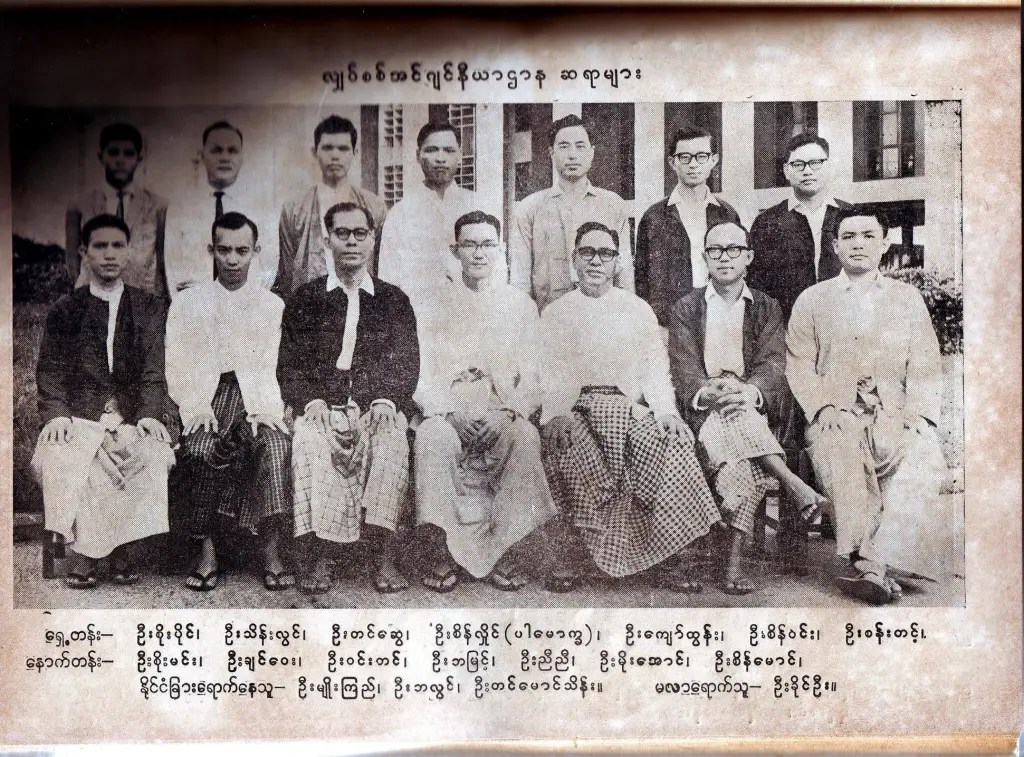
    (2) Saya U Win Mra was a Pole Vaulter before he was asked to “retire” by the doctors. Saya U Win Mra and Saya Des are excellent guitarists and singers. Saya joined the Foreign Service. He was Myanmar’s Ambassador to the United Nations. He is chair of Myanmar Human Rights Commission.

    U Khin Maung Lay (“Mutu”, M70) is a member of the Commission.

    (3) Saya Joe Ba Maung (GBNF) was Burma’s Tennis Champion in Singles and Doubles (with U Than Lwin). Saya joined Burma Railways. He served as Advisor for Burma Railways Sports Program.

    (4) Saya Sao Kangyi (Tony, GBNF) wrote as Khemarat. He is the brother-in-law of Sao Hso Holm (“Sawbwalay”, son of Arzani Sao San Htun).

    (5) Saya U Kyaw Lwin Hla transferred to UNDP.

    (6) Sayama Daw Yin Yin Mya (Terry) was Head of Department. She migrated to Australia. She was a Beauty Queen in her college days.

    (7) Sayama Daw Sheila Saing was Deputy Head. She moved to Thailand.

    (8) Sayama Naw Charity Sein U later became Head of the RIT English Department. Met her briefly at SPZP-2012.

    (9) I met Sayama Muriel when she and Saya U Aung (Alphoso) visited Saya U Tin Maung Nyunt. We had a couple of lunch gatherings.

    (10) Sayama Toni is a cousin of Ko Thet Tun (Henry, M 75). Their aunt Dr. Khin Kyi Nyunt (GBNF) is the spouse of Saya U Tin U. Met her briefly at SPZP-2012 and again in late 2019. Sayama is a Khamee Khamet of Saya U Win Mra.

    (11) Sayama Daw Khin Saw Tint (Ann, GBNF) published several books. She is the daughter of ICS U Ba Tint and Daw Khin Saw Mu (“Khit San Sar Pay”). Her mon’s siblings are ICS U Tin Tut, U Kyaw Myint (Head of Tribunal for Galon U Saw’s case), U Myint Thein (former Chief Justice and writer/translator “MMT”), Dr. Htin Aung (former Rector and author of several books about Burma and Burmans), Daw Khin Mya Mu (Inscription Expert) and Sayama Daw Tin Saw Mu.

  • Memories of Saya Des (2)

    By Des Rodgers

    On the lighter side

    I need to linger awhile and talk a bit about some delightful and noteworthy events and persons. On the lighter side, I couldn’t help but chortle at Ko Ohn Khine’s and Ko Zaw Min’s reference to their pastime of ogling the your lady-students passing by the canteen on their way to G Hall at the lunch breaks and after classes.

    Let it be known that Sayas Tony, U Khin, U Kyaw Lwin Hla and myself, no strangers to the female attractions of either the sayamas or the students, would lunch almost daily in the canteen seeking out the fringe benefits attached to our jobs, and to having lunch in that ideally situated viewpoint location. Sayas Joe Ba Maung and U Win Mra graced these occasions with their presence from time to time, and while waiting for our htamin net hin or si kyet khauk swe, we always amused ourselves watching Saya Kyaw Lwin Hla go through his ritual of asking for hot water to wash his plate, spoon and fork before eating. His explanation was that his 5 years of living in Australia (his father had been Burma’s ambassador to Australia) had more or less robbed him of his immunity to gastrointestinal bacterial attacks, and he feared developing ailments resulting from his use of non-sterilized utensils. We laughed then, but I later understood his apprehension after my son fell sick from the same kind of problem in Mandalay during our trip to Burma in 2007.

    Our wait for the food was well worth it though, especially as we could enjoy the spectacle of watching Saya U Khin “wolfing down” 3 to 4 helpings of Si Kyet Khauk Swe in double quick time. Given his slim build, I could never figure out where he stored all the food that he ate.

    During these waits, we also utilized our time well by discreetly “monitoring” the flow of traffic to and from G Hall, the ladies’ residence. It was our way of recharging our energy and relaxing our minds before returning to the heavy duty of teaching Reading, Writing, and Speaking. This practice of traffic observation got to be quite addictive, for when I played soccer on the sayas’ team, I’m sure while Sayas U Maung Maung Win, U Soe Paing, and the rest of the team were practically dripping ‘blood, sweat and tears’ in their effort to get a win, I was nonchalantly content to “play for the pleasure of the game” (read) the cheers and applause coming from G Hall, which overlooked the football field. Life, you understand, requires a balance in all things.

    Saya Win Mra and I

    On a more serious note, Saya U Win Mra and I, from early on, were earnestly determined to make something of our lives by eventually serving in the Burmese Foreign Service. I was, at that time, reasonably steeped in the knowledge of politics, history, and economics, and as he was a product of a career service family with a father enjoying the position of Secretary to the Prime Minister, it was quite natural that we would find common ground in purpose, and a meeting of the minds.

    Our RIT discussion and debate locale was Ma Tin Aye’s shop just outside the RIT premises, where we would spend a great deal of time over dinner discussing world affairs, historic events, and foreign policy of the more powerful countries in the world. My younger friend (Mra) flattered me by according me the position of mentor, as we prepared ourselves for the forthcoming FS exams.

    To trim this story, as the day of the exams approached, I discovered some disturbing trends in my thinking. Something had not been sitting well with me and had been bothering me for some time. I agonized over this unknown factor for about 10 days before the exams. As the exams drew nearer, I slowly realized that I was not sure I wanted to take the them, or to join the Foreign Service. I was slowly becoming convinced that I could not serve a calling in which I had lost my faith in the system, and my ability to give of myself 100%. After more soul-searching, I told Saya Win Mra that I wasn’t going to go through with our plan, and that I was seriously making up my mind to leave the country. To his credit, he stayed the course, disciplinarian that he is, exercising far more determination and an unshakeable grip on his dream, for which I’ve complimented him over the years.

    Pagan

    With my major decision out of the way, Saya Win Mra and I decided it would be a good idea to make a final journey to Pagan for posterity. We prepared ourselves well for the trip, reading up on all we could about this historic abode of early Burmese royalty. We decided to backpack our way through this emotional journey to make it more meaningful, which would not only cement our close friendship, but tie us more closely in spirit to the land of our mother country. We tramped around on foot for miles, taking in all the major historical sites, and shared information and knowledge about each edifice over our evening meals. These discussions continued after our evening bath in the Irrawaddy and our preparation for our night’s rest, which often took the form of spending the night in any one of the neglected and untended pagodas. The spectacular sunsets and the cool quiet dawns were surreal and created an unforgettable canvas in which these memorable events have been indelibly etched for us.

    My trip to Pagan in 2007 brought mist to my eyes, and that wasn’t just because of Mother Nature’s cool mornings and evenings. It would have been difficult to remain unemotional on seeing the shimmering rays of a setting sun on the mighty Irrawaddy. I’ve often asked myself if it has been worth leaving my homeland, and I don’t doubt that every Burmese expat living in foreign lands is constantly reminded of the price he has had to pay in giving up his country on principle.

    My former colleagues

    Well, where are all my English Department colleagues now?

    In 2000, my family and were invited to visit and spend time with Saya U Win Mra and his wife in the Burmese Embassy in Westchester, New York. After 30 long years, I was delighted to see my closest friend who was then Burma’s Ambassador or Permanent Representative to the United Nations. They welcomed us joyously, and the first words U Win Mra uttered were: “If it hadn’t been for you, I wouldn’t be here today”. I took this as a compliment, not knowing if there was a downside to this comment. We spent time going over our memorable moments over traditional Burmese dinners and complemented by one of my favorite Bordeaux French red wines – Saint Emilion! During my stay, I must have depleted the embassy’s stock considerably, as this happened to be my favorite week-end dinner Merlot. We chatted about how he had risen in the Foreign Service ranks, and in which countries he had served as ambassador. I had occasion to read some of his speeches, but I could find no grammar errors as they had all been impeccably written. This memorable trip culminated in lunch at the UN, where he introduced me to a few other foreign emissaries.

    Our meeting up in Rangoon in 2007 was no less momentous, with dinner at his residence, followed by a jam session of playing and singing some of our favs of times gone by when we did the BBS and Rangoon nightclub circuit. After a good stint at the Foreign Ministry as Director General, U Win Mra is currently heading Burma’s Human Rights Commission as its new Chairman. Much water it seems, has flowed under the bridge.

    Sayama Muriel is happily married to a Mr. [Alphonso] Rivers, and teaches English in Cheng Mai, Thailand.

    Saya U Khin left Burma after being transferred to Mandalay University, and is now engaged in freelance work as a legal consultant in Taipei, Taiwan. He’s still a bachelor, and for the rest, you can fill in the blanks.

    Saya Joe Ba Maung is retired, having left RIT while I was still there, to work for the Burma Railways. He married his ever loyal lady love Nyi Ma Lay, and looked a healthy, happy man in 2007.

    Sayama Toni, unfortunately lost her husband – Burma’s ambassador to S. Korea early in the last decade, and returned to Burma, where she teaches, along with her daughter Aye Aye – U Win Mra’s daughter-in-law, at a private school in Rangoon. She is still very attractive and has the same walking or gliding gait that one usually associates with a model – or a very graceful bird.

    Sayama Daw Khin Saw Tint was widowed some years ago, and lives in retirement in Rangoon. All my attempts to see her in 2007 failed, but I still hope to see her one day.

    Saya U Kyaw Lwin Hla, who made most of my entertainment arrangements, and arm-twisted my friends to attend my brunch at Traders in Rangoon in 2007, is well and working as a Director for the Myanmar Investment Bank (name ?) on Merchant Street in Rangoon. He also took me and my family to a sumptuous Thai dinner at a restaurant on the Royal Lakes. His previous work at the UN has not only enhanced his resumé but also showcases his smooth interactive skills with people.

    Since 1967, I have lived a successful life in Canada, one beyond my expectations, and one that has brought me recognition by the Canadian government, industry, and the field of education for my contributions to specialized language training for professionals. For all my flashy style of dressing and high aspirations, I’ve never been materialistic, my main priorities in life now being the welfare and safety of my wife and son, closely followed by a tantalizing glass of red wine and stimulating conversation. Writing my book was very rewarding, and took the better part of my last 2 years. May yet author a few more, time permitting.

    Status

    I did not come out to the west for educational or financial reasons, but along the way, I‘ve improved on my earlier status in Burma. Freedom to think as I desire, and to act as my mind dictates, were primary motivating factors in my decision to leave Burma, and I am strongly convinced that my years of study at St. Peter’s, Mandalay U., RASU, and RIT contributed immeasurably to molding me and giving me direction to succeed in life.

    In my quiet moments of reflection though, my heart always returns to the fun-filled halls of RIT, echoing the sound of familiar voices, and t other moments I drift back to the hot, humid, and dusty streets of Mandalay, where I got my first beginning in life. For this anyatha, that’s where home is, and always was ever since my first ancestor from England set foot on Burmese soil in 1825, and married a fair Burmese maiden, an event repeated by my maternal Portuguese ancestors, ultimately planting roots in the upper Burma regions favored by Burma’s mightiest kings. I may never see my homeland again, but the memories and feelings can never be erased. In closing, let me give you my slightly modified version of what some writer once said:

    “You can take the man out of the country (taing pyi), but you can’t take the country out of the man.”

    Thank you all for sharing these nostalgic moments with me, and for having played a crucial role in helping give me a more rounded identity that has made me proud to be called an RIT alumni, and a Burmese national. I’d like to wish each and every Saya, Sayama, my former students, and alumni my very best in your quest for a long, happy, healthy, and successful life, wherever and however you have chosen to follow your star.

    May Burma and RIT rise again to recapture their true glory!

    With metta,

    Des Rodgers

    Editor’s notes:

    Received New Year’s greetings from Saya U Khin (Lucien Chen, Taiwan) a few years back. Saya also wrote again in August 2016. I posted his correspondence in “RIT Alumni International Newsletter”.

    Saya “Tony” Sao Kan Gyi’s pen name was Khemarat. Saya passed away. Saya’s younger brother rowed at RUBC.

    Saya Joe Ba Maung was national tennis champion in singles and doubles. He was succeeded as singles champion by his doubles partner U Than Lwin. Saya passed away.

    Saya U Win Mra was national pole vault champion, but the doctors requested him to rest. He was winner [or runner-up] of the “Elvis Presley songs” contest. He showed up at my uncle’s birthday party dressed in G. I. Blues (or similar). U Khin Maung Lay (Mutu) works with Saya for the Myanmar Human Rights Commission.

    Saya U Kyaw Lwin Hla was a staff member of UNDP. He was succeeded by his brother U Kyaw Zin Hla. U Zaw Min Nawaday did not recognize Saya when they met in New York.

    I called Saya Des several times. I had a conversation with Sayagadaw. They have a son, who works as a physical trainer.

    Sayama Naw Charity Sein U retired as Professor and Head of RIT English department. She attended one or more SPZPs.

    Sayama “Toni” is a cousin of Ko “Henry” Thet Tun (M75, Sydney, Australia). Their youngest aunt is the spouse of Saya U Tin U.

    Sayama Muriel’s spouse is Saya U Aung (U Nge, Mr. Alphonso Rivers). U Aung’s father was H.E. U Than Aung, Minister of Education in the AFPFL Governemtn. I met them when they visited Saya U Tin Maung Nyunt in Milpitas, California, USA.

    Sayama Anne (Daw Khin Saw Tint) is an accomplished bi-lingual writer. Her mother Daw Khin Saw Mu, her four uncles (U Tin Tut, U Kyaw Myint, U Myint Thein and Dr. Htin Aung) and her two aunts (Daw Khin Mya Mu and Daw Tin Saw Mu) are well known scholars and diplomats. She donated part of her “Sar Mu Ga” — K5 Lakhs — for the YTU Library Modernization Project.

    Since I write notes for the different posts, the contents, level of coverage and style for a topic may vary. No block selected.

  • RIT Complex

    By Saya U Maung Maung Win (M61)

    RIT Complex

    There were three main buildings.

    Building One was three-storey with teaching classes, laboratory and theatres and offices for teaching staffs of Mechanical, Civil, Chemical, Math, Chemistry and English.

    Building Two was two-storey building with teaching classes, laboratory, Workshop and offices for teaching staff of Textiles, Mining, Electrical, Burmese and Political Science.

    Building Three was just single-storey building with laboratory rooms, teaching classes and offices for teaching staff of Mechanical and Metallurgy.

    Then we have students dormitories and hostels Blocks A, B, C, D, E and F and two dining rooms and cooking facilities were connected with the main building through a passage/corridor with under cover, all along so that staff and students cars could park.

    Teaching-staff Quarters

    Let me say something about teaching-staff quarters on the campus such as

    • 16 A, B, C, D, E and F, two-storey 4-unit buildings for assistant lecturers and later for instructors too;
    • 15 A, B, C, D, E and F, two-storey 2-unit buildings for lecturers
    • 14 A, B, C, D, E and F, two-storey single-unit buildings for heads of departments and professors
    • a single building called the Green House  bigger than 14 series meant for the residence of rector of the Institute.

    Also we have two-unit buildings of different sizes for clerical staff, technicians and laboratory assistants and other six-unit quarters for cleaners, securities, cooks, butlers etc at the back of the teaching staff quarters. The RIT campus including all teaching staff and employees was treated as a village/ward so it had its own social and basic amenities like clinic, ward and township councilors.

    Further Study

    Slowly one by one those teaching staff/ teachers who were sent overseas as state scholars to acquire Masters came back namely U San Tun, U Tin Hlaing, U Allen Htay, U San Hla Aung, U Win Kyaing, U Kyin Soe etc. and thus visiting lecturers from the Colombo Plan stopped coming so also those on contract staff from India.

    At that time I was so eager to have Masters Degree which was my wishful thinking. Fortunately U Ba Than nominated me in 1966, thanks and appreciation for his wise choice and later after appearing for personal interview before many rectors, departments heads and many ministers including the then Education Minister Dr U Nyi Nyi, I got selected to study in Canada. That time as the country was marching towards Socialism the majority of the students selected for further studies were sent to the Communist Block such as Russia, Yugoslavia, Czechoslovakia, Bulgaria, GDR, the Republic of China, Poland etc and only a small portion minority was sent to English-speaking countries like Canada, the United Kingdom and Australia. Because of language difficulty many took longer to finish and also some came back without any degree.

    Those who were successful had to attend the political and English and language course for three months at the training centre near the Inya Lake in June 68. After the training I left home from East stopping in Bangkok, Hong Kong, Tokyo, Alaska, Vancouver and then in Hamilton, Ontario. My university is McMaster which is very close to Niagara Falls which again is a few miles from the Rainbow Bridge, USA.

    A year later five chemistry students arrived to study in the same university for their PhDs and I had an opportunity to help them in finding accommodation and making friends with them. One of them is Daw Khin Mar Htun, the daughter of the then Burmese Ambassador Thakin Chan Htun to Canada and hence sometimes later we all were invited to his residence in Ottawa to spend 4-5 days. I met U Pe Win (Metallurgy, RIT) in Toronto many times when he was doing his Masters and later on his return, he also became rector of the Institute when I left the Institute in 1980 for Australia. I find him very polite and friendly because he was my high school teacher’s nephew in Moulmein. When I finished my study I returned home from the West visiting London, Rome, Beirut, New Delhi, from there to the Taj Mahal a gigantic marble palace really incredible and breath-taking built by a king for his wife in Agra, arriving back home on 9 Dec 70, the day right hand drive was introduced.

    Sayagyi Prof. U Ba Toke who retired as the rector of the Mandalay University came back and joined as the special Math Professor in RIT and as he was matriculation Math Convenor he invited all of us to correct Math papers of students all over Burma, in his department during summer holiday thereby we came to know him better. Once I met him in Singapore in Dec 02 at the Ex-RIT Reunion, to my surprise he called me by name which shows that he has a very sharp vivid memory. With this paper I acknowledge and give thanks and appreciation for his generosity and friendship.

  • Link

    Six degrees of separation

    In the study, a group of people were given letters (or packages) with the destination address. They were asked to forward them to someone, who they believe might know someone, and so on.

    On the average, it took six links for the letter (or package) to reach the destination.

    Has the world shrunk?

    A similar experiment was repeated in the Internet age with e-mails (or similar).

    It took about four links.

    Wisdom

    There is conventional wisdom stating, “A chain is as strong as the weakest link”. Hackers and Crackers (Criminal Hackers) try to find out the weakest link.

    • There is unconventional wisdom stating, “Your weak relation (e.g. those who meet in a church or temple) might often prove to be more helpful that your strongrelation (e.g. families and friends).”
    • For example, a weak relation might help you get a job.
    • The Montgomery Bus Boycott and the Million Man March (to Washington DC) were made possible by the seemingly “weak” relations.
    • Who knows if there are weak relations (lurking in the Internet), who might help me transform my posts into an e-book, a printed book or a series of lectures to help our beloved motherland and alma mater.
  • Exam Systems

    Intermediate College

    • During a period, students at the University of Rangoon [and Mandalay] attended Intermediate (A) classes for a year, but they did not have to take the examination.
    • They then attended Intermediate (B) classes for a year. They then take the examination for both courses.

    Compart System

    • There used to be two examinations for a class.
      The students have two chances to pass.
    • The first examination was usually held in March.
      Those who pass all subjects are eligible to apply for stipends and grants.
    • Those who pass at least three subjects have to take the remaining subjects in the second examination, which was usually held in June.

    Saya U Ba Toke

    • Saya was born in December, 1920.
    • He attended Mandalay University.
    • He joined the Students’ Strike Camp, and missed the first examination held in March.
    • The strike ended, and Saya took all the subjects in the second examination and passed.
    • He wanted to attend the Faculty of Engineering in Rangoon, but he needed a stipend. He could not get the stipend because he did not take the first examination.
    • Saya’s teachers persuaded him to take Mathematics Honors in Mandalay.

    Dr. Tint Lwin

    • He took the Pure Science option for I.Sc.
    • He attended engineering classes for a while, but he changed his mind to study Medicine.
      He took the classes needed to study medicine (e.g. Biology) and the supplementary exams.
      Finally, he was admitted to the MBBS classes.
    • During his university days, he was Goalkeeper for the University First Eleven. He team mates include Collegian Nay Win, Tun Kyi and Kenneth Shein.
    • After retirement, he moved to the USA.
  • Paulians

    • U Aung Myint (Sonny, UCC, GBNF)
    • Tekkatho Aye Maung (Reggie) : Musician
    • U Aung Chaw (Victor) : SPHS63, Retired engineer, Ashin Ukkamsa
    • Dr. Aung Win Chiong : Admitted as Roll Number One to IM(2) in 1964
    • Maung Aye (Twin) : Second highest marks in 1965
    • Dr. Ba Han : RU Law Professor, Lexicographer
    • U Ba Khin : First in Burma in Matriculation, First native Auditor General, Vipassana Teacher
    • Dr. Ba Maw, Adipati, RU English Lecturer
    • U Ba Min : Mathematics and Astronomy (Berkeley)
    • Dr. Ba Than : Surgeon, Soccer, Musician, Rector of Institute of Medicine
    • Bernard Khaw : First in Burma in 1965 : Admitted as Roll Number One to Chemistry
    • U Chan Tun / Htoon : Justice
    • Charles Cheah (Myint Lwin) : SPHS66, Burma Judo Champion, Chemistry, German Diploma
    • Charlie Rivers (Ko Cho) : SPARK
    • Dave Singh Saluja : SPHS63, Entrepreneur
    • Dennis Stevens : Lead Drummer of School Band
    • Dr. Edward Than Maung (Tin Maung Maung Than) : Admitted as Roll Number One to Physics in 1965, Political Economist
    • Dr. Frankie Ohn : First in Burma in 1959, Physics, Entrepreneur
    • George Chapman : First in Burma in 1952
    • U Han Tun Maung : Track and Field, Owner of Sein Hlyan Cafe, Active in OPA
    • Dr. Harry Wang (Than Myint) : Joint Third in 1956, Physics
    • Dr. Henry Cho Tun (Myint Tun) : Gold Medalist in I.Sc. combined in 1962, Chemistry
    • U Hla Min : Life Long Learner, Jack of all trades and Master of some
    • M. Hla Min (Moosaji) : RUBC Gold
    • Jerry Hin Hwa : Soccer, Editor
    • Jimmy Crampton : Burma Champion in 800 m and 1500 m
    • Dr. Johnny Kyaw Myint (Thane Oke Kyaw Myint) : Sixth in Burma in 1960, Pediatrician, Co-founder of Alumni of IM in Myanmar
    • U Khin Maung Htun, Past Patron of OPA
    • Dr. Khin Maung U : First in Burma in 1963, Medical Research, FDA
    • U Ko Ko Lay : Co-founder of UCC, Professor at DCS and ICST
    • Koon Yin Chu : First in Burma in 1960, Architect, Restaurant owner
    • U Kyaw Khin : National Coach for Track and Field
    • U Kyaw Paing : Golf, Law
    • U Kyaw Sint (Edward) : Burma Junior Tennis Champion, RU Soccer Selected
    • U Kyi Gwan : RU Soccer Selected
    • Micky Tan (U Thein Aung) : SPHS59, RUBC Gold
    • Dr. Min Lwin : SPHS60, Orthopedic Surgeon
    • Dr. Min Lwin (Maurice) : Admitted as Roll Number Two to IM(2) in 1964
    • Dr. Min Oo : Second in Burma in 1963, Mathematics, Professor in Germany and Canada
    • Dr. Myint Han : SPHS59, Chemistry & Chemical Engineering
    • Dr. Myo Myint : Professor
    • U Myo Myint : Engineer, RUBC Gold, Vice Chair of RUBC 90th Anniversary Magazine
    • Dr. Myo Paing : Golf, Malaria
    • Dr. Myo San (Freddie) : Third in Burma in 1963, Surgeon
    • U Myint Thin (Peter) : Admitted as Roll Number One to Mechanical Engineering, Luyechun, Rowing
    • Dr. Nyan Taw (Dicky) : Marine Biologist, RUBC Gold
    • Dr. Nyunt Tin : First in Burma in 1952, Physician
    • Dr. Nyunt Wai (Victor) : Fourth in Burma in 1963, Physiology, Painting, Poetry, Sagar Pariye
    • Dr. Paing Soe (Freddie) : Admitted as Roll Number Two to IM(1) in 1965, Joint Fifth with Dr. Yi Thway, Deputy Minister
    • Robert Sein : Second in Burma in 1958, Physics
    • Dr. Robin Ban : Second in Burma in 1961
    • U Sein Htoon : Engineer, RUBC Captain, ARAE Champion in 1960, Past President of Burma Rowing Federation
    • U Sein Lwin (Raymond) : Musician
    • Dr. Shewan Lee : Second in Burma in 1959
    • U Soe Nyunt : Owner of Taw Win Hnin Si (Royal Rose Restaurant), Recovered the “Roll of Honor”
    • U Soe Paing : Two Gold Medals for I.Sc. combined in 1958, Co-founder of UCC, UN expert
    • Dr. Soe Win : First in Burma in 1958, Chemistry, Retired YUFL Rector
    • U Than Htut : RUBC Gold
    • U Than Naing (Herman) : Musician
    • Dr. Than Nwe Aung : Third in Burma in 1959
    • Dr. Than Nyun (George) : Economist, RUBC Captain, Patron of YUBC OMA, Minister
    • U Thaung Lwin (Dexter) : Engineer, RUBC Captain
    • Thura U Thaung Lwin (Michael) : Deputy Minister
    • Dr. Thein Wai : Fifth in Burma in 1963
    • U Tin Aung Moe (Eddie) : Musician
    • U Tin Htoon : Architect, RUBC Captain, ARAE Champion in 1958 and 1960, Silver Medal for Yachting in SEAP, Organizer
    • U Tin Htut : Engineer, RUBC Captain, Co-founder of BASES
    • ICS U Tin Tut : First native ICS by invitation, Diplomat, Minister
    • Dr. Tin Wa : RUBC Captain
    • U Wan Myint : First in Burma (after nationalization)
    • U Win Paing (Sayadaw U Wara) : Kaba Aye Sun Lun Gu Kyaung
    • Winston Sein Maung : Third highest marks in 1965
    • U Wunna Sithu : Admitted as Roll Number One to Electrical Engineering in 1965, RUBC Gold, Swimming and Water Polo
    • Dr. Yi Thway : Admitted as Roll Number One to IM(1) in 1965

  • RU Notes 7

    Two Sayas named Hunter

    There were two Sayas named Hunter at the University of Rangoon.

    • Matthew Hunter taught Physics and Chemistry, and also studied Geology.
      He served as Principal of Rangoon College.
      He tried to persuade the student leaders of the 1936 RU Strike.
      The students explained, “We are not protesting you.
      We are protesting to have changes to the University Act.”
      He loved the students very much. Tears fell when he had to bid farewell after retiring from Rangoon University.

      Some awards (given out at the early Convocations) are named after “Matthew Hunter”.
      
    • Mark Hunter (John Mark Hunter) taught and wrote on English Literature. He was a member of the Commission responsible for the implementation of the Rangoon University Act of 1920. He later served as Professor at RU.
      

    Judson

    • Andoniram Judson Jr. (1788 – 1850) was the most significant American Baptist Missionary to Burma.

      His supervisors told him that it would be a tough task.

      There were a few ABMs before him, but they did not stay long.
      
    • Judson and his team (which included some former dhamma teachers) compiled the English-Burmese and Burmese-English Dictionaries (see photos of two editions).
    This image has an empty alt attribute; its file name is bur-eng-dictonary.jpg
    This image has an empty alt attribute; its file name is img_20191005_0001.jpg
    • Judson published the Burmese translation of the Bible.
    • He helped found the association for Baptists.
      
    • He is honored by having a church and a college named after him.
      
    • In 1920, Judson Collegeand Rangoon College became constituent colleges of the newly established University of Rangoon.
    • Two buildings for Judson College were donated by the American Baptists.
    • The Willington Hall was built in memory of two families — the Vintons and the Johnsons — of the Church of Willington for their missionary work in Burma.
      It was later known as Dagon Hall.
    • The Benton Hall was donated by Ms. Benton (Treasurer of the Judson Church and/or Judson College).
      It was later known as Thiri Hall.
      
    • Note: Depending on the period, a Hall may house classrooms or may be used as a hostel.
      There was also a building named North Hall (which later became Shwebo Hall).
    • Examples of evolution of halls
    • Mandalay Hall was a Residence Hall.
    • After the “Dark Days” (7th July and 8th July 1962), several Residence Halls were converted into Admin Offices and/or Classrooms.
    • Mandalay Hall was a temporary home for the UCC project before moving to Thamaing College Campus.
    • Geology majors had most of their classes at Mandalay Hall.
    • G-Hall in the Gyogone Campus initially housed single sayas.
    • In November 1964, G-Hall became a resident hall for female students.
      Madan Chand (C70) was inadvertently listed to reside at G-Hall.
      Lyo Kyin Sein (T69) was inadvertently listed to attend at a men’s Hall (e.g. C-Block)

    Burmese

    • In the early days, several languages (e.g. Pali) were taught by the Department of Oriental Studies.
    • Sayagyi U Pe Maung Tin (Pali and Burmese Scholar) proposed to have a separate Burmese Department.
    • Sayagyi translated Pali books (e.g. Visuddhi Magga) and Suttas (e.g. Dhammacakka and Anattalekkhana) into English.
    • ICS U Sein Tin (Theikpan Maung Wa), U Thein Han (Zawgyi) and U Wun (Minthuwun) were the early Burmese (Honors) students of Sayagyi. The trio is also known as co-founders of the Khit San Sar Pay movement.
    • U Sein Tin was a victim of a bungled burglary or the case of mistaken identity.
    • U Thein Han was offered to do Masters by both the Burmese Department and the English Department, but he chose to study Library Science in the UK. He succeeded U Khin Zaw as Chief Librarian of the Rangoon University Central Library.
    • U Wun studied Linguistics and Literature in the UK. He headed the Translation Department at the University of Rangoon. He later served as Professor of the Burmese Department, and as Visiting Professor at the University of Osaka (at the invitation of Professor Harada (pen name : Chit Mann Nwe). He is the father of U Htin Kyaw (former President).
    • In December 2019, the Myanmar Sar Htar Na (Burmese Department) will unveil a statue honoring Sayagyi.

    Met Daw Tin Tin Myaing (Brenda Pe Maung Tin, Sayagyi’s daughter) at Winner Inn. She attended the unveiling of Sayagyi’s statue. She was also a guest at the Fund Raising Concert for RU Centennial. Two friends mentioned that his spouse (an Old Paulian) passed away in UK during the COVID-19 pandemic.

    There is an album called Burmese (Myanmar Sar).

    Some Posts

    Per Hlaing Bwa : According to a “Shay Hmi Nauk Hmi” Saya, U Chit was detained for “providing food to the University Student Protesters”. He was questioned repeatedly for the rationale of his work. He wrote, “The students are my benefactors. I therefore need to repay their kindness in times of need.” Finally, a relative with connections managed to secure the release of U Chit. Sadly, he passed away 8 months later. He is an “unsung hero.”

    Per Myo Thaik : He witnessed the “Tha Dar Phyu” (later referred to as “Tha Dar Ni”) incident and endured a tear gas bomb. His posts are based not only on his experience (recorded as dairy entries), but also on other sources : Gabriel (Thet Tun) and a post from the on-line forum.

    Poems

    • Yadana Thu
    • Novem Pink
    • Min Oo Idw

    Memories

    • Saya U Khin Zaw (Workers’ College)
    • U Tin Aye
    • Lin Htike
    • Thann Htutt Aung
    • Dr. Thwe Oo : Daughter of Saya U Khin Maung Nyunt and Sayama Daw Mya Mya Nu
    • Dr. Jillian Phyu Maung : Grand daughter of Saya U Aung Khin (Chemistry)