My older brother and sister took two Government examinations — 7th Std exam & 9th Std exam — before entering Rangoon University.
I had to take four examinations — 7th Std exam, 9th Std exam (twice) & 10th Std exam — as a Guinea Pig of the changing Education Systems.
We had to study most subjects in Burmese and English. Thin Char, Yupa Beda and Dhatu Beda in 9th standard Mathematics, Physics and Chemistry in 10th standard
We took the last 7th Standard Government examination in 1960.
Note that there were protests regarding the 7th Standard examination in 1956. Harry Tan, who lived nearby, was killed by a stray bullet. All those who took the examination were declared “Pass”.
There used to be a Combined High School Final & Matriculation examination. Successful candidates could attend the University.
However, the System Changed.
HSF Only Exam
We had to take the first ever High School Final Only examination in 1962. We lost one precious year of our lives as guinea pigs of the frequently changing Education System. We answered all tests in Burmese (except English).
We (those from Rangoon) took the HSF examination with the security troops roaming the city after the Coup d’etat on March 2, 1962. The examination was annulled citing “leakage of questions”. We had to retake the HSF in August 1962.
We would normally be attending Rangoon University in 1962. We might witness two dark days in the History of Rangoon University on July 7, 1962 and July 8, 1962.
Matriculation Only Exam
We took the Matriculation Only in 1963. We answered all tests in English (except Burmese).
SPHS63
University Days
We attended the last ever I.Sc.(A) classes at Leik Khone (Rangoon Intermediate College).
There were protests in July 1963 to commemorate the anniversary of 7th July 1962 and 8th July 1962.
The higher authorities closed most schools (except the Faculty of Medicine and Engineering).
Those who were one year senior to us in High School graduated 2.5 years ahead of us from RIT.
The schools later faced many closures — short term and long term — citing Security Concerns.
Reorganization
Rangoon University was closed following the 7th July Anniversary Protests. It was reorganized into Universities and Institutes.
Accreditation
Rangoon University was accredited. Most Institutes were not accredited (for a long time).
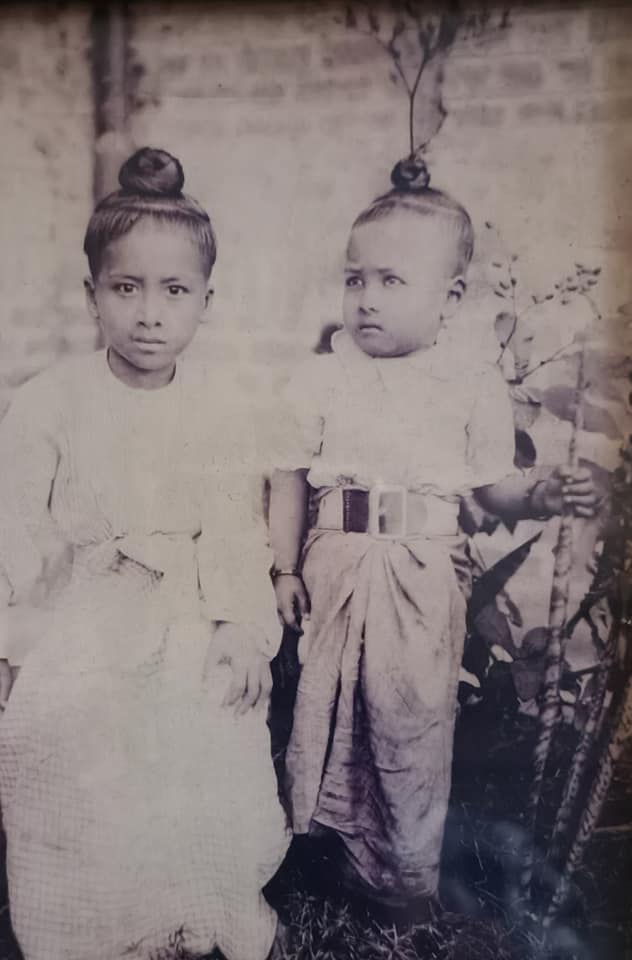
Dr. U Ohn Pe (the elder brother) studied Medicine in India.Medical College was not opened yet in Myanmar in those days. Retired as Director of Malaria, Ministry of Health. Awarded “Wunna Kyaw Htin”
U Khin Maung Gyi (the younger brother) was 3 or 4 years old. He received BA in 1930. He became BCS (Sr. Branch) in 1950. He received BL in 1953.
He had three daughters. The youngest is Daw Mae Khin Nyunt (Rosie Gyi, ChE71). She posted additional photos in the RU Centennial Facebook pages.
There are different ways to classify devices in general, and computers in particular.
Analog, Digital or Hybrid
An analog device is based on measurement or analogy. Examples :
Speedometer
Mercury thermometer
Slide rule
Differential analyzer
A digital device is based on counting or computing. Examples :
Odometer
Electronic digital computer
Digital watch
A hybrid device contains
Analog parts
Digital parts
Converters
Analog to digital converter
Digital to analog converter
Early Computers
Several early computers have names ending with -AC (meaning Automatic Computer). Examples :
EDSAC Built by M V Wilkes and team at Cambridge University
EDVAC Designed by Eckert and Mauchly
UNIVAC Built by Eckert & Mauchly’s company
ILLIAC Built at University of Illinois
SWAC and SEAC Computers for Bureau of Standards
There is no longer need for terms such as Automatic.
Computer Generations
One way to classify computers is by Generation.
Zero Generation : Predates the electronic computers
First Generation : uses Vacuum Tubes
Second Generation Uses Transistors
Third Generation Uses Integrated Circuits
There are extensions for Fourth and Fifth Generations
Computer Types
Another way to classify is
Micro computer
Mini computer
Mainframe
Super computer
Other terms
Portable computer
Hand held computer
Desk top computer
Lap top computer
Network computer
Virtual machine
History
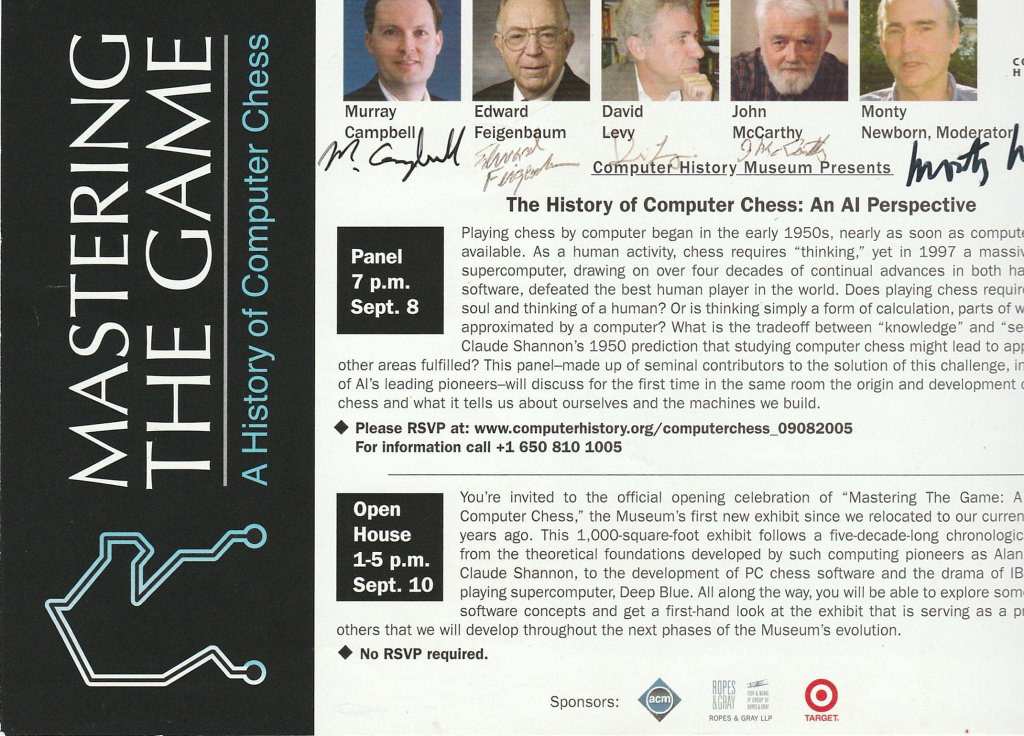
At the Computer History Museum, a visitor was showing his son the Cray-1 (Supercomputer of its time) costing $10+ million. The son asked, “How fast is Cray-1?” The father replied, “Your smart phone and your PC at home are much faster than Cray-1.”
We need to know the history and the context to appreciate the Prime Movers and Early Adopters for their contributions to Science and Technology.
De La Salle Brothers is an Order in the Catholic Church. The mission is to promote education.
A Brother is one who has taken three vows : Chasity Loyalty and Poverty.
De La Salle Schools in Burma
The De La Salle Brothers founded the following schools in Burma.
De La Salle Schools
St. Patrick’s High School in Moulmein
St. Paul’s High Schools in Rangoon
St. Peter’s High School in Mandalay
St. Albert’s High School in Maymyo
St. Joseph’s High School in Loikaw
St. Columban’s High School in Bhamo
De La Salle School in Twante.
B.O.B
Alumni of Brother Schools
The Brothers refer to their former students as Brothers’ Old Boys.
ConBro
Alumni of Convent Schools and Brother Schools in Burma.
Old Paulian
An Old Paulian is an alumni of St. Paul’s High School (SPHS).
OPA is Old Paulians Association.
Old Paulians include
U Tin Tut (first Burmese ICS by invitation)
U Chan Htoon (Politician and law practitioner)
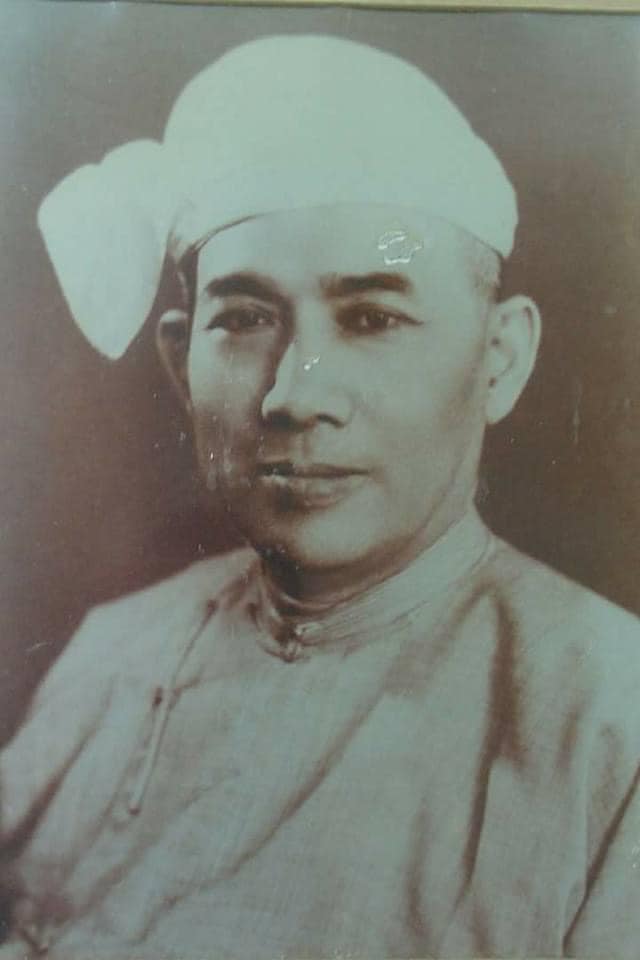
Dr. Ba Han (Compiler of the U Ba Han Dictionary)
Dr. Ba Maw (Adipati)
U Than Aung (Education Minister in AFPFL government)
U Ba Khin (renowned Vipassana teacher and mentor of S. N. Goenka)
Dr. U Ba Than (Rector of IM(1) and founder of Zwe Ah Nyeint)
Father and Son
Saya Sein was our Burmese teacher in high school.
His son Dr. Soe Win stood first in Burma in the Matriculation of 1958. Studied Chemistry Honors Doctorate from Imperial College, University of London. Retired Rector of YUFL.
Honor Roll
SPHS Honor Roll
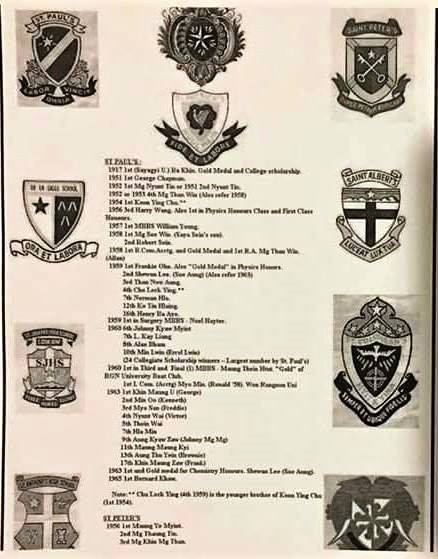
During our school days, St. Paul’s High School displayed an Honor Roll with the outstanding Matriculates starting from the 1950s.
Prior to Honor Roll
Sayagyi U Ba Khin (Vipassana Meditation Teacher) was first in Burma in the Pre-war days.
Honor Roll
The Post-war saw SPHS heading the top list for most academic years. The following stood First in Burma in their Matriculation class.
George Chapman (1951)
Dr, Nyunt Tin (1952)
Koon Yin Chu (1954)
Dr. Soe Win (1958)
Dr. Frankie Ohn (1959)
Dr. Khin Maung U (1963)
After nationalization, the Honor Roll disappeared. It was recovered by a junior Paulian U Soe Nyunt (Taw Win Hnin Si).
Post Honor Roll
Bernard Khaw (1965)
My memories of SPHS
Std. VIII (A)
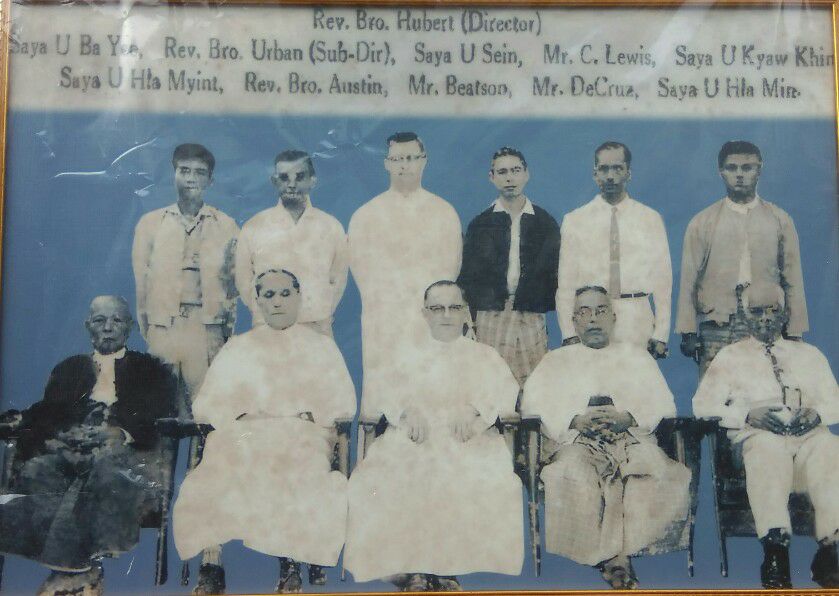
Our teachers include
Brother Felix (Brother Director)
Brother Anthony (Class Teacher)
Brother Xavier
Saya Sein
Saya U Nyunt Maung
Saya Beatson
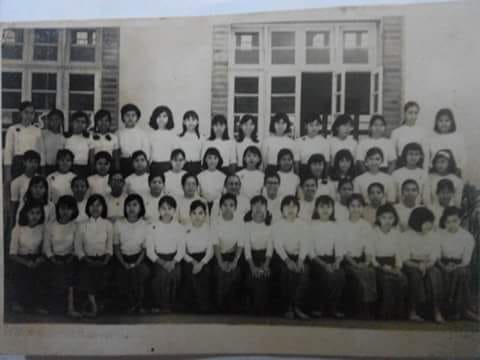
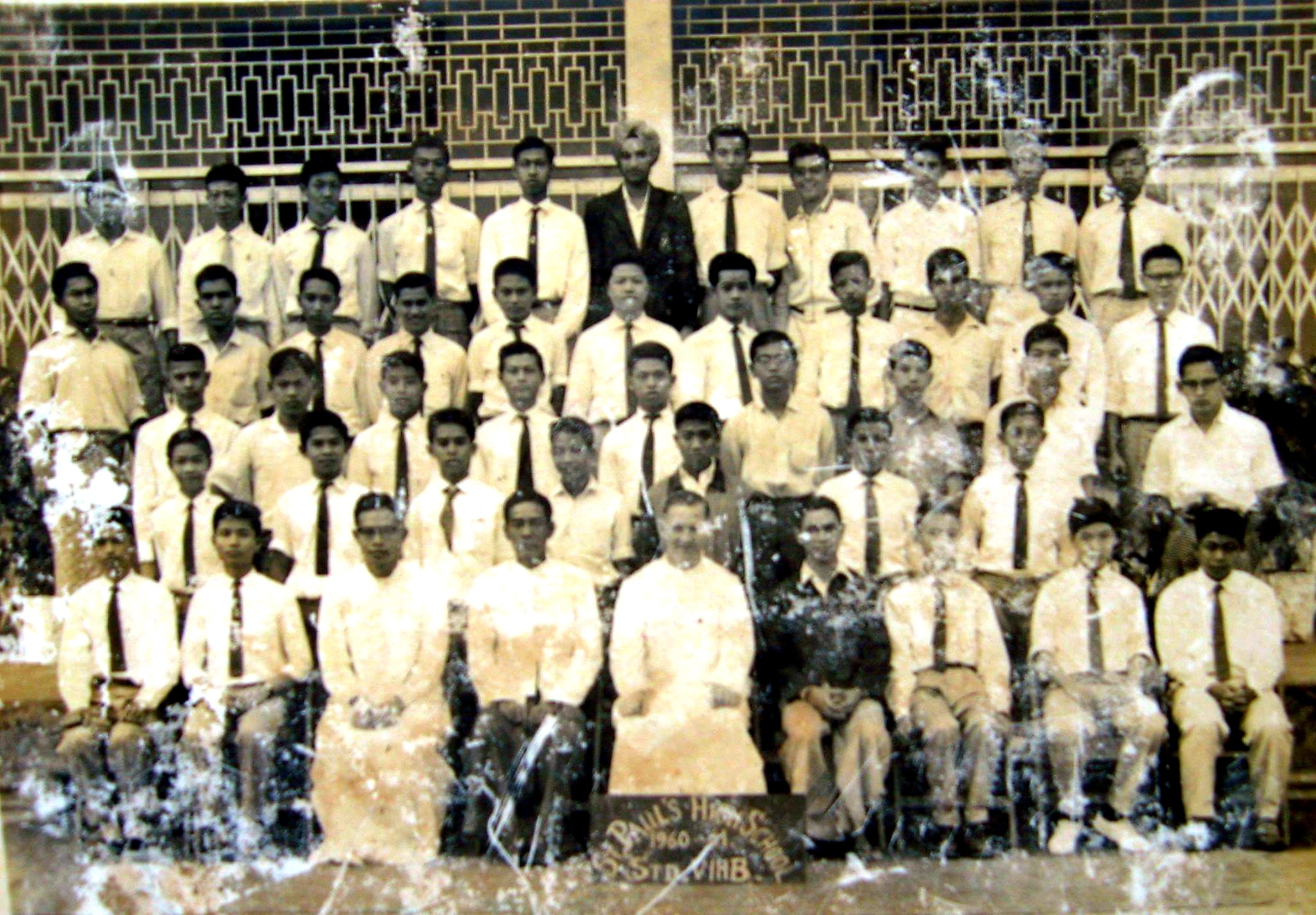
SPHS VIII A
My school mates from Std. VIII(B)
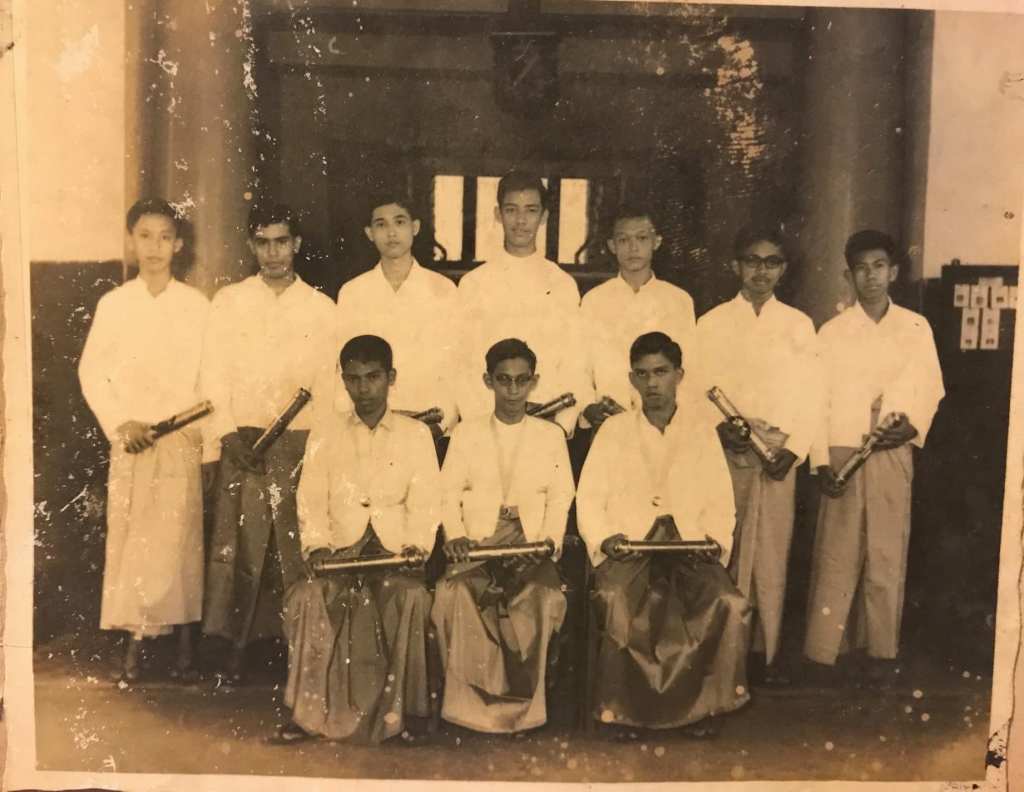
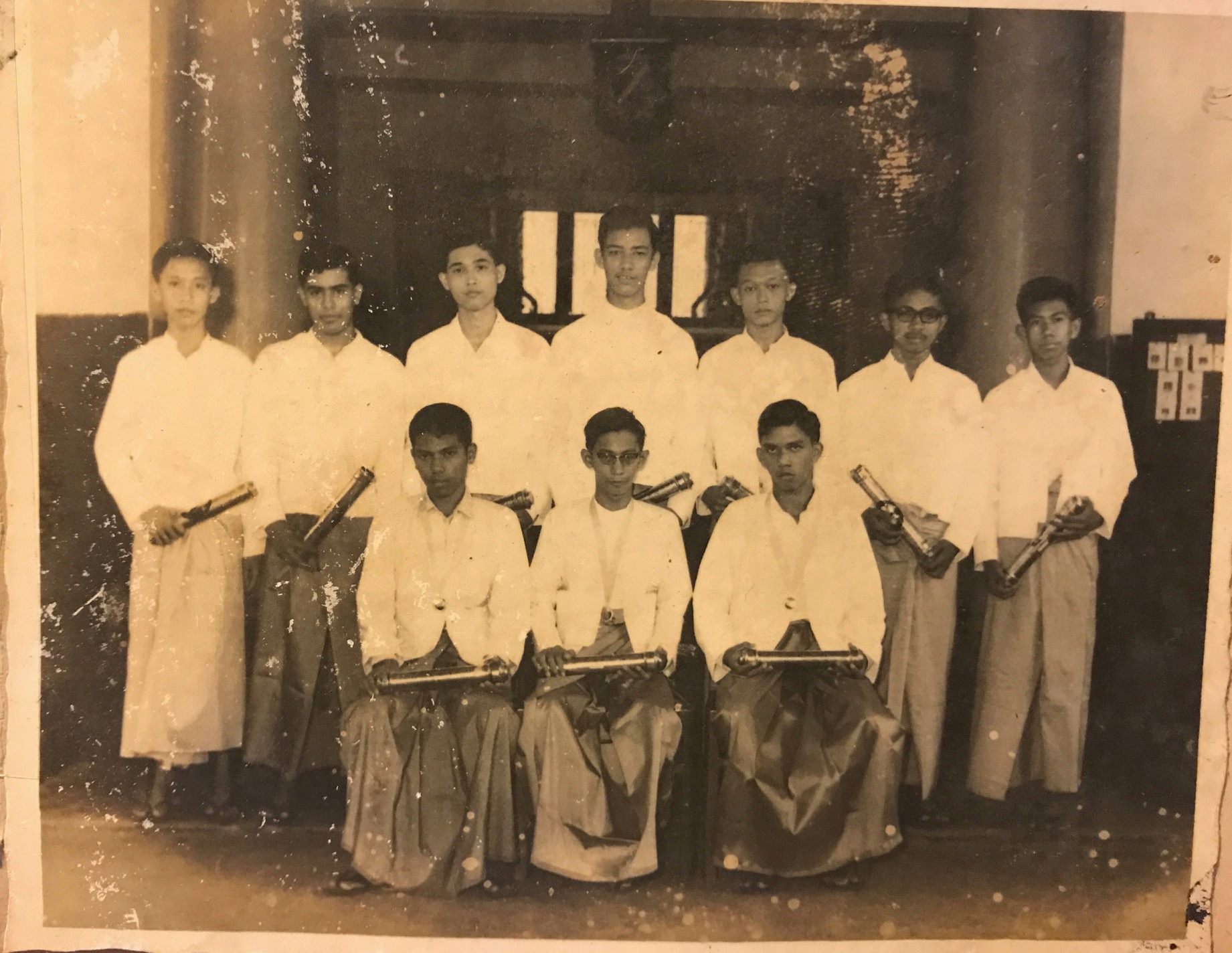
Awards for outstanding Matriculates in 1963
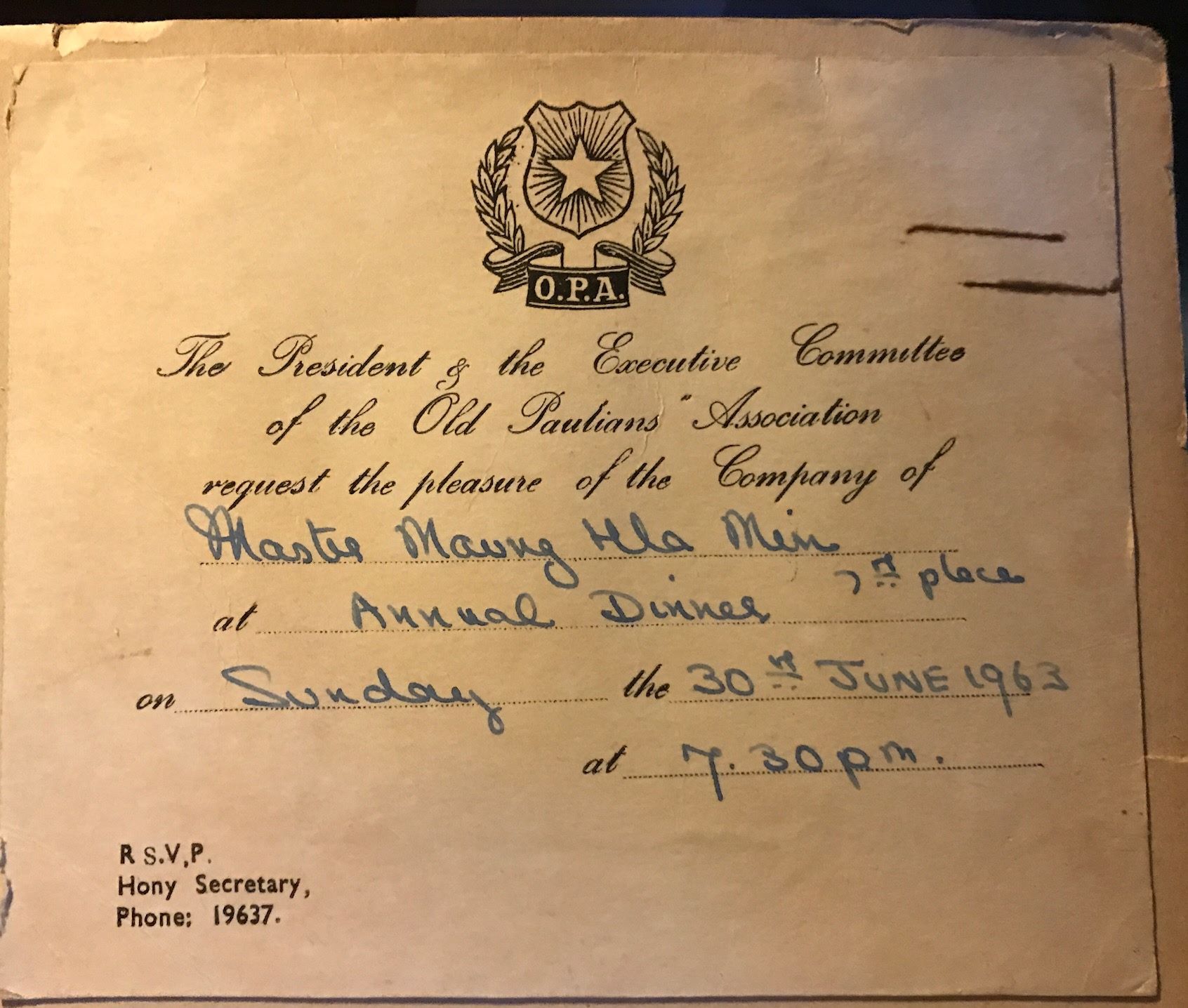
Invitation to the OPA Annual Dinner in 1963
Mini-gathering of SPHS63 in Yangon
Aye Ngwe (Edwin Ngwe)
Kyaw Wynn (Host for his Birthday Dana)
Khin Maung Bo (Alan Saw Maung)
Hla Min
Aung Chaw (Victor Chaw, Uzin Okkantha)
Than Win
Aung Kyi (Arthur Kyi)
Tin Tun
Khin Maung Zaw (Frank Gale)
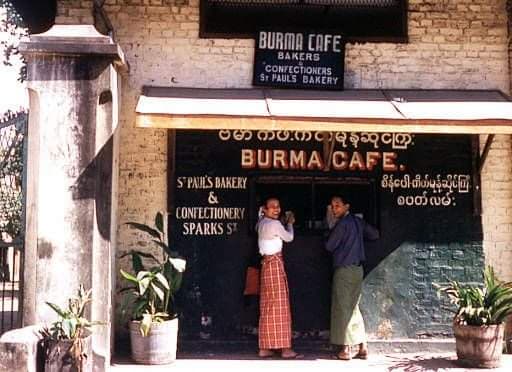
St. Paul’s Bakery and Confectionery
Old Paulian’s Association
During our school days, the Old Paulian Association (OPA) was inside the school compound.
In 1963, ten of us were invited to the Annual OPA Dinner.
Khin Maung U (1st)
Min Oo (2nd)
Myo San (Freddie Ba San, 3rd)
Nyunt Wai (Victor Nyunt, 4th)
Thein Wai (5th)
Hla Min (7th)
Aung Kyaw Zaw (Johnny Maung Maung, 9th)
Maung Maung Kyi (11th)
Aung Thuyein (Brownie Way, 13th)
Khin Maung Zaw (Frank Gale, 17th)
SPHS Sayas and Sayamas
After nationalization, the OPA moved out. Sadly, OPA allowed non-Paulians to “join” for billiards and drinks.
Some joined SPHS from KG. They would know more sayas and sayamas than me.
Some Paulians (mostly SPHS63 – 65) offer Soon to Uzin Beatson at a selected restaurant.
After standing second in 3rd standard at PPBRS (Private Primary Boundary Road School), I transferred to Std. IV (D) at SPHS. As Dr. Thane Oke Kyaw Myint noted, most of the transfer students were placed in Section (D).
Sections (A) and (B) were reserved mostly for the bright students.
I had to be in the Top Two for four consecutive years, before I was assigned to Section (A) in Std. VIII.
My Class Teachers include :
Ms. A Benjamin (IVD)
Mrs. V Boudville (VD)
U Pe Tin (VID)
U Nge (VIID)
Brother Anthony (VIIIA)
Brother Xavier (IXA)
Brother Austin (XA)
Ms. Amelia Kyi (“Miss Hong Kong”) taught us English in VI and VII Standards. She would fine 25 pyas for failing the weekly test. However, she would reward 50 pyas for topping the test. My daily pocket money was 25 pyas.
Brother Xavier taught us English in VIII and IX. He would mark a dictation test starting out with 100 and then subtracting 10 for every spelling error. One of my classmates ended with -130. For some reason, the Albertians said that Brother Xavier stopped being strict after he transferred from St. Paul’s to St. Albert’s.
After Nationalization, Brother Xavier moved back to the UK. He subsequently left the Order.
Brother Austin taught us English in X. He also taught “Morals and Manners” for the period when the Catholic students studied Catechism. He was the School Librarian and also in charge of the 8mm projector. Every week, he would take us to the School Library (which had books donated by Ford Foundation and Asia Foundation), ask us to check out a book and then write a review over the weekend.
For the “Morals and Manners” class, he would ask us to recite poems from the book. The first three who recited perfectly could take “time off for the rest of the period”. I was lucky to win a few special prizes : a ticket to see “1960 Rome Olympics” documentary at Thamada (President) cinema, and a book covering North America (complete with history and atlas).
He abhorred plagiarism. He said, “It’s okay if you did not time to finish your homework. But don’t copy other’s works. It’s a waste of time for you and me.”
Contrary to his expectations, I did not end up in the Top Three.
After Nationalization, Brother Austin moved to a De La Salle School in Malaysia, and continued teaching until his demise.
Saya Sein was our Burmese teacher in High School. He taught us “Mingala Pa Pun Lu Na Ta Tu Ti Sein Ta Ti Ti Mingala” as an example of giving the meaning of Pali words. Saya Sein is the father of Dr. Soe Win (Chemistry, ICST, Retired Principal of UFL)
Saya Kyaw Sein (brother in law of Saya Sein) taught VII(A) and was our relieving teacher.
There were several subject teachers and relieving teachers. They include :
Brother Clementian
Brother Joseph
Saya Beatson
Saya D’Cruz
Saya Nyunt Maung
Saya Htay Myint
Saya Htwe
Saya Lewis
Saya Timms
Saya Kyaw Khin
Saya Johnny Myo
Saya M. Hla Min
Saya Hla Myint
Saya Kyaw Oo
Saya Aye
Saya San Thein
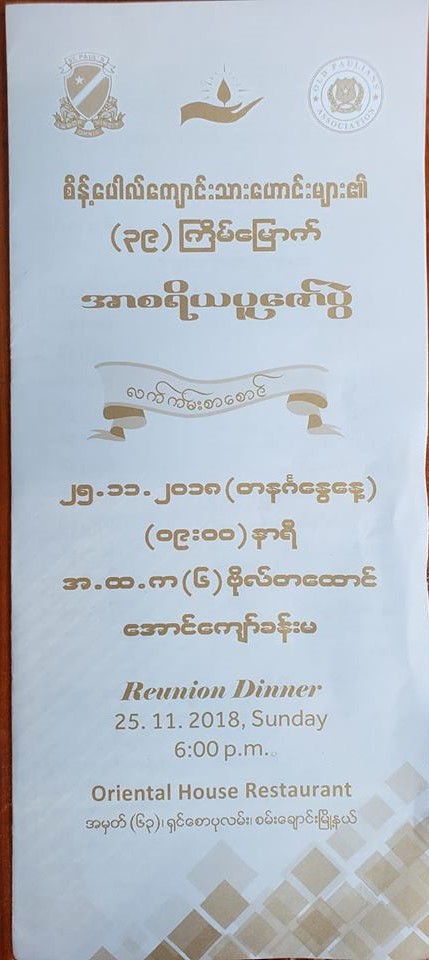
Reunion and Acariya Pu Zaw Pwe
It took some time, before the Old Paulians — mostly from the late 50s and early 60s — took over the OPA and organized Reunions and Acariya Pu Zaw Pwes. OPA also awarded prizes to the children of Old Paulians who had done well academically (mostly in high school).
After Nationalization, St. Paul’s High School was renamed as No. (6) Botahtaung State High School.
The Acariya Pu Zaw Pwes are generally held in “Aung Kyaw Khan Ma (Hall)”.
The Reunion Dinners are held at a selected restaurant.
Among the sayas and sayamas of our times, only Saya Beatson (now Uzin) remains.
Some Old Paulians (from SPHS63 – 65) occasionally offer Soon to Uzin Beatson.
Trilingual Dictionary (e.g Pali, English & French)
Scrabble Dictionary
Crossword Puzzle Dictionary
Rhyming Dictionary
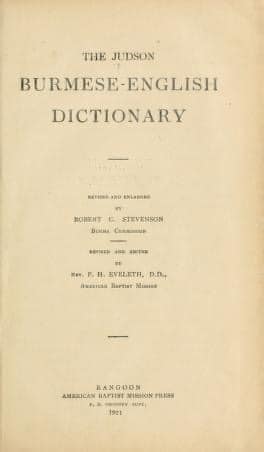
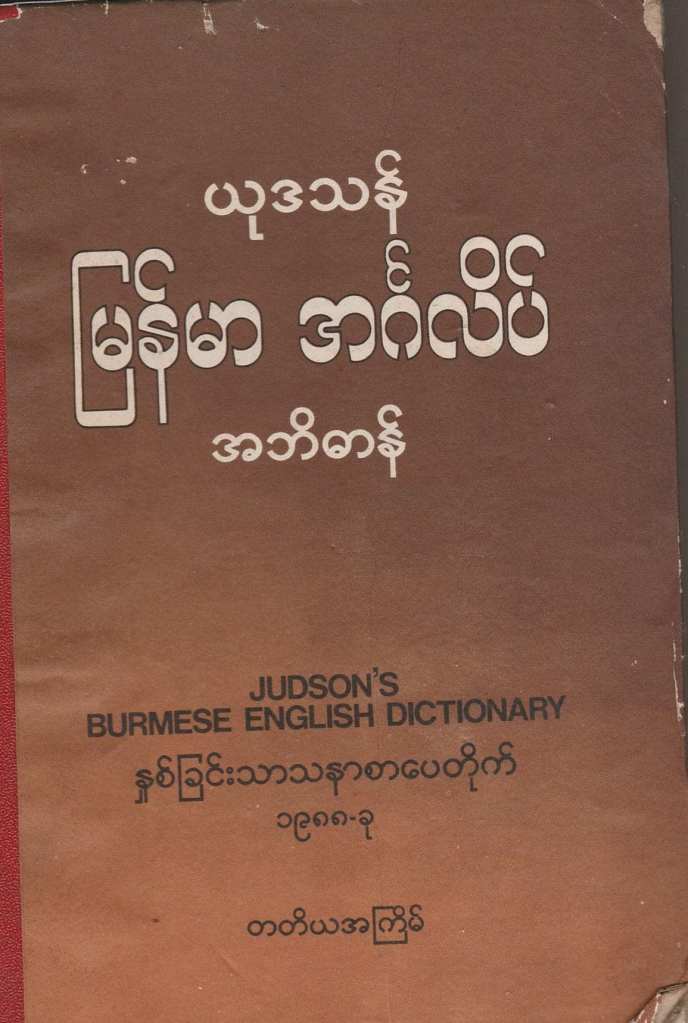
English to Burmese Dictionary (e.g. Judson)
Burmese to English Dictionary (e.g. Judson)
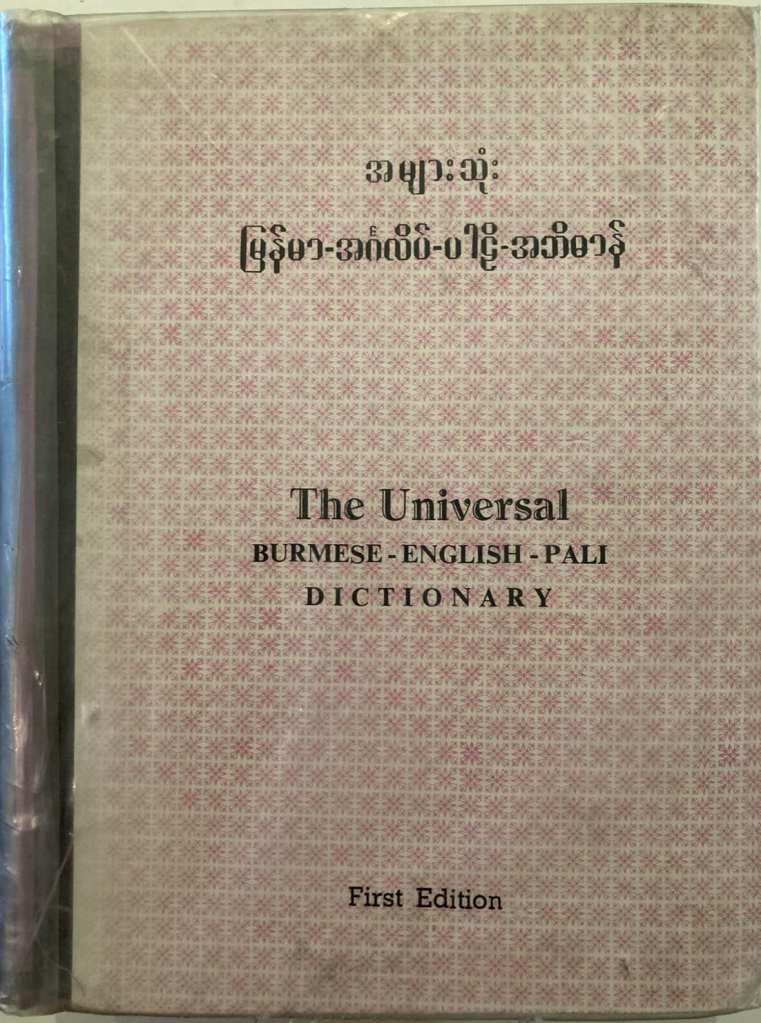
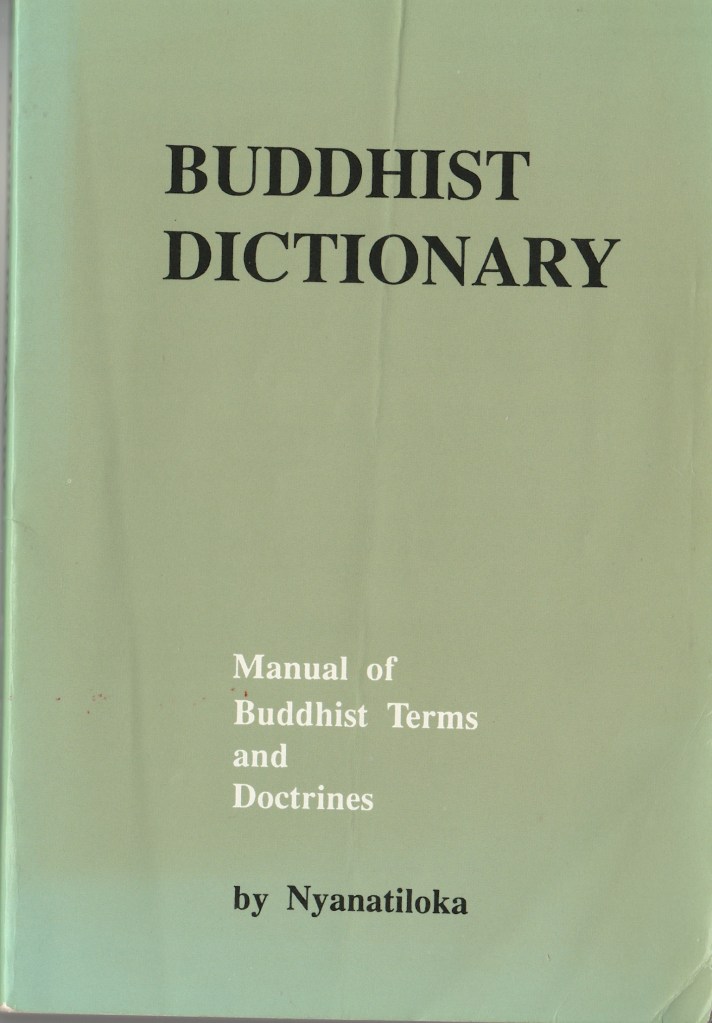
Pali-English, Pali-Burmese and Pali-English-Burmese Dictionary
Coverage
A dictionary may cover
meaning
usage
etymology (origin and evolution) of words
synonyms
antonyms
Usage
One looks up a dictionary when one knows the word but is not sure of its meaning and usage.
One looks up a thesaurus when one has an idea or concept but needs to choose an appropriate word from a list of synonyms and antonyms. Dr. Mark Roget compiled a thesaurus based on his classification scheme.
Visual Dictionary and Visual Thesaurus allows one to see the relations and links of words and concepts.
With the advent of computers and Internet, dictionaries are provided in most Word Processing Systems.
Vocabulary
An early study said that an average person learns about 20 new words every year.
By subscribing to “Word of the Day” from Merriam-Webster or by listening to “Word for the Wise” from NPR (National Public Radio), one can learn 300+ new words every year.
Lexicon
The old dictionaries are also known as Lexicon. The compilers are known as Lexicographers.
Lexicon is an early card game for building words. Scrabble is a later and more popular word forming game. The word challenge in Scrabble is processed using a Dictionary (e.g. Chambers or Jones’ Pronouncing Dictionary).














 HlaMin