There are different ways to classify devices in general, and computers in particular.
Analog, Digital or Hybrid
An analog device is based on measurement or analogy. Examples :
Speedometer
Mercury thermometer
Slide rule
Differential analyzer
A digital device is based on counting or computing. Examples :
Odometer
Electronic digital computer
Digital watch
A hybrid device contains
Analog parts
Digital parts
Converters
Analog to digital converter
Digital to analog converter
Early Computers
Several early computers have names ending with -AC (meaning Automatic Computer). Examples :
EDSAC Built by M V Wilkes and team at Cambridge University
EDVAC Designed by Eckert and Mauchly
UNIVAC Built by Eckert & Mauchly’s company
ILLIAC Built at University of Illinois
SWAC and SEAC Computers for Bureau of Standards
There is no longer need for terms such as Automatic.
Computer Generations
One way to classify computers is by Generation.
Zero Generation : Predates the electronic computers
First Generation : uses Vacuum Tubes
Second Generation Uses Transistors
Third Generation Uses Integrated Circuits
There are extensions for Fourth and Fifth Generations
Computer Types
Another way to classify is
Micro computer
Mini computer
Mainframe
Super computer
Other terms
Portable computer
Hand held computer
Desk top computer
Lap top computer
Network computer
Virtual machine
History
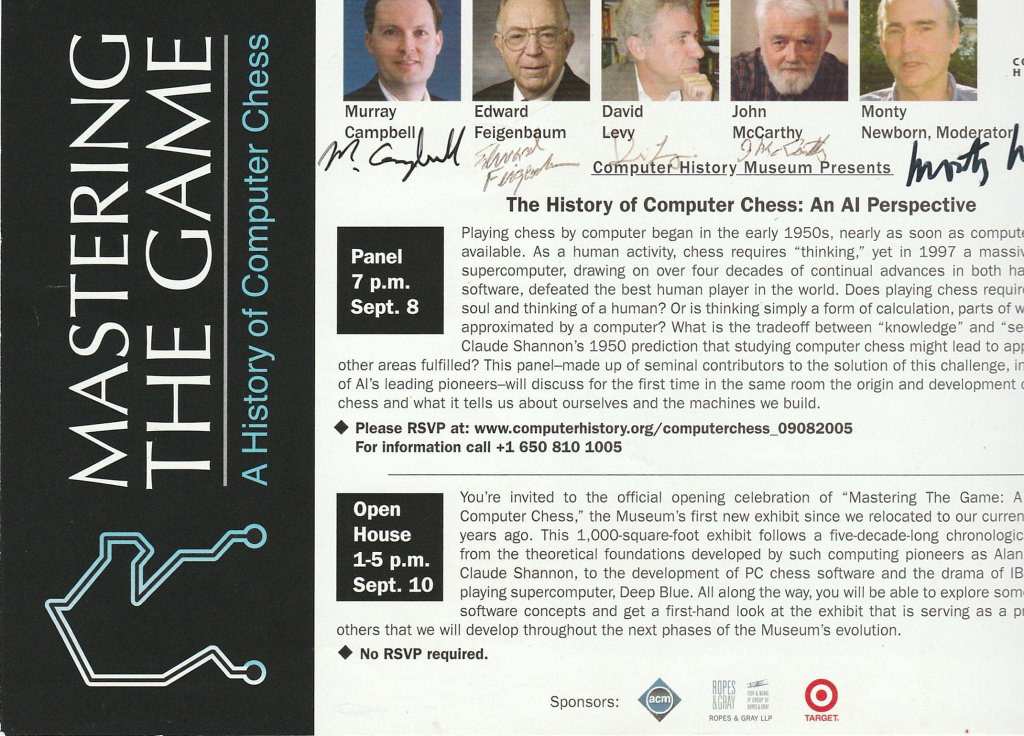
At the Computer History Museum, a visitor was showing his son the Cray-1 (Supercomputer of its time) costing $10+ million. The son asked, “How fast is Cray-1?” The father replied, “Your smart phone and your PC at home are much faster than Cray-1.”
We need to know the history and the context to appreciate the Prime Movers and Early Adopters for their contributions to Science and Technology.
De La Salle Brothers is an Order in the Catholic Church. The mission is to promote education.
A Brother is one who has taken three vows : Chasity Loyalty and Poverty.
De La Salle Schools in Burma
The De La Salle Brothers founded the following schools in Burma.
De La Salle Schools
St. Patrick’s High School in Moulmein
St. Paul’s High Schools in Rangoon
St. Peter’s High School in Mandalay
St. Albert’s High School in Maymyo
St. Joseph’s High School in Loikaw
St. Columban’s High School in Bhamo
De La Salle School in Twante.
B.O.B
Alumni of Brother Schools
The Brothers refer to their former students as Brothers’ Old Boys.
ConBro
Alumni of Convent Schools and Brother Schools in Burma.
Old Paulian
An Old Paulian is an alumni of St. Paul’s High School (SPHS).
OPA is Old Paulians Association.
Old Paulians include
U Tin Tut (first Burmese ICS by invitation)
U Chan Htoon (Politician and law practitioner)
Dr. Ba Han (Compiler of the U Ba Han Dictionary)
Dr. Ba Maw (Adipati)
U Than Aung (Education Minister in AFPFL government)
U Ba Khin (renowned Vipassana teacher and mentor of S. N. Goenka)
Dr. U Ba Than (Rector of IM(1) and founder of Zwe Ah Nyeint)
Father and Son
Saya Sein was our Burmese teacher in high school.
His son Dr. Soe Win stood first in Burma in the Matriculation of 1958. Studied Chemistry Honors Doctorate from Imperial College, University of London. Retired Rector of YUFL.
Honor Roll
SPHS Honor Roll
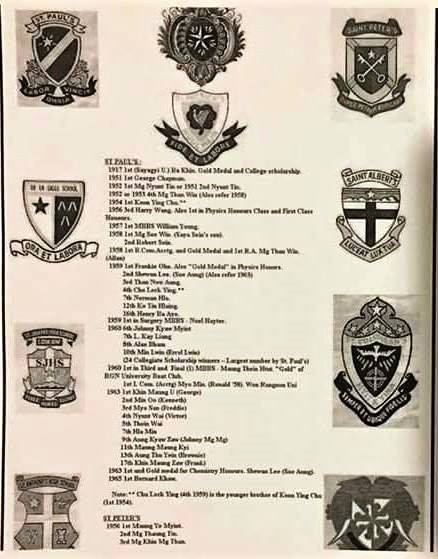
During our school days, St. Paul’s High School displayed an Honor Roll with the outstanding Matriculates starting from the 1950s.
Prior to Honor Roll
Sayagyi U Ba Khin (Vipassana Meditation Teacher) was first in Burma in the Pre-war days.
Honor Roll
The Post-war saw SPHS heading the top list for most academic years. The following stood First in Burma in their Matriculation class.
George Chapman (1951)
Dr, Nyunt Tin (1952)
Koon Yin Chu (1954)
Dr. Soe Win (1958)
Dr. Frankie Ohn (1959)
Dr. Khin Maung U (1963)
After nationalization, the Honor Roll disappeared. It was recovered by a junior Paulian U Soe Nyunt (Taw Win Hnin Si).
Post Honor Roll
Bernard Khaw (1965)
My memories of SPHS
Std. VIII (A)
Our teachers include
Brother Felix (Brother Director)
Brother Anthony (Class Teacher)
Brother Xavier
Saya Sein
Saya U Nyunt Maung
Saya Beatson
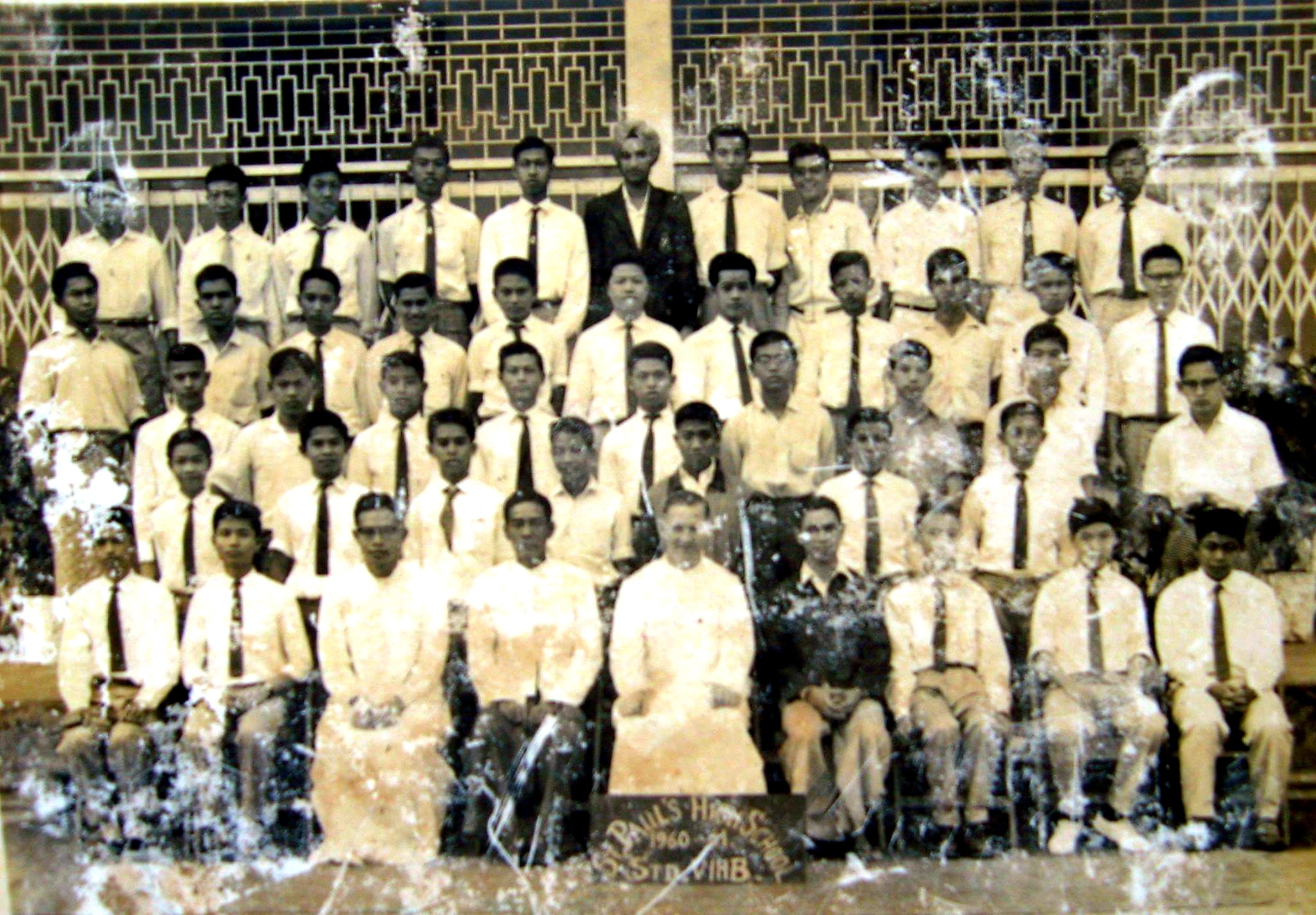
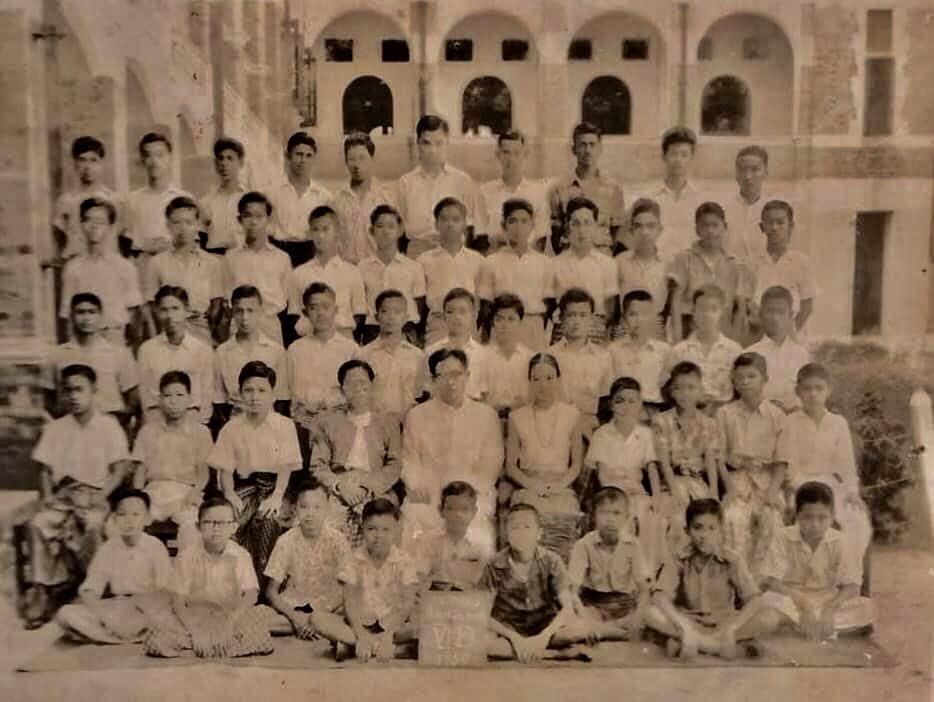
SPHS VIII A
My school mates from Std. VIII(B)
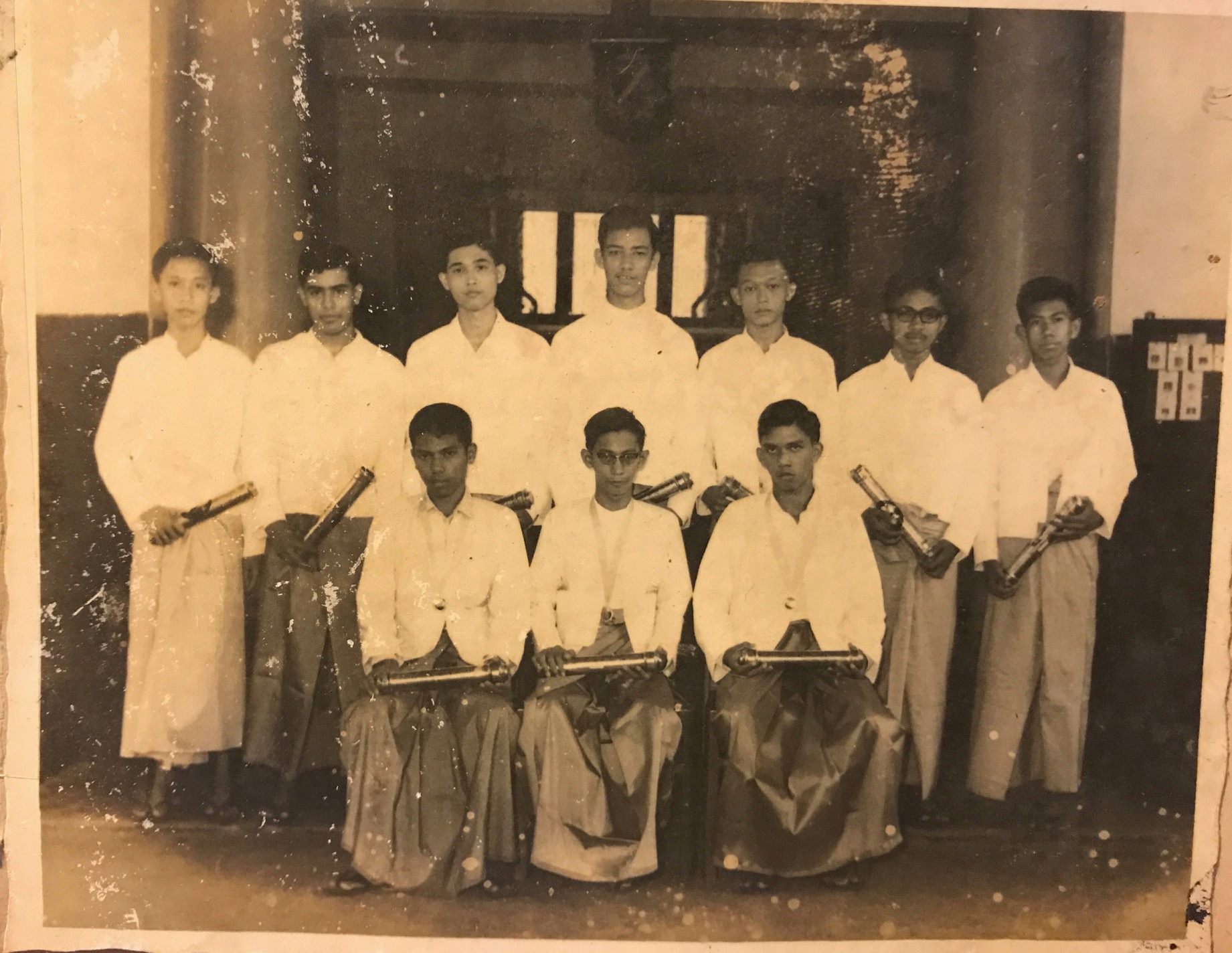
Awards for outstanding Matriculates in 1963
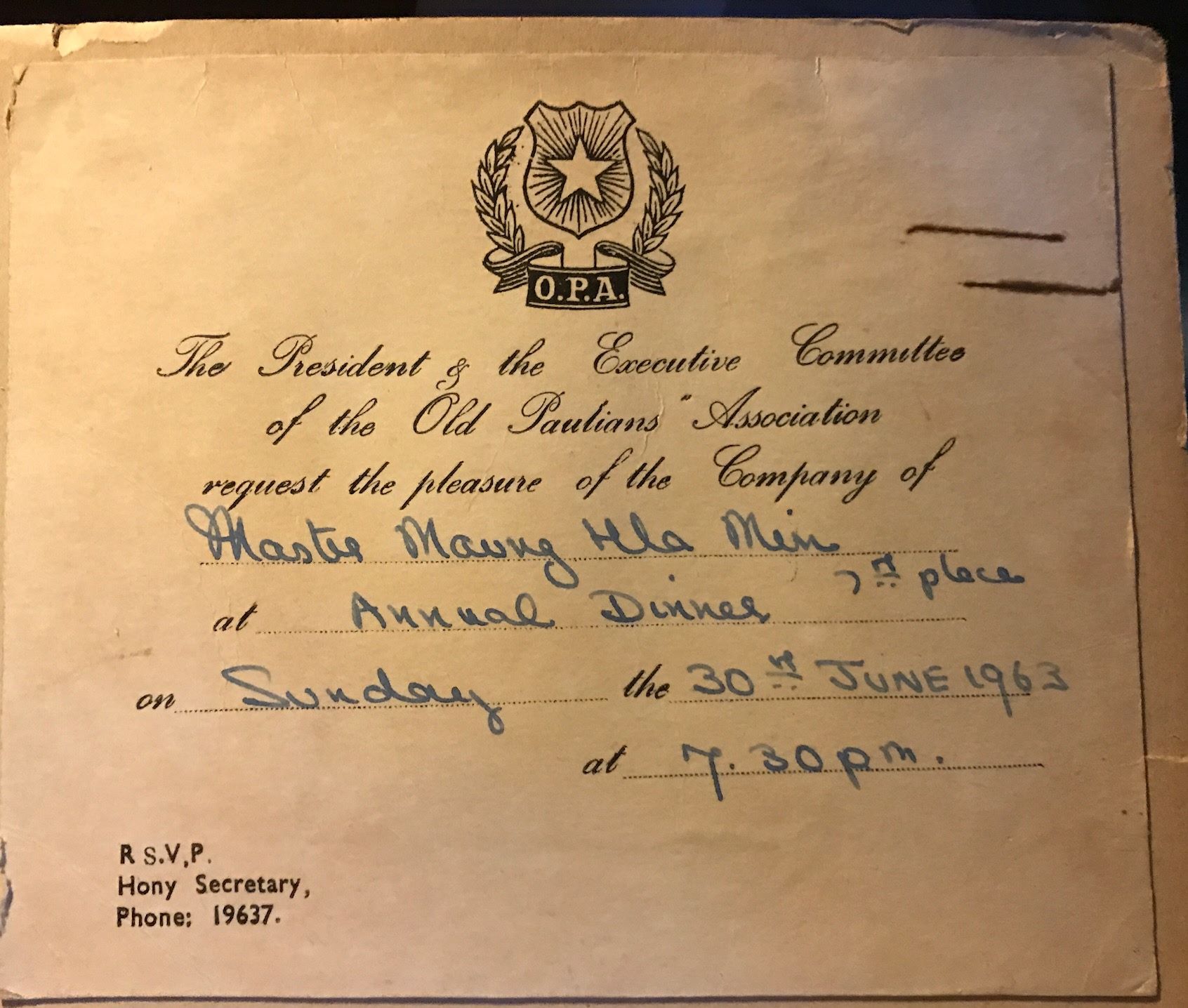
Invitation to the OPA Annual Dinner in 1963
Mini-gathering of SPHS63 in Yangon
Aye Ngwe (Edwin Ngwe)
Kyaw Wynn (Host for his Birthday Dana)
Khin Maung Bo (Alan Saw Maung)
Hla Min
Aung Chaw (Victor Chaw, Uzin Okkantha)
Than Win
Aung Kyi (Arthur Kyi)
Tin Tun
Khin Maung Zaw (Frank Gale)
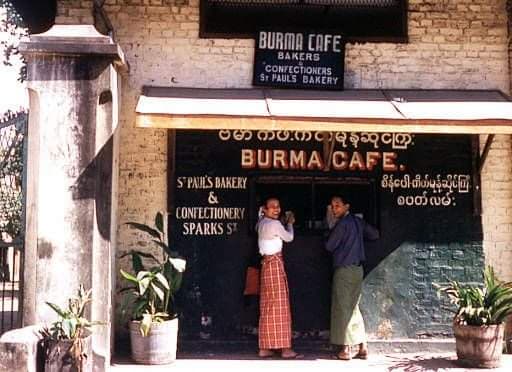
St. Paul’s Bakery and Confectionery
Old Paulian’s Association
During our school days, the Old Paulian Association (OPA) was inside the school compound.
In 1963, ten of us were invited to the Annual OPA Dinner.
Khin Maung U (1st)
Min Oo (2nd)
Myo San (Freddie Ba San, 3rd)
Nyunt Wai (Victor Nyunt, 4th)
Thein Wai (5th)
Hla Min (7th)
Aung Kyaw Zaw (Johnny Maung Maung, 9th)
Maung Maung Kyi (11th)
Aung Thuyein (Brownie Way, 13th)
Khin Maung Zaw (Frank Gale, 17th)
SPHS Sayas and Sayamas
After nationalization, the OPA moved out. Sadly, OPA allowed non-Paulians to “join” for billiards and drinks.
Some joined SPHS from KG. They would know more sayas and sayamas than me.
Some Paulians (mostly SPHS63 – 65) offer Soon to Uzin Beatson at a selected restaurant.
After standing second in 3rd standard at PPBRS (Private Primary Boundary Road School), I transferred to Std. IV (D) at SPHS. As Dr. Thane Oke Kyaw Myint noted, most of the transfer students were placed in Section (D).
Sections (A) and (B) were reserved mostly for the bright students.
I had to be in the Top Two for four consecutive years, before I was assigned to Section (A) in Std. VIII.
My Class Teachers include :
Ms. A Benjamin (IVD)
Mrs. V Boudville (VD)
U Pe Tin (VID)
U Nge (VIID)
Brother Anthony (VIIIA)
Brother Xavier (IXA)
Brother Austin (XA)
Ms. Amelia Kyi (“Miss Hong Kong”) taught us English in VI and VII Standards. She would fine 25 pyas for failing the weekly test. However, she would reward 50 pyas for topping the test. My daily pocket money was 25 pyas.
Brother Xavier taught us English in VIII and IX. He would mark a dictation test starting out with 100 and then subtracting 10 for every spelling error. One of my classmates ended with -130. For some reason, the Albertians said that Brother Xavier stopped being strict after he transferred from St. Paul’s to St. Albert’s.
After Nationalization, Brother Xavier moved back to the UK. He subsequently left the Order.
Brother Austin taught us English in X. He also taught “Morals and Manners” for the period when the Catholic students studied Catechism. He was the School Librarian and also in charge of the 8mm projector. Every week, he would take us to the School Library (which had books donated by Ford Foundation and Asia Foundation), ask us to check out a book and then write a review over the weekend.
For the “Morals and Manners” class, he would ask us to recite poems from the book. The first three who recited perfectly could take “time off for the rest of the period”. I was lucky to win a few special prizes : a ticket to see “1960 Rome Olympics” documentary at Thamada (President) cinema, and a book covering North America (complete with history and atlas).
He abhorred plagiarism. He said, “It’s okay if you did not time to finish your homework. But don’t copy other’s works. It’s a waste of time for you and me.”
Contrary to his expectations, I did not end up in the Top Three.
After Nationalization, Brother Austin moved to a De La Salle School in Malaysia, and continued teaching until his demise.
Saya Sein was our Burmese teacher in High School. He taught us “Mingala Pa Pun Lu Na Ta Tu Ti Sein Ta Ti Ti Mingala” as an example of giving the meaning of Pali words. Saya Sein is the father of Dr. Soe Win (Chemistry, ICST, Retired Principal of UFL)
Saya Kyaw Sein (brother in law of Saya Sein) taught VII(A) and was our relieving teacher.
There were several subject teachers and relieving teachers. They include :
Brother Clementian
Brother Joseph
Saya Beatson
Saya D’Cruz
Saya Nyunt Maung
Saya Htay Myint
Saya Htwe
Saya Lewis
Saya Timms
Saya Kyaw Khin
Saya Johnny Myo
Saya M. Hla Min
Saya Hla Myint
Saya Kyaw Oo
Saya Aye
Saya San Thein
Reunion and Acariya Pu Zaw Pwe
It took some time, before the Old Paulians — mostly from the late 50s and early 60s — took over the OPA and organized Reunions and Acariya Pu Zaw Pwes. OPA also awarded prizes to the children of Old Paulians who had done well academically (mostly in high school).
After Nationalization, St. Paul’s High School was renamed as No. (6) Botahtaung State High School.
The Acariya Pu Zaw Pwes are generally held in “Aung Kyaw Khan Ma (Hall)”.
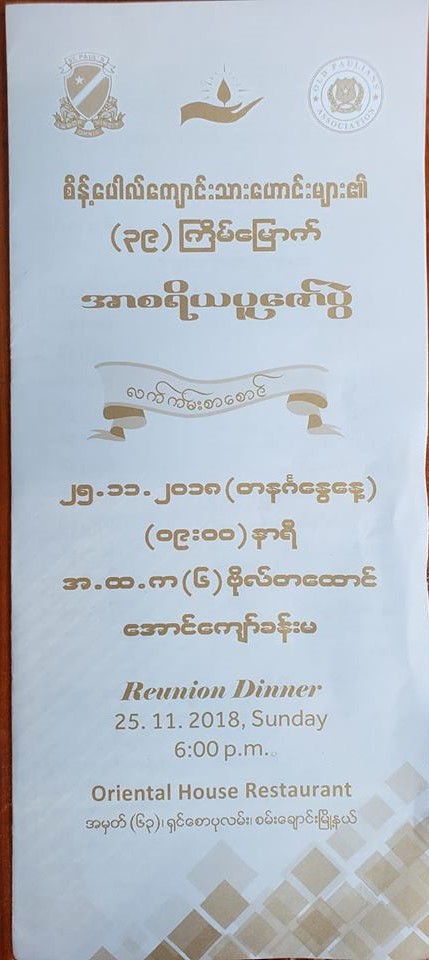
The Reunion Dinners are held at a selected restaurant.
Among the sayas and sayamas of our times, only Saya Beatson (now Uzin) remains.
Some Old Paulians (from SPHS63 – 65) occasionally offer Soon to Uzin Beatson.
Trilingual Dictionary (e.g Pali, English & French)
Scrabble Dictionary
Crossword Puzzle Dictionary
Rhyming Dictionary
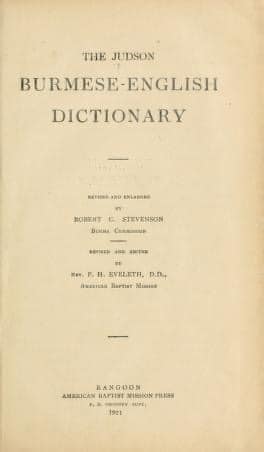
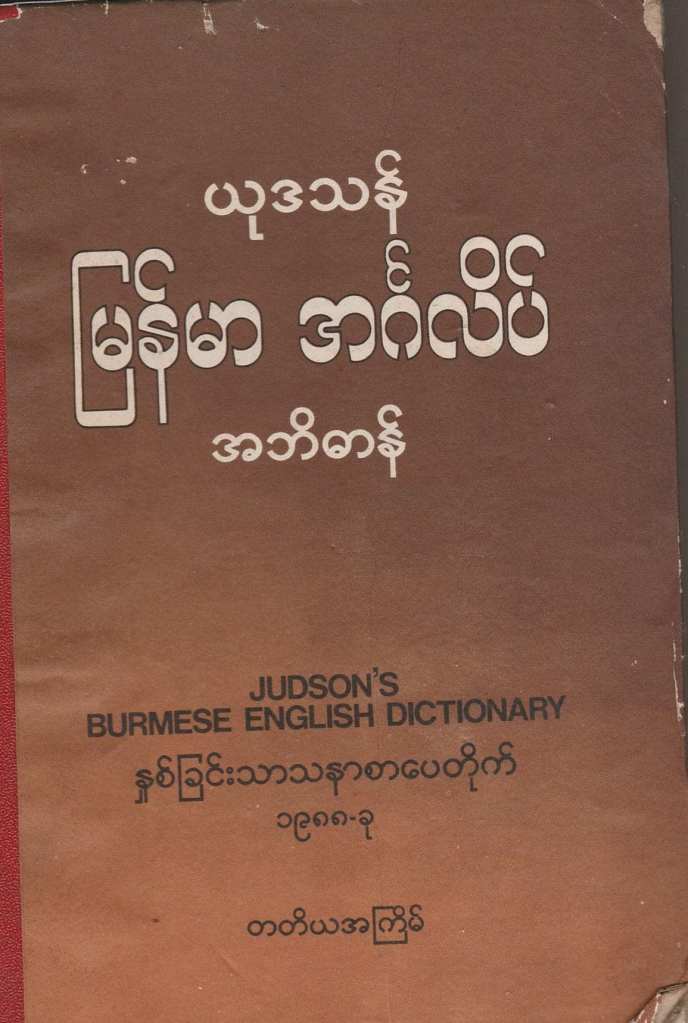
English to Burmese Dictionary (e.g. Judson)
Burmese to English Dictionary (e.g. Judson)
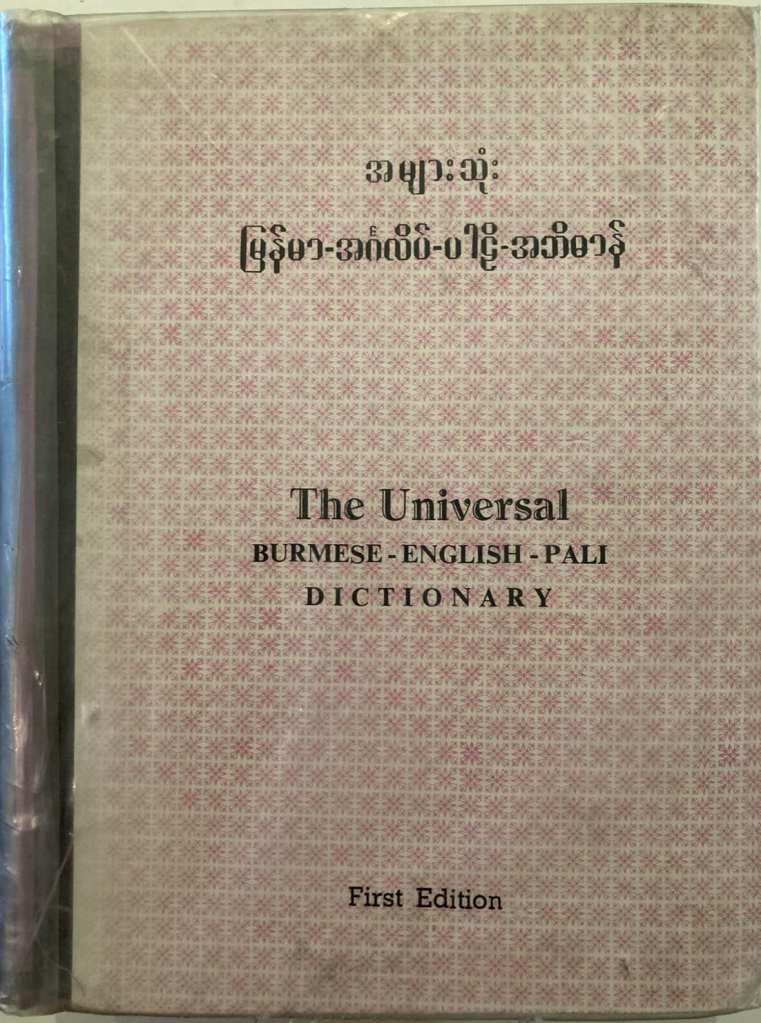
Pali-English, Pali-Burmese and Pali-English-Burmese Dictionary
Coverage
A dictionary may cover
meaning
usage
etymology (origin and evolution) of words
synonyms
antonyms
Usage
One looks up a dictionary when one knows the word but is not sure of its meaning and usage.
One looks up a thesaurus when one has an idea or concept but needs to choose an appropriate word from a list of synonyms and antonyms. Dr. Mark Roget compiled a thesaurus based on his classification scheme.
Visual Dictionary and Visual Thesaurus allows one to see the relations and links of words and concepts.
With the advent of computers and Internet, dictionaries are provided in most Word Processing Systems.
Vocabulary
An early study said that an average person learns about 20 new words every year.
By subscribing to “Word of the Day” from Merriam-Webster or by listening to “Word for the Wise” from NPR (National Public Radio), one can learn 300+ new words every year.
Lexicon
The old dictionaries are also known as Lexicon. The compilers are known as Lexicographers.
Lexicon is an early card game for building words. Scrabble is a later and more popular word forming game. The word challenge in Scrabble is processed using a Dictionary (e.g. Chambers or Jones’ Pronouncing Dictionary).
It is an Order — founded by St. John Baptist De La Salle — in the Catholic Church.
A Brother has to take three vows:
Chasity
Loyalty
Poverty
The mission of the Brothers is to promote Education.
De La Salle Schools in Burma
De La Salle Schools
St. Patrick’s High School (Moulmein)
St. Paul’s High School (Rangoon)
St. Peter’s High School (Mandalay)
St. Albert’s High School (Maymyo)
St. Joseph’s High School (Loikaw)
St. Columban’s High School (Bhamo)
De La Salle School (Twante)
Old Paulians
They include
ICS U Tin Tut
U Tin Tut
U Chan Htoon
Dr. Ba Han
Dr. Ba Han
Dr. Ba Maw
H.E. U Than Aung
Vipassa Sayagyi U Ba Khin
SPHS Honor Roll
During our school days, St. Paul’s High School displayed an Honor Roll with the outstanding Matriculates starting from the 1950s.
Sayagyi U Ba Khin stood First in Matriculation in the Pre-war days.
The Post-war saw SPHS heading the top list for most academic years. The following stood First in Burma in their Matriculation class.
George Chapman (1951)
Dr. Nyunt Tin (1952)
Koon Yin Chu (1954)
Dr. Soe Win (1958) — heading the Top Two
Dr. Frankie Ohn (1959) — heading the Top Four
Dr. Khin Maung U (1963) — heading the Top Five
After nationalization, the Honor Roll disappeared.
It was recovered by Ko Soe Nyunt (Taw Win Hnin Si, SPHS66).
Old Paulian’s Association
During our school days, the Old Paulian Association (OPA) was inside the school compound.
SPHS63OPA Invitation
In 1963, ten of us were invited to the Annual OPA Dinner.
Khin Maung U (1st)
Min Oo (2nd)
Myo San (Freddie Ba San, 3rd, GBNF)
Nyunt Wai (Victor Nyunt, 4th)
Thein Wai (5th)
Hla Min (7th)
Aung Kyaw Zaw (Johnny Maung Maung, 9th)
Maung Maung Kyi (11th, GBNF)
Aung Thuyein (Brownie Way, 13th, GBNF)
Khin Maung Zaw (Frank Gale, 17th)
After nationalization, the OPA moved out. Sadly, OPA allowed non-Paulians to “join” for billiards and drinks.
It took some time, before the Old Paulians — mostly from the late 50s and early 60s — took over the OPA and organized Reunions and Acariya Pu Zaw Pwes. OPA also awarded prizes to the children of Old Paulians who had done well academically (mostly in high school).
OPA held Acariya Pu Zaw Pwes yearly.
Pu Zaw Pwe Invitation
SPHS Sayas and Sayamas
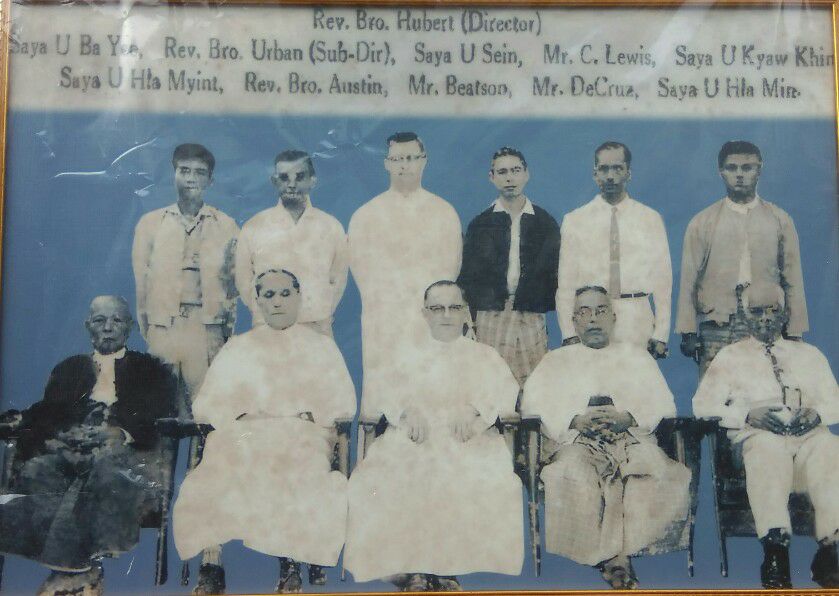
SPHS Brothers & Sayas
Some joined SPHS from KG. They would know more sayas and sayamas than me.
After standing second in 3rd standard at PPBRS (Private Primary Boundary Road School), I transferred to Std. IV (D) at SPHS. As Dr. Thane Oke Kyaw Myint noted, most of the transfer students were placed in Section (D).
Sections (A) and (B) were reserved mostly for the bright students.
I had to be in the Top Two for four consecutive years, before I was assigned to Section (A) in Std. VIII.
My Class Teachers include :
Ms. A Benjamin (IVD)
Mrs. V Boudville (VD)
U Pe Tin (VID)
U Nge (VIID)
Brother Anthony (VIIIA)
Brother Xavier (IXA)
Brother Austin (XA)
Ms. Amelia Kyi (“Miss Hong Kong”) taught us English in VI and VII Standards. She would fine 25 pyas for failing the weekly test. However, she would reward 50 pyas for topping the test. My daily pocket money was 25 pyas.
Brother Xavier taught us English in VIII and IX. He would mark a dictation test starting out with 100 and then subtracting 10 for every spelling error. One of my classmates ended with -130. For some reason, the Albertians said that Brother Xavier stopped being strict after he transferred from St. Paul’s to St. Albert’s.
After Nationalization, Brother Xavier moved back to the UK. He subsequently left the Order.
Brother Austin taught us English in X. He also taught “Morals and Manners” for the period when the Catholic students studied Catechism. He was the School Librarian and also in charge of the 8mm projector. Every week, he would take us to the School Library (which had books donated by Ford Foundation and Asia Foundation), ask us to check out a book and then write a review over the weekend.
For the “Morals and Manners” class, he would ask us to recite poems from the book. The first three who recited perfectly could take “time off for the rest of the period”. I was lucky to win a few special prizes : a ticket to see “1960 Rome Olympics” documentary at Thamada (President) cinema, and a book covering North America (complete with history and atlas).
He abhorred plagiarism. He said, “It’s okay if you did not time to finish your homework. But don’t copy other’s works. It’s a waste of time for you and me.”
Contrary to his expectations, I did not end up in the Top Three.
After Nationalization, Brother Austin moved to a De La Salle School in Malaysia, and continued teaching until his demise.
Saya Sein was our Burmese teacher in High School. He taught us “Mingala Pa Pun Lu Na Ta Tu Ti Sein Ta Ti Ti Mingala” as an example of giving the meaning of Pali words. Saya Sein is the father of Dr. Soe Win (Chemistry, ICST, Retired Principal of UFL)
Saya Kyaw Sein (brother in law of Saya Sein) taught VII(A) and was our relieving teacher.
There were several subject teachers and relieving teachers. They include :
My cousin Daw Myint Thwe was celebrating her birthday on July 19, 1947 when the sad news were announced. The birthday celebration was put on hold.
Arzanis
Time (or rather a clock) stood still at 10:37 AM on July 19, 1947.
Seven Cabinet Ministers led by Bogoke Aung San, a Cabinet Secretary and a body guard were mercilessly gunned down. Eight perished on July 19, 1947. Mongpawn Sawbwa passed away on July 20, 1947.
Bogyoke Aung San
Thakin Mya
Deedok U Ba Cho
Mahn Ba Khine
Sao San Htun (Mongpawn Sawbwa)
U Ba Win
U Razak
ICS U Ohn Maung
Yebaw Ko Htwe
Bogyoke Aung San
There were several politicians named “U Mya”. Thakin Mya was a leader of an AFPFL faction. He was a “Minister without Portfolio” and was regarded as an unofficial Deputy Prime Minister.
U Razak and his body guard Yebaw Ko Htwe received their last rites according to their faith.
The remaining seven were honored at the Jubilee Hall before being moved to Arzani Gon near Shwe Dagon Pagoda.
In our younger days, we walked to Shwe Dagon Pagoda on Saturdays.
Martyrs’ Mausoleum
We would occasionally stop by at the “Arzani Beikman” (Martyrs’ Mausoleum). Nine Oke Gu’s were on display. Four each flanked Bogyoke’s Oke Gu.
We noticed that there were two tombs in the vicinity: one for U Tin Tut and one for Bo Sein Hman. Only recently did I learn about the “Empty Tomb” of U Tin Tut, Bagyee of Dr. Thane Oke Kyaw Myint.
ICS U Tin Tut
Lucky Ones?
Two ministers (U Tin Tut and U Kyaw Nyein) did not attend the meeting. on July 19, 1947.
According to “Phaw Kaung Ba Nyunt”, he could not find U Nu (Speaker of the Chamber of Deputies) at his office.
A few ministers (such as Pagan U Ba Gyan and U Aung Zan Wai) who were seated at the “far side” of the meeting table escaped.
U Ba Gyan is the elder brother of U Ba Shan (Secretary of the Mathematics Curriculum Committee, and father of Ko Boe Ba Shan [ex-UCC]).
U Aung Zan Wai was a signer of the Panlong Agreement.
Some Relatives
Ma Nge (Nge Ma Ma Than, ex-UCC, daughter of U Aung Than) lost two uncles : U Ba Win and Bogyoke Aung San.
Sayama Daw Myint Myint Khaing (Maths) lost her father Mahn Ba Khaing.
Ma Khin Myint Cho lost her grand father Deedoke U Ba Cho. She invited us to a soon kwyay on one Arzani Nay.
Saya U Tin Maung Thein (EE62) lost his father U Ohn Maung. Bogyoke asked U Ohn Maung for a presentation after the Cabinet Meeting.
U Tin Myint (GBBF) and U Hla Kyi (sons of U Razak) were RUBC members.
MongPawn Sawbwa Sao San Htun died in the hospital on July 20, 1947. San Hso Holm (“Sawbwa Lay”, his son, was an Old Paulian, an RUBC Green and winner of the Senior Novices crew coxed by Saya U Tin Htut, a scholar (English Honors (First Class) and two Law degrees), and an excellent writer. The Sawbwas requested his legal services. He was detained on March 2, 1962. After serving in the Education Ministry, he and his family migrated to Australia. His wife (sister of Saya Sao Kan Gyi) published an “autobiography”.
New Mausoleum
The “attempted massacre of Chung Doo Wan and his party” was carried out by three North Korean agents.
One set of bombs did not go off and thus spared the lives of the Burmese contingent. U Soe Minn (son of Dr. Tha Minn — dentist in our younger days) was on duty as Deputy Director of Myanmar Ah Than TV. He was hit by shrapnel, but he survived. The award winning Kyemon reporter, who “switched” duties, was killed.
The “new” Arzani Beikman would not have a roof.
The nine tombs would be transformed into a monolithic “Gu”.
The families of the fallen leaders (e.g. Sayama Daw Myint Myint Khine) would not be invited to State functions and dinners.
Top tier leaders are no longer mandated to attend Arzani Day. Second tier leaders would show up as a token of respect for the fallen leaders.
The public would have little or no access to the ceremonies.
Trust
Did Bogyoke trust his people too much?
Reports that 200 Bren Guns were stolen from COD (Central Ordinance Depot) did not move the administration to beef up security at the Secretariat (Ah Twin Wun Yone).
In contrast, the former No. 1 would have three (or more) layers of security personnel. He would not eat anything that has not been tasted by his loyal chef.
Dots
There are some other dots that need to be connected. There are some rumors that need to be substantiated.
Galon U Saw
U Saw was a former Prime Minister of Burma. He prefixed his name with “Galon” to display his high esteem for Saya San and the Galon Troup.
During the Second World War, he was detained in Uganda. A head reader supposedly cautioned U Saw that “every person he had met with that kind of head ended up in the gallows”.
U Saw has hopes and inspirations to return to power in Burma. He presumably had the covert support of some Conservative Party leaders and members who disliked Bogyoke Aung San.
U Saw was hit in or near the eye by a sharpshooter (supposedly Yangon Ba Swe). This caused U Saw to hold a grudge against Bogyoke and AFPFL.
Smuggled Guns
Around 2007, several Classified Documents in the UK passed the moratorium period.
Those documents became a basis of the BBC Documentary “Who really killed Aung San?”
According to those documents, the British smuggled Captain Vivian, the man who gave U Saw 200 Bren guns and then misinformed the press that he had died in action. Captain Vivian “died naturally sometime ago in his native Wales”.
The Martyrs died from Sten Gun shots. The cache of Bren Guns were found in U Saw’s compound. The weapons added intrigue.
Books and Articles
The old newspapers cover Arzani Nay in somewhat detail.
Bogyoke’s body guards include Natmauk Phone Kyaw (writer) and Bo Tun Hla (Tekkatho Nay Win, writer and actor).
I used to read the articles by Tekkatho Nay Win.
Dr. Maung Maung wrote a book on the Trial.
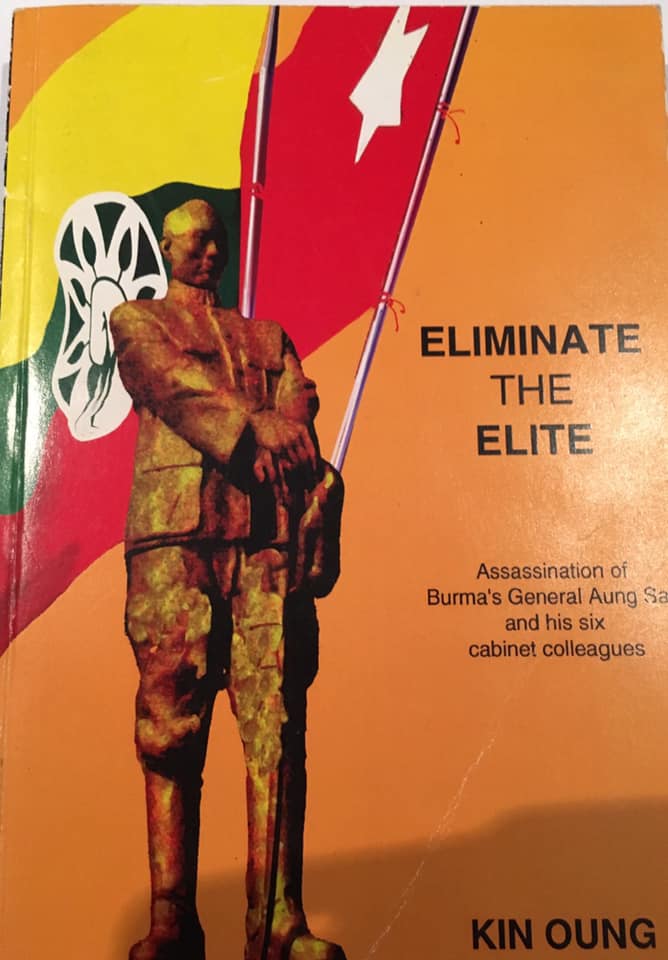
A few years back, I read the book “Who killed Aung San?” by Kin Oung (former Naval Officer living in Australia). His father U Tun Hla Oung “arrested” Galon U Saw and his father-in-law U Thaung Sein (as Secretary of Insein Prison) “kept watch of” U Saw so that U Saw and his team can be “tried” by a Special Tribunal headed by U Kyaw Myint (father of Dr. Thane Oke Kyaw Myint).
At one time, the public was “barred” from paying respect, and those who tried were detained.
I did not have a chance to read the revised versions of the book.
Book by Kin Oung
I also saw the BBC’s production titled, “Who really killed Aung San?”
Grudge?
Several noted that the then Number One never attended the ceremonies. A few hinted that he was a member of the Thakin Ba Sein faction of AFPFL and had some “grudges” for those from the Thakin Mya faction. He was supposedly having fun with the Derby every July in UK.
Ken Olson and several other MIT alumni founded DEC (Digital Equipment Corporate).
Supposedly, there was a protocol in government departments to purchase computers. In order to circumvent that, DEC named their mini-computers as PDP (Programmable Digital Processors).
CHM
CHM (Computer History Museum) has a PDP-1 on display. Retired DEC engineers restored a PDP-1. The exhibit has demos : one for play a “primitive” Space War game, another for “playing” music …
PDP
PDP-8 is a 12-bit mini-computer used in many universities of that period.
PDP-11 is a 16-bit mini-computer. UCC acquired it.
PDP 11/70
VT-101 (or similar) terminals became the “new” mode of entering and running programs.
VAX
DEC later introduced VAX (Virtual Address eXtended) series.
Gordon Bell was the VAX architect and co-author of the book using CMS (Computer Memory System) and formal methods to describe and evaluate computer systems. The artifacts that he collected for the book project were displayed in DEC as BCM (Boston Computer Museum) with Gwen Bell as the Curator. It later became CHM (Computer History Museum) in Mountain View, California.
Docent
I volunteered as a Docent for CHM for two years.
I gave guided tours (for 45 minutes to an hour).
One child asked his father how fast the 10 Million Dollar computer (Cray 1) was. The reply, “It’s slower than your PC and your smart phone”.
U Khin Maung Zaw (KMZ) wrote :
It was a shame that DEC/VAX/VMS did not take off well as some people hoped. Fortunately, Bill Gates hired VAX/VMS main architect Dave Cutler in 1988, who brought many of his team from DEC, 20+ as reported, as part of the hiring agreement of Dave Cutler.
Dave Cutler and his team developed Windows NT, New Technology – a 64bit OS, and the rest is history. He has his hands on RedDot, which be came Microsoft Azure.
Dr. Mark Russinovich, received his doctorate in 1989 from Carnegie Mellon, developed a very popular Windows utility suite called ‘SysInternals’ with his partner. This was a godsend for all Windows Systems Engineers, a Swiss Army Knife, if you will. He also had a short stint at IBM, he also wrote a series of articles comparing Windows NT with VMS?? in Windows Internals magazine. Microsoft eventually acquired the SysInternals, Mark included. Mark is now CTO of Microsoft Azure.
The astronomers studied and mapped the space objects such as stars and comets first with the naked eye and then with the help of telescopes (optical, radio, …).
Before the advent of the communication satellites and GPS (Global Positioning System), seafarers had to rely on their knowledge of astronomy for navigation.
Greenwich is known for its observatory and the adoption of GMT (Greenwich Mean Time). UCT (Universal Coordinated Time) is now preferred.
Edmund Halley is an Astronomer Royal known for the discovery of Halley’s comet. Mark Twain’s birth and death coincided with the two visits of Halley’s comet.
AstroPhysics and AstroBiology are some disciplines using Astronomy.
Astronomy Sayas
U Ba Min
He matriculated from SPHS in 1956.
He joined the Mathematics Department.
He received MS in Mathematics and Astronomy at the University of California at Berkeley in the USA.
He resigned citing medical reasons when he was transferred to Myitkyina College.
He opened a shop in Mandalay Zay Gyo. One day, a group of Japanese visited his shop. They were surprised to learn that U Ba Min was a classmate of their Professor back in the USA, They took a photo to show to their professor.
U Min Wun (Civil, GBNF)
He retired as Professor from RIT.
He is well versed in both Western and Eastern Astronomy.
He is a founding member of BARB. He served as Vice President.
He was an Advisor for the Myanmar Pyet Gs Dein မြန်မာ ပြက္ခဒိန် Committee
U Min Wun
U Aye Win Kyaw (C70, GBNF)
He is a founding member of BARB. He was an EC member & Teacher.
He taught Astronomy at BARB & MARB.
U Aye Win Kyaw (Center)
U Soe Min
He received State Scholarship to study Astronomy in the USA.
He taught Astronomy at RASU Mathematics Department. His assistant was Saya U Sein Win.
Reading, (W)riting and (A)rithmetic were the Three R’s.
Burmese version is Ah Thone Lone (for Ah Phut, Ah Yay and Ah Twet.
Had to study some subjects in English and Burmese.
Texts
Our elders used the textbook by Workman.
We use the book by U Pann Yi (who adapted/translated Workman’s book).
Rapid Mental Calculation
During our younger days, there was an Indian lady who could do large calculations in her head.
There was Trachtenberg’s method of rapid mental calculation. To keep his sanity in a prison, Tratchenberg developed a method to perform arithmetic operations quickly.
Short cuts
Before the advent of calculators and computers, it was advantageous to learn some short cuts.
(a) To find the square of a number ending in five.
(b) use “Casting out the nines” to check if multiplication is correct.
It follows from “Modulo Arithmetic”.
A number, which is a power of 10, when divided by 9 gives a remainder of 1.
Abacus
Some use abacus. There are several variations.
(a) Most abacus has two sets of bead : Two beads (with a weight of 5) Five beads (with a weight of 1) (b) Some use less beads : One bead (with a weight of 5) Four beads (with a weight of 1) (c) Currently, some after-school classes in the USA teach abacus
Computational Aids
Mechanical, electro-mechanical and electronic calculators became computational aids. The early calculators were beaten by a proficient abacus user.
There are 100+ varieties of apples. Most are eaten fresh. Some are eaten as salad. Some are cooked or made into pie or sauce.
Grannie Smith was chosen by the Beatles for the logo of their company “Apple Records”.
Steve Wozniak (“Woz”) and Steve Jobs formed “Apple” Company to market their Apple computers.
“Apple” Company was sued by “Apple Records” for copyright infringement. The judge said that it was okay to use the name Apple for two different domains : computers and music. The judge might be surprised to learn that several decades later, Apple computers are playing Beatles albums on iTunes.
Steve Jobs named another product as “Macintosh”. In British English, Macintosh is a rain coat. McIntosh is an apple.
There used to be a grocery chain called “Apple Tree” and a restaurant chain called “Apple Bee”.
There are words and phrases like Adam’s apple, the apple of my eye, and apple pie order.
It is probable that Adam and Eve ate apple in the Garden of Eden. The Hebrew scriptures simply mention the “forbidden fruit”.
Sir Isaac Newton was in an apple orchard when he discovered the law of gravity. It is not sure if an apple fell on his head. He noticed that apples fall vertically to the ground. He asked himself why the moon did not fall to the earth.
Both men and women have Adam’s apple, but men have larger, distinctive ones.
















 HlaMin