Category: RU

  • SEAP Games

    Second SEAP Games

    • Burma hosted the Second SEAP games in 1961.
    • About twenty Rangoon University students represented Burma in the games.
      They include:
      Tun Mra, Kyaw Mra, Soe Mra and Tun Naung — Track and Field
      Kyaw Han — Volleyball
      Than Lwin and Mu Mu Khin — Tennis
      Richard Yu Khin — Yachting
      Aye Kyaw and Derek Lynsdale — Swimming

    Fifth SEAP Games

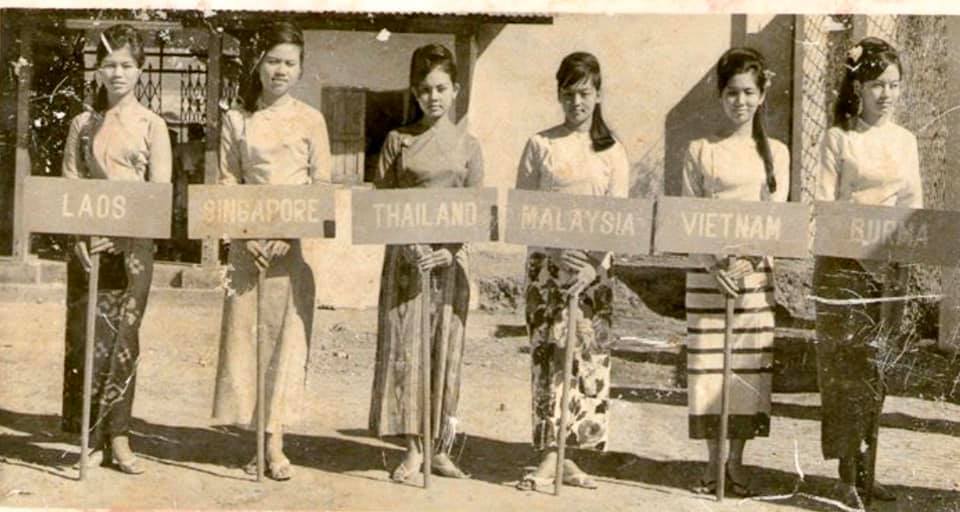
    • Burma also hosted the Fifth SEAP Games in 1969.
    • [Nyunt Nyunt Tin] : I was in the 7th standard at Myoma National High School (Rangoon) and participated Kabyaluk dance.
      The team of 400 high school girl students danced Kabyaluk at the opening ceremony. Never forget, ever.

    Six belles held the signs for the competing nations (visitors in alphabetical order followed by the host nation).

    • Laos
    • Singapore
    • Thailand
    • Malaysia
    • Vietnam
    • Burma
    Sign bearers for Fifth SEAP Games
  • RU 7

    • RU Convocation
    • RU Rectors
    • RU Registrars

    RU Convocation

    • The Prime Minister of the Union of Burma attended Convocations as Chancellor of the University.
    • Pro Chancellor, Vice Chancellor, Pro Vice Chancellor also attended Convocations. Their roles are described in “Order of Procedure”.
    • Some dignitaries receive honorary degrees.
    • Prizes (medals, books) were awarded to outstanding students (graduates and some undergraduates)
    • Related posts
      1958 Convocation
      Visits
    Convocation
    This image has an empty alt attribute; its file name is ru1958convcover-page-001.jpg
    Convocation in 1958

    RU Rectors

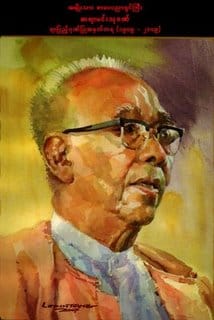
    • Dr. Htin Aung (First native Rector)
      Retired as Vice Chancellor
      Outstanding author
    • Dr. Hla Myint
      Economist and Educator
    • U Kar
      Served as Minister in the Caretaker Government
    • Dr. Tha Hla
      Geologist
      Retired from United Nations
    • Dr. Maung Maung Kha
      Meteorological Physicist
      Longest tenure among the Rectors

    RU Registrars

    • U Htin Si
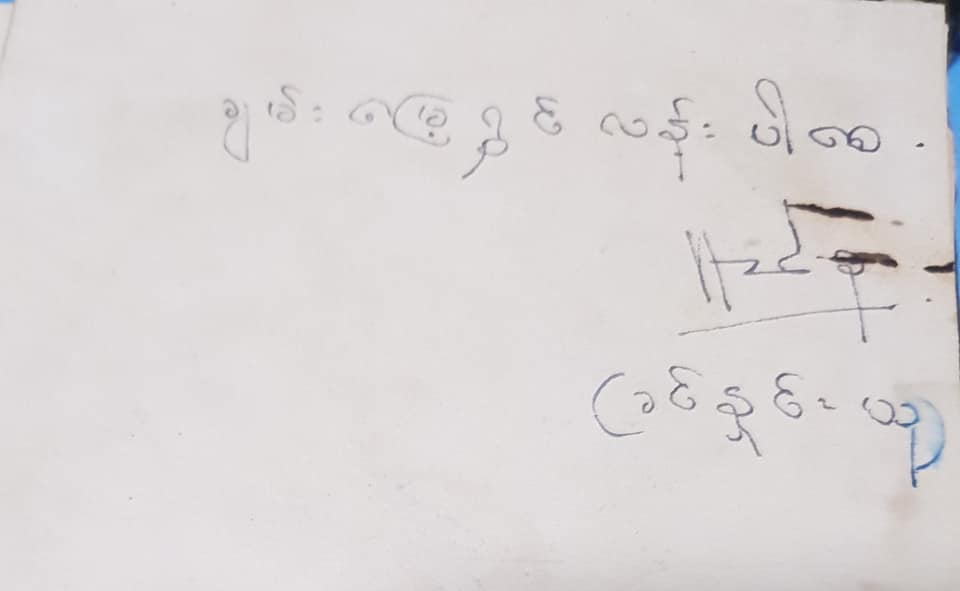
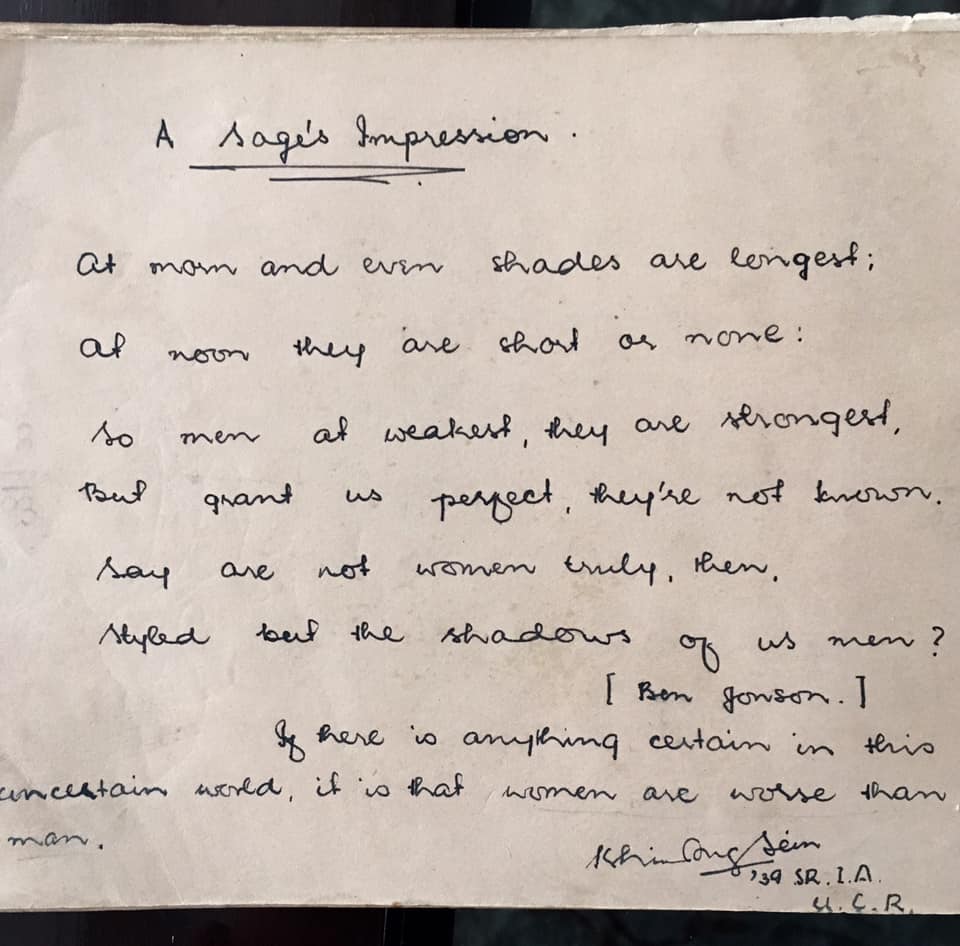
    • U Yu Khin
      Earlier served as Dean, Chair of RU Sports Council
      After retirement, helped found IFL (Institute of Foreign Languages)
    • Daw Sein Sein
      Retired as Director, Ministry of Education
  • Khit San Sar Pay Founders

    The three co-founders were were the early students of Sayagyi U Pe Maung Tin (Pali and Burmese Scholar) at the then newly established “Burmese Department” at the Rangoon University.

    • Theikpan Maung Wa
      (ICS U Sein Tin)
    • Zawgyi
      (U Thein Han)
    • Minthuwun
      (U Wun)
    This image has an empty alt attribute; its file name is minthuwun.jpg
    U Wun
  • RU Donors

    RU Library Donor

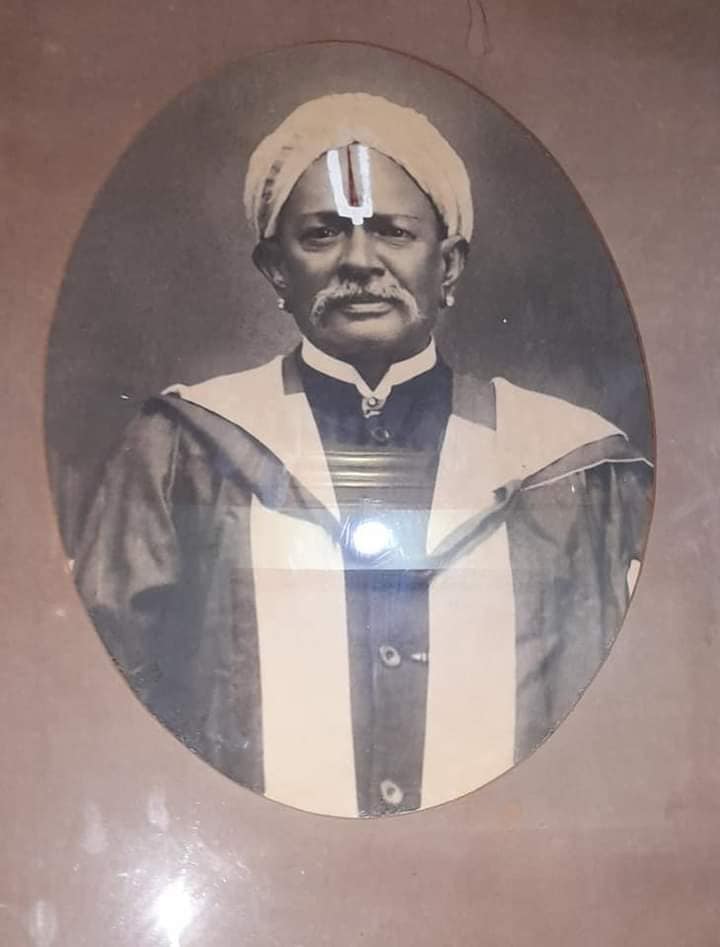
    Raja Dr. S. Ramanatha Reddiar(b. 1871-1932) L.L.D.(Honoris Causa), F.R.U

    Other donors

    • U Nyo (RUSU Building, RUBC Club House and several in the RU Estate)
    • Chan Chor Khine (son of Chan Mah Phee and Daw Aye Mya) donated for the RU Gymnasium
    • Sir Arthur Eggar (Law Professor) pledged a third of his salary for the operation of RUBC
  • Mya Kyun Nyo Nyo

    • Maung Ngwe Hlinne is the pen name of Saya U Thet Lwin, who taught Burmese at the Institute of Economics and later transferred to RIT as Registrar.
    • He is a distinguished Composer.
      His songs include “Mya Kyun Nyo Nyo”.
    • [Saya Dr. Soe Win] : My father Saya Sein was U Thet Lwin‘s Burmese teacher at St. Paul’s High School.
    This image has an empty alt attribute; its file name is mya-kyun-nyo-1.jpg
    Mya Kyun Nyo
    This image has an empty alt attribute; its file name is mya-kyun-nyo-4.jpg
    U Thet Lwin (Maung Ngwe Hlinne)
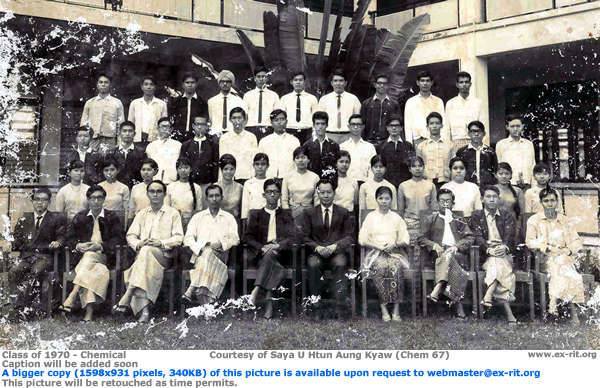
  • ChE 70

    Chemical

  • ChE 71

    Chemical

  • Interim Deans of Engineering

    Four Sayas served as Interim Dean of Engineering

    Dr. Htin Aung

    Dr. Tha Hla

    Dr. Maung Maung Kha

    U Po Tha

    ** Notes

    * Dr. Htin Aung served as Rector of Rangoon University and Burmese Ambassador to Ceylon.

    * Dr. Tha Hla served as Professor of Geology and Rector of RU.

    * Dr. Maung Maung Kha served as Professor of Physics and Rector of RU, RASU and University of Distance Learning.

    * U Po Tha served as Professor of Chemistry.

    He wrote Foreword for one of Dr. Htin Aung’s book.

    He advised his nephew Saya U Aung Khin to study Engineering.

  • Early Colleges and Courses

    • A University may consist of several colleges.
    • Rangoon University was founded in 1920 with Rangoon College and Judson College as its constituents.

    Intermediate Classes

    • In the early days, Rangoon University offered Intermediate Courses.
      They were known as Inter (A) and Inter (B).
    • The Science Option is available for I.Sc. (Intermediate of Science).
    • The Arts Option is available for I.A (Intermediate of Arts).
    • Intermediate courses were initially offered in the Main Campus.
    • In the mid and late 50’s, the Yankin College and the Htee Dan College served the First Year Intermediate classes.
    • The Pure Science, Engineering and Medical students attended Yankin College.
      My brother U Sein Htoon attended Yankin in 1957 along with Sayama Daw May Saw Lwin.
      My sister Daw Khin Than Nwe attended Yankin in 1958 along with Saya Dr. Soe Win.
    • The Arts and Social Science students attended Htee Dan College.
      My cousin U Myo Min attended Hteedan in 1958.

    BOC, Main and Leik Khone

    • After completing the I.Sc. classes, the engineering students attended BOC College for their main subjects and took some courses (e.g. Mathematics, Geology) at the Main Campus.
    • Later, the engineering students attended Leik Khone (Dome) and its extensions for their main subjects and spent some time (e.g. workshop) at BOC College.
    • Leik Khone is a place holder for the Dome and the nearby buildings used for Admin and Teaching).
    • Saya U Tin Htut (M60) and U Tin Htoon (A60) were from the last batch of engineering students to attend classes at Leik Khone (before the opening of Burma Institute of Technology at Gyogone Campus).
    • In 1961, the Faculty of Engineering moved to the Gyogone Campus.
      It was also known as Burma Institute of Technology (BIT).
      The first batch of BIT graduated in 1962.
    • The I.Sc classes were moved to Leik Khone (which used to be under the Faculty of Engineering).
      Those aspiring to become medical doctors take the “A: option.
      Those aspiring to become engineers and scientists take the “B” option.

    We attended the last ever I.Sc.(A) classes at Leik Khone in 1963.

    Our teachers for our I.Sc.(A) classes included

    • Daw Tinsa Maw-Naing (English) — spouse of Bo Yan Naing
    • Daw Khin Kyi Kyi (English)
    • Daw Po (Burmese) — sayama at the 1965 Inlay Lu YeChun Camp, retired as Professor of Burmese
    • U Khin Zaw (Mathematics) — later headed Maths Department at Worker’s College
    • Mr. Chowdry (Mathematics)
    • Daw Khin Ma Ma (Mathematics) — Sayama and her spouse U Soe Nyunt taught Mathematics at DSA
    • U Min Than Thaung (Physics) — RUBC Gold, retired as Rector of Long Distance Learning
    • Daw Khin Khin Su (Physics)
    • Daw Khin Aye (Chemistry)

    Some of my friends attended I.A. Intermediate of Arts) and I.Com (Intermediate of Commerce) classes at BOC College.

    New Education System

    Under the new Education System, the Faculty of Medicine became Institute of Medicine(s). The 1st MBBS Jr. and Sr. classes were held at Leik Khone. My spouse attended at Leik Khone.

    Leik Khone also housed the offices of the Directorate of Higher Education (DHE). Saya U San Tha Aung and Saya Dr. Nyi Nyi were the early Director Generals for Higher Education.

    Intermediate Colleges

    Intermediate Colleges were opened in

    • Mandalay
    • Taunggyi
    • Moulmein (Mawlamyine)
    • Bassein (Pathein)
    • Myitkyina
    • …

    Some of them became full-fledged Universities.

    Early Examinations

    • In some years (probably due to the insurgency in some parts of Burma), students have to sit the “combined” Intermediate examination.
    • Otherwise, they have to sit for Inter (A) and Inter (B) exams separately.
    • Even then, there were two chances to pass the exam.
    • The first exam was usually held in March.
    • The second (aka supplementary) exam was usually held in June.
    • The “compart” (compartmental) system requires a student to re-take only the subjects they have failed.
    • Stipends and awards (Gold and Silver medals, …) are eligible only for students who pass all subjects in the first exam.

    Early Engineering Courses

    • Per Sayagyi U Aung Khin (Retired Professor of Mechanical Engineering) : Those who aspire to become engineers have to pass I.Sc. with 50+ marks in Mathematics, Physics and Chemistry.
    • According to U Aw Taik Moh (C54) and Saya Dr. San Hla Aung (C58), they had to take a bike or walk to the Main Campus to attend Mathematics and/or Geology classes (usually from 7AM to 9AM). They then had to attend Engineering Courses at the B.O.C College from 10 AM.
    • Saya U Ba Toke taught Mathematics to several engineering students (including Saya Dr. Aung Gyi, U Min Wun and U Khin Aung Kyi).
    • Grapevine says that the Second Year of Engineering (equivalent to 4th BE) and 2nd MBBS were the “filters” (or “stumbling blocks“) for engineering and medical students. Some decided to change their study to Pure Science or Arts.
    • A three storey building and a “Leik Khone” were constructed in the mid 1950s on Prome Road.
    • The architect envisioned a Htee (Umbrella), but the Burmese saw the roof top as “Leik Khone”).
    • Per Saya Dr. San Hla Aung (C58), the new building was opened by Prime Minister U Ba Swe.
    • Some engineering classes were taught at the new building.
      Some classes (e.g. Workshop) were taught at the BOC College.
    • The “Leik Khone” was used mainly as Assembly Hall.
    • It was also used for Exhibitions and Entertainment (e.g. Louis Armstrong).
    • One building was used for
      Admin Office (of the Dean)
      Hangout for Sayas
      Library
    • Sad to note that the Dome deteriorated and “collapsed” (probably due to maintenance problems).
    • The land mark is now a memory.
  • Exam Systems

    Intermediate College

    • During a period, students at the University of Rangoon [and Mandalay] attended Intermediate (A) classes for a year, but they did not have to take the examination.
    • They then attended Intermediate (B) classes for a year. They then take the examination for both courses.

    Compart System

    • There used to be two examinations for a class.
      The students have two chances to pass.
    • The first examination was usually held in March.
      Those who pass all subjects are eligible to apply for stipends and grants.
    • Those who pass at least three subjects have to take the remaining subjects in the second examination, which was usually held in June.

    Saya U Ba Toke

    • Saya was born in December, 1920.
    • He attended Mandalay University.
    • He joined the Students’ Strike Camp, and missed the first examination held in March.
    • The strike ended, and Saya took all the subjects in the second examination and passed.
    • He wanted to attend the Faculty of Engineering in Rangoon, but he needed a stipend. He could not get the stipend because he did not take the first examination.
    • Saya’s teachers persuaded him to take Mathematics Honors in Mandalay.

    Dr. Tint Lwin

    • He took the Pure Science option for I.Sc.
    • He attended engineering classes for a while, but he changed his mind to study Medicine.
      He took the classes needed to study medicine (e.g. Biology) and the supplementary exams.
      Finally, he was admitted to the MBBS classes.
    • During his university days, he was Goalkeeper for the University First Eleven. He team mates include Collegian Nay Win, Tun Kyi and Kenneth Shein.
    • After retirement, he moved to the USA.