The three co-founders were were the early students of Sayagyi U Pe Maung Tin (Pali and Burmese Scholar) at the then newly established “Burmese Department” at the Rangoon University.
Rangoon University was founded in 1920 with Rangoon College and Judson College as its constituents.
Intermediate Classes
In the early days, Rangoon University offered Intermediate Courses. They were known as Inter (A) and Inter (B).
The Science Option is available for I.Sc. (Intermediate of Science).
The Arts Option is available for I.A (Intermediate of Arts).
Intermediate courses were initially offered in the Main Campus.
In the mid and late 50’s, the Yankin College and the Htee Dan College served the First Year Intermediate classes.
The Pure Science, Engineering and Medical students attended Yankin College. My brother U Sein Htoon attended Yankin in 1957 along with Sayama Daw May Saw Lwin. My sister Daw Khin Than Nwe attended Yankin in 1958 along with Saya Dr. Soe Win.
The Arts and Social Science students attended Htee Dan College. My cousin U Myo Min attended Hteedan in 1958.
BOC, Main and Leik Khone
After completing the I.Sc. classes, the engineering students attended BOC College for their main subjects and took some courses (e.g. Mathematics, Geology) at the Main Campus.
Later, the engineering students attended Leik Khone (Dome) and its extensions for their main subjects and spent some time (e.g. workshop) at BOC College.
Leik Khone is a place holder for the Dome and the nearby buildings used for Admin and Teaching).
Saya U Tin Htut (M60) and U Tin Htoon (A60) were from the last batch of engineering students to attend classes at Leik Khone (before the opening of Burma Institute of Technology at Gyogone Campus).
In 1961, the Faculty of Engineering moved to the Gyogone Campus. It was also known as Burma Institute of Technology (BIT). The first batch of BIT graduated in 1962.
The I.Sc classes were moved to Leik Khone (which used to be under the Faculty of Engineering). Those aspiring to become medical doctors take the “A: option. Those aspiring to become engineers and scientists take the “B” option.
We attended the last ever I.Sc.(A) classes at Leik Khone in 1963.
Our teachers for our I.Sc.(A) classes included
Daw Tinsa Maw-Naing (English) — spouse of Bo Yan Naing
Daw Khin Kyi Kyi (English)
Daw Po (Burmese) — sayama at the 1965 Inlay Lu YeChun Camp, retired as Professor of Burmese
U Khin Zaw (Mathematics) — later headed Maths Department at Worker’s College
Mr. Chowdry (Mathematics)
Daw Khin Ma Ma (Mathematics) — Sayama and her spouse U Soe Nyunt taught Mathematics at DSA
U Min Than Thaung (Physics) — RUBC Gold, retired as Rector of Long Distance Learning
Daw Khin Khin Su (Physics)
Daw Khin Aye (Chemistry)
Some of my friends attended I.A. Intermediate of Arts) and I.Com (Intermediate of Commerce) classes at BOC College.
New Education System
Under the new Education System, the Faculty of Medicine became Institute of Medicine(s). The 1st MBBS Jr. and Sr. classes were held at Leik Khone. My spouse attended at Leik Khone.
Leik Khone also housed the offices of the Directorate of Higher Education (DHE). Saya U San Tha Aung and Saya Dr. Nyi Nyi were the early Director Generals for Higher Education.
Intermediate Colleges
Intermediate Colleges were opened in
Mandalay
Taunggyi
Moulmein (Mawlamyine)
Bassein (Pathein)
Myitkyina
…
Some of them became full-fledged Universities.
EarlyExaminations
In some years (probably due to the insurgency in some parts of Burma), students have to sit the “combined” Intermediate examination.
Otherwise, they have to sit for Inter (A) and Inter (B) exams separately.
Even then, there were two chances to pass the exam.
The first exam was usually held in March.
The second (aka supplementary) exam was usually held in June.
The “compart” (compartmental) system requires a student to re-take only the subjects they have failed.
Stipends and awards (Gold and Silver medals, …) are eligible only for students who pass all subjects in the first exam.
EarlyEngineering Courses
Per Sayagyi U Aung Khin (Retired Professor of Mechanical Engineering) : Those who aspire to become engineers have to pass I.Sc. with 50+ marks in Mathematics, Physics and Chemistry.
According to U Aw Taik Moh (C54) and Saya Dr. San Hla Aung (C58), they had to take a bike or walk to the Main Campus to attend Mathematics and/or Geology classes (usually from 7AM to 9AM). They then had to attend Engineering Courses at the B.O.C College from 10 AM.
Saya U Ba Toke taught Mathematics to several engineering students (including Saya Dr. Aung Gyi, U Min Wun and U Khin Aung Kyi).
Grapevine says that the Second Year of Engineering (equivalent to 4th BE) and 2nd MBBS were the “filters” (or “stumbling blocks“) for engineering and medical students. Some decided to change their study to Pure Science or Arts.
A three storey building and a “Leik Khone” were constructed in the mid 1950s on Prome Road.
The architect envisioned a Htee (Umbrella), but the Burmese saw the roof top as “Leik Khone”).
Per Saya Dr. San Hla Aung (C58), the new building was opened by Prime Minister U Ba Swe.
Some engineering classes were taught at the new building. Some classes (e.g. Workshop) were taught at the BOC College.
The “Leik Khone” was used mainly as Assembly Hall.
It was also used for Exhibitions and Entertainment (e.g. Louis Armstrong).
One building was used for Admin Office (of the Dean) Hangout for Sayas Library
Sad to note that the Dome deteriorated and “collapsed” (probably due to maintenance problems).
During a period, students at the University of Rangoon [and Mandalay] attended Intermediate (A) classes for a year, but they did not have to take the examination.
They then attended Intermediate (B) classes for a year. They then take the examination for both courses.
Compart System
There used to be two examinations for a class. The students have two chances to pass.
The first examination was usually held in March. Those who pass all subjects are eligible to apply for stipends and grants.
Those who pass at least three subjects have to take the remaining subjects in the second examination, which was usually held in June.
Saya U Ba Toke
Saya was born in December, 1920.
He attended Mandalay University.
He joined the Students’ Strike Camp, and missed the first examination held in March.
The strike ended, and Saya took all the subjects in the second examination and passed.
He wanted to attend the Faculty of Engineering in Rangoon, but he needed a stipend. He could not get the stipend because he did not take the first examination.
Saya’s teachers persuaded him to take Mathematics Honors in Mandalay.
Dr. Tint Lwin
He took the Pure Science option for I.Sc.
He attended engineering classes for a while, but he changed his mind to study Medicine. He took the classes needed to study medicine (e.g. Biology) and the supplementary exams. Finally, he was admitted to the MBBS classes.
During his university days, he was Goalkeeper for the University First Eleven. He team mates include Collegian Nay Win, Tun Kyi and Kenneth Shein.
There were two Sayas named Hunter at the University of Rangoon.
Matthew Hunter taught Physics and Chemistry, and also studied Geology. He served as Principal of Rangoon College. He tried to persuade the student leaders of the 1936 RU Strike. The students explained, “We are not protesting you. We are protesting to have changes to the University Act.” He loved the students very much. Tears fell when he had to bid farewell after retiring from Rangoon University.
Some awards (given out at the early Convocations) are named after “Matthew Hunter”.
Mark Hunter (John Mark Hunter) taught and wrote on English Literature. He was a member of the Commission responsible for the implementation of the Rangoon University Act of 1920. He later served as Professor at RU.
Judson
Andoniram Judson Jr. (1788 – 1850) was the most significant American Baptist Missionary to Burma.
His supervisors told him that it would be a tough task.
There were a few ABMs before him, but they did not stay long.
Judson and his team (which included some former dhamma teachers) compiled the English-Burmese and Burmese-English Dictionaries (see photos of two editions).
Judson published the Burmese translation of the Bible.
He helped found the association for Baptists.
He is honored by having a church and a college named after him.
In 1920, Judson Collegeand Rangoon College became constituent colleges of the newly established University of Rangoon.
Two buildings for Judson College were donated by the American Baptists.
The Willington Hall was built in memory of two families — the Vintons and the Johnsons — of the Church of Willington for their missionary work in Burma. It was later known as Dagon Hall.
The Benton Hall was donated by Ms. Benton (Treasurer of the Judson Church and/or Judson College). It was later known as Thiri Hall.
Note: Depending on the period, a Hall may house classrooms or may be used as a hostel. There was also a building named North Hall (which later became Shwebo Hall).
Examples of evolution of halls
Mandalay Hall was a Residence Hall.
After the “Dark Days” (7th July and 8th July 1962), several Residence Halls were converted into Admin Offices and/or Classrooms.
Mandalay Hall was a temporary home for the UCC project before moving to Thamaing College Campus.
Geology majors had most of their classes at Mandalay Hall.
G-Hall in the Gyogone Campus initially housed single sayas.
In November 1964, G-Hall became a resident hall for female students. Madan Chand (C70) was inadvertently listed to reside at G-Hall. Lyo Kyin Sein (T69) was inadvertently listed to attend at a men’s Hall (e.g. C-Block)
Burmese
In the early days, several languages (e.g. Pali) were taught by the Department of Oriental Studies.
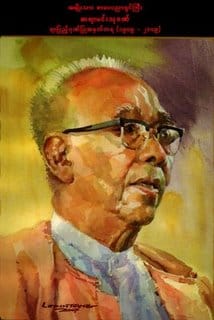
Sayagyi U Pe Maung Tin (Pali and Burmese Scholar) proposed to have a separate Burmese Department.
Sayagyi translated Pali books (e.g. Visuddhi Magga) and Suttas (e.g. Dhammacakka and Anattalekkhana) into English.
ICS U Sein Tin (Theikpan Maung Wa), U Thein Han (Zawgyi) and U Wun (Minthuwun) were the early Burmese (Honors) students of Sayagyi. The trio is also known as co-founders of the Khit San Sar Pay movement.
U Sein Tin was a victim of a bungled burglary or the case of mistaken identity.
U Thein Han was offered to do Masters by both the Burmese Department and the English Department, but he chose to study Library Science in the UK. He succeeded U Khin Zaw as Chief Librarian of the Rangoon University Central Library.
U Wun studied Linguistics and Literature in the UK. He headed the Translation Department at the University of Rangoon. He later served as Professor of the Burmese Department, and as Visiting Professor at the University of Osaka (at the invitation of Professor Harada (pen name : Chit Mann Nwe). He is the father of U Htin Kyaw (former President).
In December 2019, the Myanmar Sar Htar Na (Burmese Department) will unveil a statue honoring Sayagyi.
Met Daw Tin Tin Myaing (Brenda Pe Maung Tin, Sayagyi’s daughter) at Winner Inn. She attended the unveiling of Sayagyi’s statue. She was also a guest at the Fund Raising Concert for RU Centennial. Two friends mentioned that his spouse (an Old Paulian) passed away in UK during the COVID-19 pandemic.
There is an album called Burmese (Myanmar Sar).
Some Posts
Per Hlaing Bwa : According to a “Shay Hmi Nauk Hmi” Saya, U Chit was detained for “providing food to the University Student Protesters”. He was questioned repeatedly for the rationale of his work. He wrote, “The students are my benefactors. I therefore need to repay their kindness in times of need.” Finally, a relative with connections managed to secure the release of U Chit. Sadly, he passed away 8 months later. He is an “unsung hero.”
Per Myo Thaik : He witnessed the “Tha Dar Phyu” (later referred to as “Tha Dar Ni”) incident and endured a tear gas bomb. His posts are based not only on his experience (recorded as dairy entries), but also on other sources : Gabriel (Thet Tun) and a post from the on-line forum.
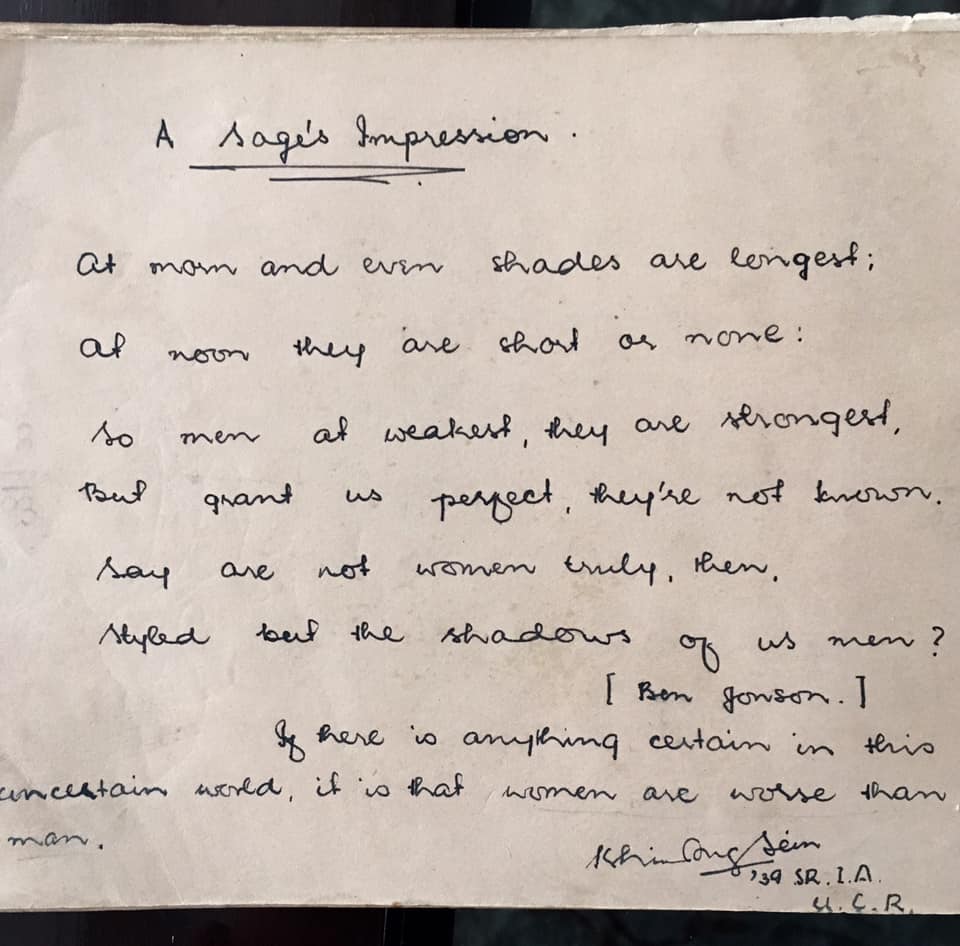
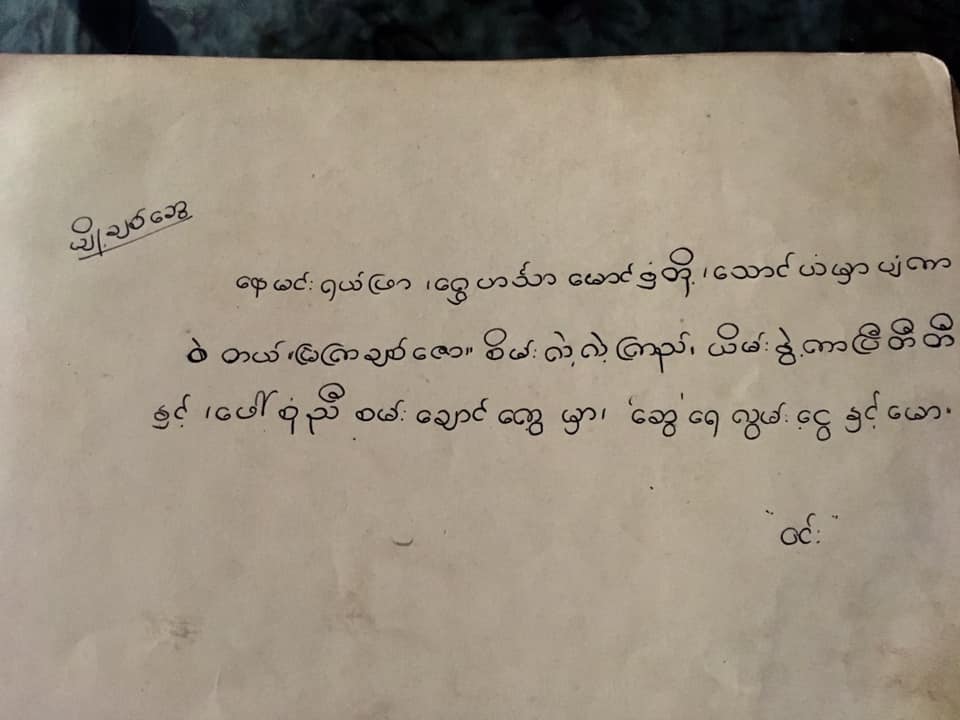
Hazel Kyaw Zaw has posted some more messages from her mother’s autograph (from 1939). It reinforced the concept of “Six degrees of separation” (in the early days) and “Four (or less) degrees of separation” (in the Internet age). Many of her mother’s friends had children who became schoolmates (some senior, a few classmates and some junior) of Hazel.
Hazel invited me to a mini-gathering with Saya Dr. Soe Win, Sayama Daw May Saw Lwin, and her friends. We met again at the lunch given by Saya and Sayama to celebrate their 49th Anniversary.
Ma Chit Swe’s autograph
Several sayas — Two U Khin Zaw (one from Mathematics and one from Chemistry), U Kyaw (Geography, Principal), Daw Khin Aye, Dr. Aung Myint, Dr. Tin Win (Alan), U Aung Zaw (UCC) — taught at Worker’s College.
Saya U Kyaw (Principal, Worker’s College) is the father of Ko Myo Nyunt (Harry Kyaw, SPHS63) and Ma San San Kyaw (UCC). During my visits to Yangon, Dr. Kyaw Min (SPHS65) would take to me the OPA mini-gatherings where Ko Harry is the de facto senior / leader. Recently, the group donated to the Molecular Laboratory Workforce and Mobile Swab Collection Team (for COVID-19 testing) of DMR.
U Khin Zaw (Chemistry) has shared his memories (good, bad, funny, sad) about the school, teachers, friends and the decline of the Education System.
Even in the early days, several sayas (including Sayagyi U Ba Toke) told the story of a star athlete who spelled KAWPHY for COFFEE and failed the interview even though he was guaranteed a pass if he could get one letter correct.
There are several poets and writers.
Min Oo wrote a long kabyar covering events and activities during his stay at RU.
Yadanar Thu posted some kabyars that she had published for the reunions and Pu Zaw Pwes.
Than Than Mu recounted her memories as a student at Education, and later as “Sar Sit Sayama”.
Some posted mementos. They include an old post card and a key chain that were bought at a store inside the Recreation Center.
A few attended the make-shift Convocation at the Kyaikkasan Ground.
Those who graduated in 1962 attended the Convocation at Kyaikkasan in 1963.
Some refused to attend because the Convocation held outside the Campus.
There were some who had to wait for several years after graduation to attend the Convocation. They were then married and had to beg for extra tickets for the family members (spouse, children, in-laws).
Some wrote about their friends who were scared of Practical examination and Viva, and how some fellow students helped them.
Many early members taught or studied Chemistry.
A reason may be that the group was founded by Dr. Nyi Thet Lwin and U Aung Mon, who are sons of Saya Dr. Soe Win and Sayama Daw May Saw Lwin.
The membership is quite diverse.
Sayama Daw Khin May (English) is one of the recent GBNF (Gone But Not Forgotten). Her siblings/relatives include Sayama Daw Phwa Yin (Former Head of English), Saya U Tin Lwin (Pali) and Sayama Daw Sein Sein (Registrar, Director).
The GBNF has grown. Some recent casualties include U Myat Hla Sein (Movie Technology) and Dr. Khin Maung Swe (Tekkatho Maung Thin Char).
Suggestion
There are 1000+ posts and many of them has invaluable photos.
There are tens of thousands of posts.
It’ll be nice if the photos can be organized into albums with relevant titles. It will help if the group or some sponsors decide to compile the posts into digital and printed books to commemorate the Centennial of the University of Rangoon in 2020. It will be an excellent pay back to the alma mater and the mentors.
I created albums in the group last year, but have not updated them. Some photos need to have proper credits (especially if they are to be used in publications).






 HlaMin