Month: May 2025

  • HMEE (4th Installment)

    Saya U Soe Paing (EE)
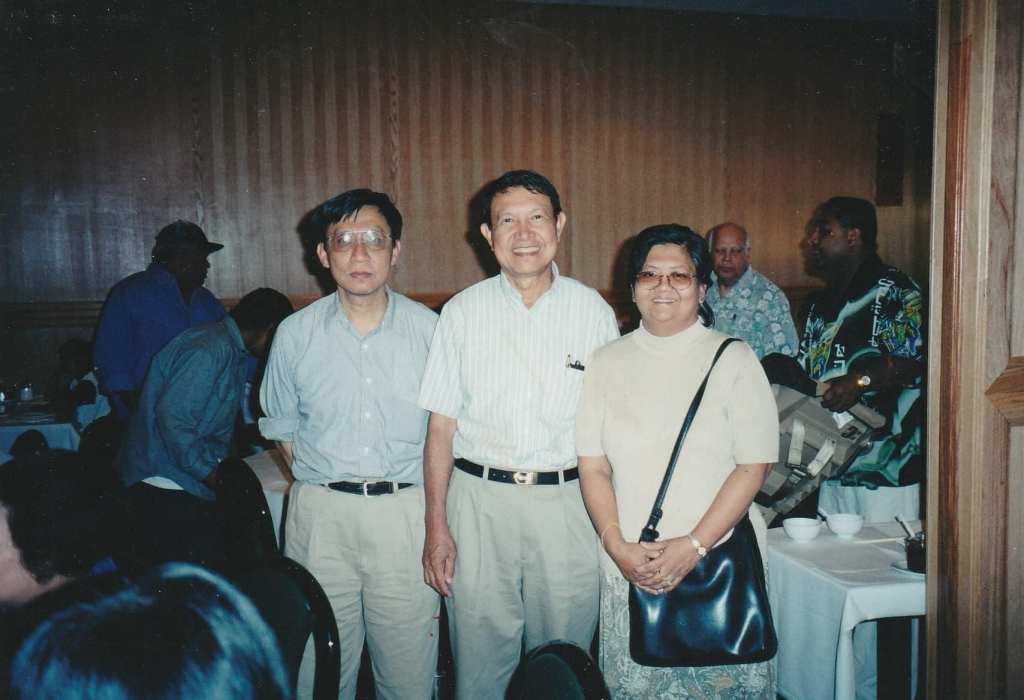
    U Soe Paing

    Rangoon University (10) years after its inauguration

    Buildings for Student use built during the first decade of RU

    To place all the colleges under Rangoon University in one area the Burmese government allocated eight lakh kyats for purchasing land for a University Estate. With these funds more than 400 acres of land now known as University Estate was bought. At that time the land known as “Na Nat Taw” was a thick forest. The estate was surrounded by Inya Road on the East and North side, Prome Road on the West side, and Windermere Road on the South. In 1927, Rangoon University leased from the Government under a 90-year grant, Scout Island in Inya Lake where the Rangoon University Boat Club (RUBC) was located. The area of the University estate expanded up to Inya Lake in the North.

    To construct buildings in the estate a University Building subcommittee was formed and the committee chose Mr. T. O. Foster as the Architect. Mr. Foster went to England and brought back with him the required staff and started drawing plans and designs of the buildings in the estate. The bushes and trees on the estate were cleared with the help with of Forest Officer Mr. A Roger and the building constructed.

    The British Government support funds for the building of the Rangoon University was only about one lakh kyats annually. There was also no endowment/main funds for the construction. To get funds for the construction and for the expenses of the University, the Governor, Sir Harcourt Butler allowed gambling officially known as “Our Day” in the whole country. From the funds raised the buildings were slowly constructed.

    Two years after Rangoon University was opened, the University Chancellor, Sir Reginald Craddock laid the foundation of the Convocation Hall on 2nd December 1922 but was completed only in 1931.

    The number of students had grown and in December 1923 two double storey wooden buildings that can accommodate 224 students were built on Prome Road and completed in June 1924. One was named Tagaung Hall and the other Prome Hall and opened for occupancy. In 1925 Engineering students started staying at Tagaung Hall and in 1927 some Engineering students stayed at Prome Hall.

    In 1927 Mr. Rao Bahadur S Ramanatha Reddiar donated 200,000 Kyats for building of the University Library. University Chancellor Sir Harcourt Butler laid the foundation for the library on 8th December 1927. Architect Foster designed and built the library, and finished it in 1931.

    The BOC College building funded by the BOC Company was completed in 1927, and was inaugurated by the Governor Sir Harcourt Butler on 30th November 1927.

    The University Avenue was built in 1928, and the University Hospital building on University Avenue was finished in June 1928. There was one Resident doctor and one assistant doctor at that time.

    The foundation of the Rangoon University Arts Hall was laid by the University Chancellor Sir Charles Innes on 3rd November 1928, and completed in 1931. The Rangoon University Science Hall was also completed in the same year.

    Merchant U Chan Chor Khine (son of Chan Mah Phee) donated Kyats 100,000 for the construction of the Rangoon University Gymnasium. Construction started in 1929, and was completed and opened in 1930.

    Besides the above mentioned buildings, Medical College, Education College, Hostels for students, Houses for Professors, Staff quarters, University Post Office, University Bookshop, telephone exchange, the football and athletics fields, tennis courts, and the boat club were built mainly on the University estate. Apart from the two wooden buildings, the remaining buildings were built by the University Building Construction Committee. The committee formed in 1931 was disbanded in August 1932 when all the buidings were completed.

    Rangoon University Students’ Union and Union Building

    The most memorable development concerning all the college students occurred in 1930 when the Students’ Union building was finished and the Rangoon University Students’ Union was formed. Some of the engineering students became members.

    Old documents and reports showed that when Rangoon University was first established, the University authorities believed that there should be a Students Union building. However in 1926-27 only when Dr. U Nyo (K.S.M. LL.D) generously donated 170,000 Kyats to build the Students Union building that construction started.

    The Students Union building was constructed in 1929 in a plot at the corner of Chancellor Road and University Avenue and completed in the middle of 1930.

    The senior students held meetings hall-wise and according to the decisions reached at the meetings Ko Kyaw Khin, Ko Tint Swe and Ko Ba Gyan representing the students met with University Vice-Chancellor U Ba on 12/9/1930 and discussed forming of a committee to set up rules and regulations for the Students’ Union. As agreed at the meeting Ko Kyaw Khin chaired a students mass meeting at the University Gymnasium where there was unanimous agreement to form a students’ union. A committee to draft the rules and regulations of the union was formed with the following students: Ko Kyaw Khin (Chairman), Ko Ba Gyan (Secretary), Ko Kyaw Thein, Ko Tint Swe, Ko Htun Tin, Ko Ba Thein, Mr. M. A. Raschid, Ko Ohn, Mr. Paratasan, Ko San Phaw Aung, Ko Ba Pe and Ko Nyunt.

    The committee submitted the report on 23/11/1930. The suggestions made by the University authorities and students were considered and some incorporated into the amended report which was accepted and approved by the student mass meeting on 9/1/1931. An executive committee was formed at the meeting with Chairman Ko Kyaw Khin (who later became Barrister-at-Law), and Secretary Mr. M. A. Raschid (who later became Minister of Mines, Industry, Labor).

    However the meeting did not like some of the paragraphs regarding handing over of the union building in the agreement between the University authorities and the student union and authorized the executive committee to continue discussions. Eventually an agreement was reached and on 27/2/1931 the working meeting accepted it. The executive committee of the Rangoon University Students’ Union signed accepting the agreement at 11AM on 28/2/31.

    When writing the rules and regulations to establish the Rangoon University Students Union, Students Unions at Oxford and Cambridge universities in England were taken as standard examples. However those students unions are primarily associations that emphasize debating. Under Chapter (1), Section (3) of the University Rules and Regulations, it was stipulated that, for the objectives of the Rangoon University Students Union to be met, debates, talks, discussions, fun fairs should be organized and provided for the benefit of the students.

    But it was inevitable that the colonized countries’ attempt to gain independence and educated youths would come together sooner or later.

    Situation after the first ten years

    When Rangoon University was first established in 1920 there were 839 students and 6 Professors and. In 1930 there were 1550 students and 21 Professors. Out of the 21 Professors, one was the Professor of Engineering. Professor Elgood had retired at that time and Prof. C. H. E. Cherry was the acting Professor.

    Two remarkable developments in 1930 were the opening of the Teachers’ Training College and Medical College under Rangoon University as constituent colleges. The Honors courses for the Arts and Sciences were changed from a 2-year course to a 3-year course. The more important modifications in academic policy during the year were the lengthening of Honors courses leading to the B.A. and B.Sc. degrees from two to three years duration; amendments of the Matriculation Regulations to take effect from June 1934 requiring all candidates for admission to the University to have passed in Burmese in the High School Final Examination.

    Recognition of BSc (Engineering) degree by the Institute of Engineers (India)

    In the 1930-31 academic year, a special committee formed by the Boards of Study wrote the new regulation regarding the curriculum. The new regulation was approved by the Boards of Study and used starting from the 1931-32 academic year.

    At the time the new regulations were used, the Engineering College made approaches for the Institute of Engineers (India) to recognize the B.Sc. Engineering degree awarded by Rangoon University starting in the 1930-31 academic year.

    There were only 4 teaching staff at the Engineering College up to 1930. See Appendix (1D). In the academic year there were no plans to appoint more staff or to get external lecturers, and the number of teaching staff was still below the minimum advised by the Sandes Committee report. Hence the Institute of Engineers (India) did not recognize the B.Sc.Engineering degree from Rangoon University. This demand for increased staff came at an awkward time. The Rangoon University Engineering graduates were ruled ineligible for any of the Government of India competitive exams for professional appointments in the Railway and Telegraph departments.

    Financial stringency and the need for rigid economy loomed large in University administration throughout the 1931-32 academic year. Faced with the possibility of a radical reduction of income the Univer­sity examined ways to reduce the expenses and to use the existing resources effectively.

    Among the proposals for a very substantial reduction of the cost to Government of Engineering Education by adjustments of courses between the Insein Technical Institute and the B.O.C. College. This involved the opening of Diploma Courses in the B.O.C. College with but small addition to the staff of the College and the closing down of the advanced courses in Mechanical and Electrical Engineering in the Insein Technical Institute involving considerable reduction of staff in that institution.

    The recognition of the B.Sc. Degree in Engineering of the University by the Institution of Engineers (India) was again addressed. The Institution appointed Mr. C. Innes, Deputy Chief Engineer, P. W. D., to report on the standards of the Courses and Examinations in Engineering. The Inspection was carried out during the University Examinations of March 1931 and a report submitted.

    In 1931-32, the teaching staff increased to 5 and the Institute of Engineers (India) eventually recognized the B.Sc.(Engg) degree starting at the time of the degree examinations in March 1932.

    The high standard of the B.Sc.(Engg) degree conferred by Rangoon University was maintained for the March examinations in 1934. In the opinion of the External Examiner the standard was up to that of a British University. Nevertheless in spite of the high aggregate of marks required two students secured a distinction without any serious overwork.

    Teaching staff

    When the Rangoon University engineering department opened in 1924, there were only 2 teaching staff. It increased to 4 in 1928. One workshop superintendent was appointed in 1931. In the 1930-31 academic year due to financial difficulties in the University administration the minimum required number of teaching staff cannot be reached. In 1932 with an addition of one teaching staff, the number was 5 teaching staff and a workshop superintendent making it a total of 6. The situation remained the same till 1939. Only in the 1940-41 academic year the number of students increased substantially and the number of courses were increased that the number of teaching staff became 7 with a workshop superintendent making it a total of 8.

    During 1934 to 1939 the Engineering department added diploma courses in Mechanical and Electrical Engineering, degree courses in Mechanical and Electrical Engineering, Honours courses in Civil Engineering. However during the period no additional staff was appointed and the existing staff had to bear more teaching loads than they could.

    All this time the teaching staff appointed up to 1940 were only English and Indians. Only in the 1940-41 academic year, a Rangoon University Engineering graduate and Burmese national, U San Shin was the first to be appointed. It was evident that during that time there were no plans to develop nationals as teaching staff for the long term.

    The list of all the teaching staff of the Engineering department from 1924 to 1941 giving names, position and period of service are shown in Appendix (1D).

    Although there were not enough teaching staff in the engineering department, the staff from other departments of the Rangoon University had helped in teaching related engineering subjects all this time. Especially the Mathematics department took responsibility for teaching mathematics. Geology and Chemistry departments also helped.

    A Library was opened in BOC College and a Librarian, one upper division clerk and one lower division clerk were appointed for the library.

    Prof. W. N. Elgood was the first Head and Professor of the Engineering Department. He retired in the 1930-31 academic year and Prof. H. .C. E. Cherry took over his duties temporarily. In 1932-33, Prof. F. Webster took over from Professor Webster and served as Head and Professor) until 1940. In 1940-41 Professor Webster took leave for war duties, and Prof. D. P. Davies took over his duties.

    Job opportunities for the graduates.

    Since the time the Rangoon University Engineering Department started producing engineers, graduate engineers had difficulties finding employment and even some were jobless. Besides in 1922-23 academic year the government had financial difficulties and stop the government departments from recruiting graduates. It however had the effect of directing the attention of such graduates to the necessity of securing adequate practical experience and also to the greater possibility of employment with private industry. Thus practical industrial training was emphasized more in the engineering instruction.

    That year Head of Engineering Department Prof. Webster went to various private industries and factories and spent a great deal of time discussing about employment for the engineering graduates. The private engineering industry organization in their search and recruitment of new engineers for their industries, helped in making the Engineering College a regular source to supply qualified graduate engineers.

    That’s why in the 1934-35 academic year, the prospects of employment graduates increased and became better. In the first examination of the Publice Service Commission for the Superior Engineering Services in which graduates of this College were allowed to appear, one of them Mr. Sen Gupta, secured one of the two vacancies in open competition with the rest of India.

    At that time, there was good rapport with BOC and arrangements were made for the students to undergo training in the fields of BOC, and fresh graduates to serve a short term apprenticeship with the ultimate prospect of joining the technical services of the company. For this purpose, Prof. Webster was invited to the oil fields and to consult with Mr. Bowlby, the Field Manager. This also permitted him to make a tour of the fields to satisfy himself that students would be capable of providing the required services. As a result, arrangements were made to get at least 15 students send to Yenangyaung and Chauk oil fields for the summer training.

    All engineering graduates in the 1938-39 academic year got employment in industry and the job opportunity for engineering graduates was very good.

    BOC played a major role in employing most of the graduates in 1940-41. All 4 engineering graduates got jobs, and out of the 11 combined Mech/Elec diploma holders, 10 were employed. It could be clearly seen that employment prospects and opportunities had become better.

    This year for the first time for several years inquiries have been made for the services of engineering graduates for the public sector.
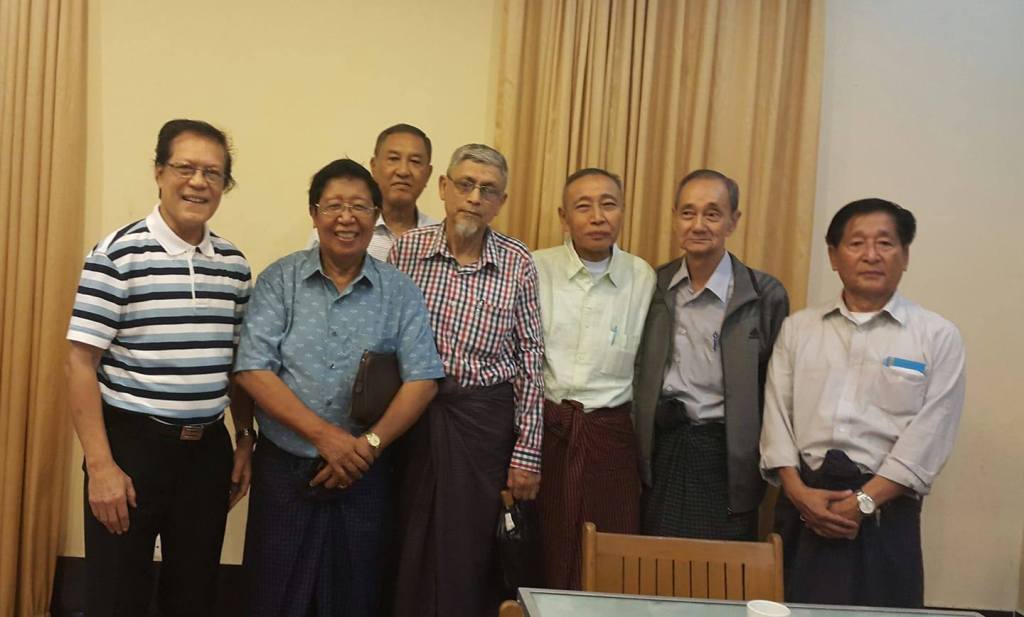
  • RIT Alumni

    RIT Alumni

    Telecom Alumni

    • Mehm Ye Win (EC69) served as Secretary of RIT Electrical Engineering Association.
      He was Chief Engineer (of Yangon Telephone).
    • U Han Tha Myint (EC70) was Deputy Chief Engineer of Yangon Telephone.
      He was forced to retire after 8-8-88.
      He joined NLD.
      Father : U Thein Pe Myint

    Zarnee Tun wrote : I am also MPT engineer also services for 16 years my seniors are CE U Ye Win and Dy CE U Han Tha Myint at Yangon Telephone 40th street as Digital switching project engineer. They know me as their junior.

    Sittang Paper Mill Alumni

    Several 69ers worked at Sittang Paper Mill

    • Ko Albert Kyaw Min
    • Ko Tin Maung Aye
    • Ko Kyaw Zin
    • Ko Chit Pe
    • Ko Tin Shein
    • Sa Maung Maung

    Others include

    • Ko Win Thein (M67, GBNF)
    • Ko Tin Myint (David Ko, M67)
    • Ko Maung Maung Kyi (Dip. Ing, Wales, UK)

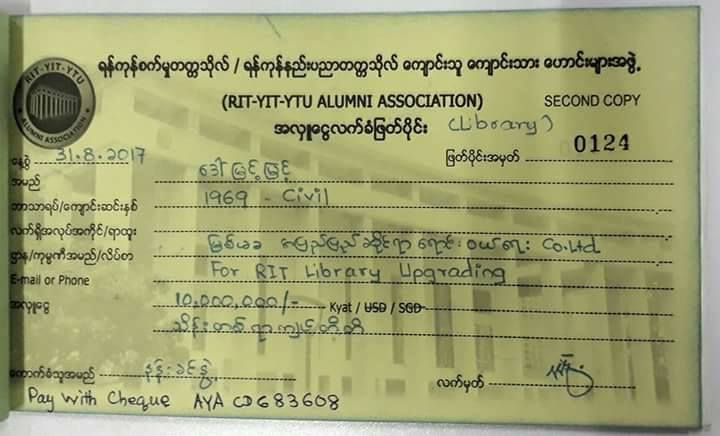
    Donation by Daw Myint Myint (C69)

    • Major donor to the 69er Health Care Fund
    • Major Donor to the YTU Library Modernization Project
      Receipt of an early donation in 2017
    Daw Myint Myint (C69)
  • May 21, 2020

    • Award by Neurology Academy
    • Professor Aye Maung Han

    Award by Neurology Academy

    Dr. Ba Han wrote :

    I still feel strongly we lost a good relative and a friend for lack of PPE in UK!!!! I would understand if this happened in a poor country.

    Dr. Ruby (Peter’s aunt) wrote:

    Minko and Ye. Lay, The recognition of your father‘s outstanding achievements in medicine and the high evaluation of his qualities and character as well as the impression his personality made on people whom he worked with and shared his life will be remembered ……this award which will be named after him can be no consolation for your great loss,but take pride in the fact that he will always be present and honoured.
    We are glad to share the comforting news.

    Professor Aye Maung Han

    Retired as Rector of UM 1. He was a Professor of Paediatrics before taking Rector post.

    Remembering Peter Khin Tun

    Peter gave his life while fighting against Covid-19 a highly infectious and most deadly virus the world has ever encountered. He died as a Hero for not just being in the front line in this battle but also for his courage to speak out against the Commanders in the NHS who recklessly place the lives of his colleagues at high risks. Everyone knew Peter as soft spoken and humble but when it needs be, he’s bold and straightforward.

    I have known Peter since he was a final year Medical student in 1980. He may not be the top student in his class but he’s highly intelligent and amicable. His patients and colleagues loved him dearly because of his empathy, compassion and unwavering devotion. I could still remember about a patient when he was a House Officer in my Ward at Yangon Children’s Hospital. He was taking responsibility of monitoring and treating an extremely sick child with very severe pneumonia. He was beside this patient the whole time, reporting the progress and discussing with me how he could provide the best possible treatment. Thanks to Peter’s diligence the patient recovered fully and went home happily.

    He has a special charisma that could motivate his juniors to work . His sense of humor is also a stress reliever for many around him. His generosity and kindness has helped many during their difficult times.

    He has been such a fabulous person and will be remembered him for his Metta and Setana for everyone. He’s like a brother to me whom I find him to be honest, trustworthy and reliable. Taking all these virtues together, he’s matchless and exceptional amongst his peers.

    His Sila, Samadhi and Pyinnya ( from meditation) will surely attribute to earn his place in a higher realm. Peter’s unexpected demise has created an emptiness not only for his family but also to people like us who has great affection for him.

    Good Friends, are hard to find, harder to leave and impossible to forget.

    Aye Maung Han , Ma Thiri and Family

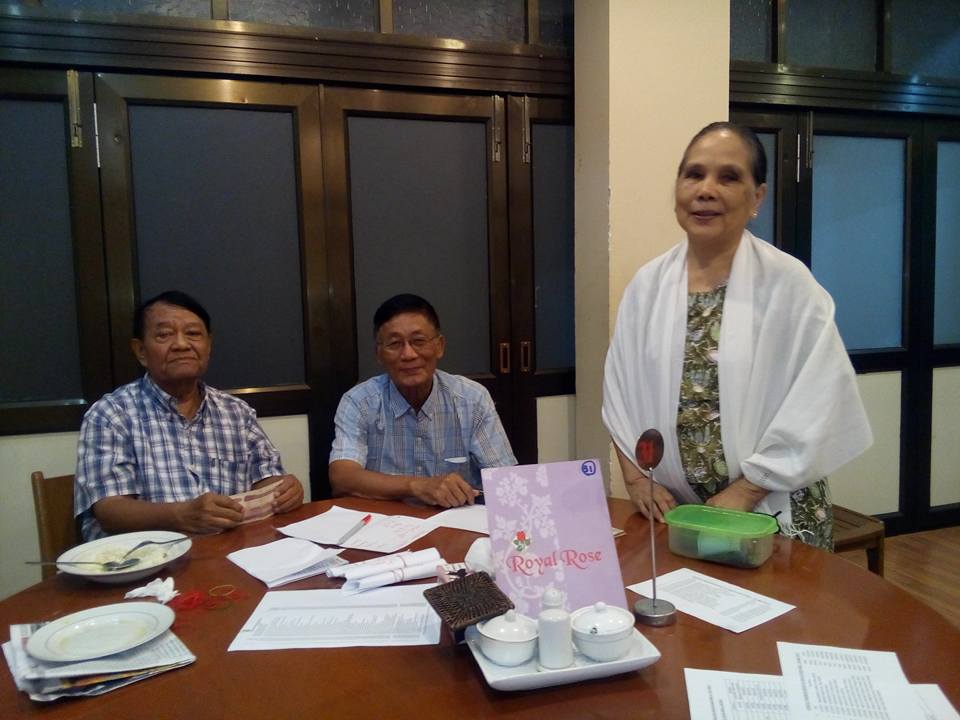
  • Saya Allen Htay

    SPZP-2000 Organizers
    • Leader, San Francisco Bay Area RIT Alumni Group
    • Founding member of RIT Alumni International and first President
    • Wrote a classic article for SPZP-2000
      to raise awareness of the First RIT Grand Reunion and Saya Pu Zaw Pwe
    • Saya passed away several years back
    • In Saya’s memory, Daw Mu Mu Khin
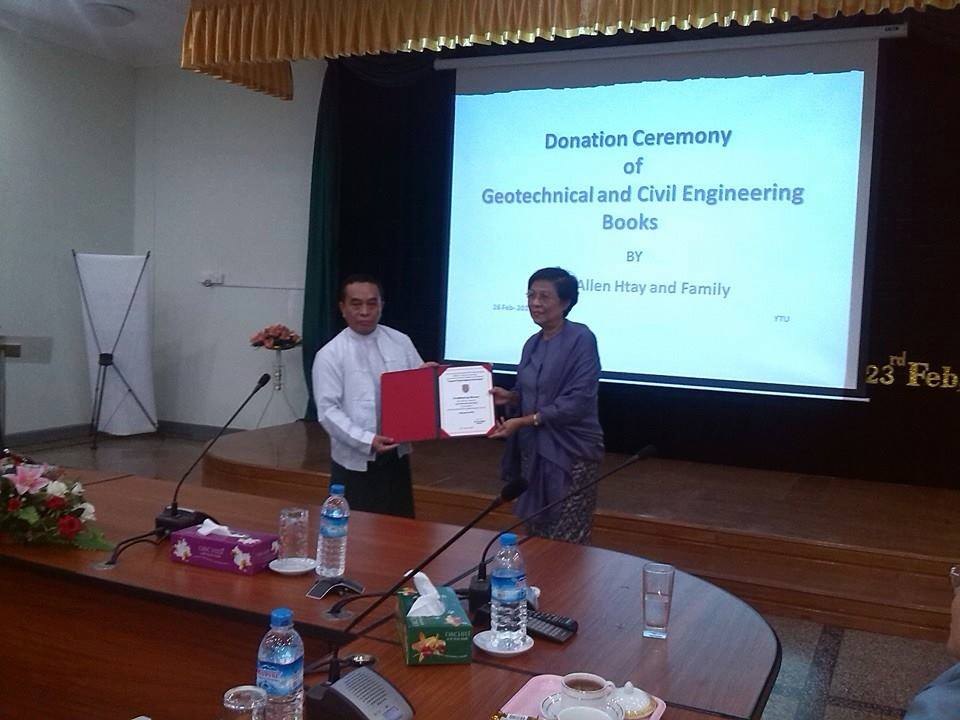
      donated Saya’s books to YTU Library
      provided financial support for eligible YTU students
    Donation of Saya Allen’s Books

    Brother, can you afford US $500?

    by Allen Htay

    And many weekends spent away from your family as well? If you can then you probably are a member of the RIT Grand Reunion and Saya Pu Zaw Pwe organizing committee.

    It all began one day several months ago when we met over lunch at Benny Tan’s home in Hillsborough. Ko Hla Min and Ko Khin Maung Zaw among the lunch party had started the RIT Alumni website and were receiving enthusiastic responses. Hearing that the duo were carrying on the project all by themselves we decided to throw in our moral and financial support to assure its survival, realizing that it was providing a needed service for the RIT alumni to locate and communicate with each other. Every one present, ten of us at that time, took out our checkbooks and wrote out one hundred dollars each, with promises of more as needed. We informally called ourselves the RIT Alumni Bay Area Group. I was asked to be the group leader.

    After that fateful event we continue to have regular meetings, hosted in turn at the homes of some among group members: Ko Hla Min, Maurice Chee, Ko Myat Htoo, Ko Thein Aung, and most recently Dr Nyo Win. Did I leave out any one? Ah yes! Ko Myint Swe and San San Swe. All the while the membership continues to grow and our objective keeps on changing from support of the website to some vague dream of a future RIT alumni organization on a global scale and finally settled on a plan for RIT Alumni Grand Reunion at the beginning of the 21st Century. Ko Hla Min broached the idea to include Saya Pu Zaw Pwe as part of the Grand Reunion in keeping with the Myanmar custom of honoring one’s teachers. As our plan jelled we got carried away by our own excitement and started talking about holding the reunion before the end of the Year 2000. After all, ending one millennium successfully augers well for success in the next millennium.

    Before we fully realized what we were up to we have found an ideal site, the Embassy Suites Hotel conference hall near the San Francisco International Airport, and found ourselves making a commitment for a definite date, 28 October 2000 and a attendance fee of fifty dollars, a modest amount to encourage maximum number of Alumni to participate. The minimum capacity of the conference hall is 200 seats and we were required to make down payment and sign a rental and service agreement based on 200 seatings. Our most optimistic estimate at the time was 100 attendees. If the attendance is low that means the Bay Area Group, as the Organizing Committee
    was not in force at the time, will have to make up the short fall. Which could amount to as much as five thousand dollars, or five hundred dollar from each group member. We hesitated a moment to reflect on what that means to us individually in terms of diminished spending power. But, in the end our attachment to RIT and the engineering profession, our sincere desire to meet the Sayas and class mates from whom we were separated for long over came us. We will accept the risks.

    Thus was born the preparations in full swing for the Grand RIT Reunion and Saya Pu Zaw Pwe. Others must tell the rest of the story – of struggles, compromises, and elations along the way and from participants themselves what it means to be present at the defining moment in the history of RIT Alumni.

    Allen Htay,
    RIT Alumni International – Bay Area Group
    RIT Grand Reunion and Saya Pu Zaw Pwe Organizing Committee

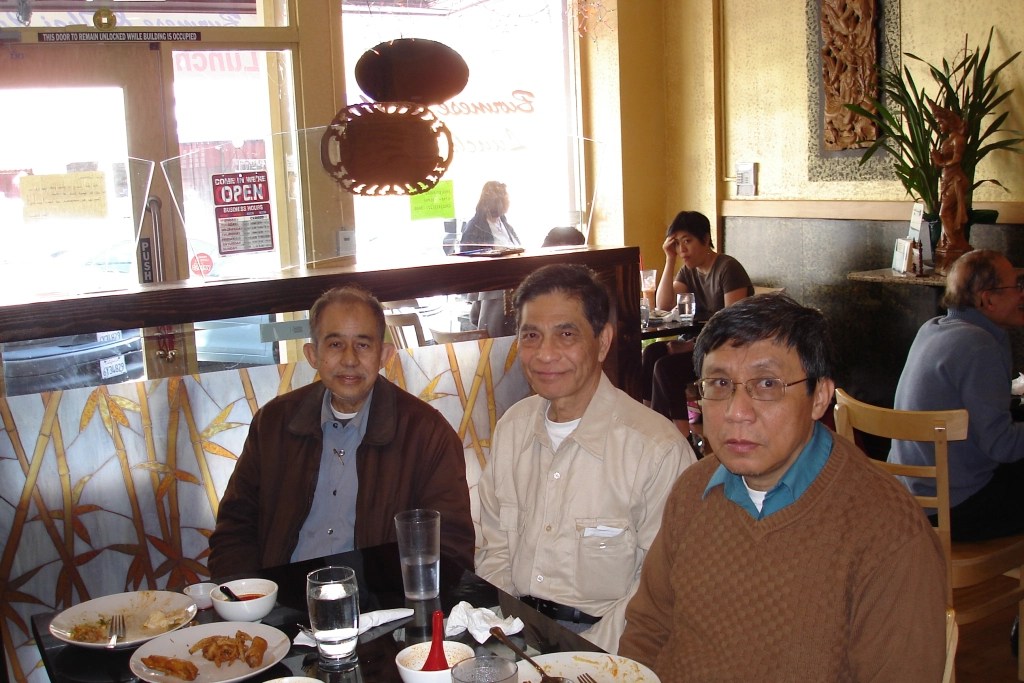
    Saya Allen, Dr, San Lin and Hla Min
    Class of C58
    Class of C58
    This image has an empty alt attribute; its file name is bay-area-0.jpg
    SF Bay Area RIT Alumni Group
  • RUBC Alumni

    Kin Maung Bo

    • Past Captain and Gold
    • Commander / First native Chief of the Burma Navy
    • Succeeded by Commodore Than Pe

    Commodore Than Pe

    • Past Captain and Gold
    • Vice Chief of Staff (Navy)
    • Member of 17-man Revolutionary Council in 1962
    • Minister of Health and Education
    • Succeeded Sir Arthur Eggar as President of RUBC
    • Helped found Defense Services Rowing Club and Burma Rowing Federation

    James Barrington

    • Gold
    • ICS
    • Permanent Representative of the Burmese Delegation to the United Nations
    • Preceded U Thant as Permanent Representative
    • Succeeded U Thant who was elected Secretary General of the United Nations

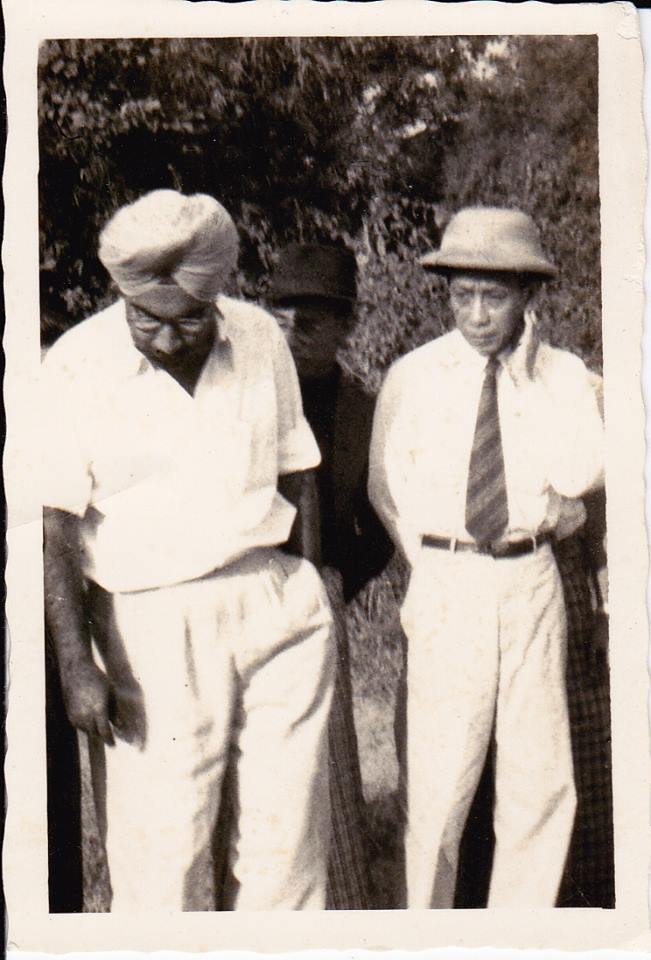
    Balwant Singh

    • Gold
    • Pali
    • Commissioner of Pegu (Bago) Division
    • High ranking official in the United Nations for Security

    Chan Tha

    • Past Captain and Gold
    • Soccer star (Faculty of Engineering, Rangoon University team Captain, Burma Selected)

    Harry Saing (Htut Saing)

    • Past Captain and Gold)
    • Multiple sports athlete : represented Faculty of Medicine, Rangoon University and Burma in Hockey, Cricket, Soccer, Track and Field, Rowing
    • Represented RUBC 10+ times
    • Won Venables Bowl for Coxless Pairs at the 1958 ARAE Regatta at Calcutta with Tin Htoon
    • Won Willingdon Trophy for Coxed Fours at the 1960 ARAE Regatta at Colombo with Tin Htoon, Victor Htun Shein, Sunny Teng and Sein Htoon
    • Pediatric Surgeon: With Dr. Pe Nyun (Past Secretary and Gold, Lead Surgeon), Ko Harry conducted the first operation in Burma to separate conjoined twins (Ma Nan Soe and Ma Nan San)
    • Professor at Hong Kong Medical School
    • Patron of Hong Kong Rowing / Sailing Club
    • His ashes were scattered into the waters near the Hong Kong Rowing Club
    • He supported RUBC teams competing at the FEARA Regatta in Hong Kong
    • Mostly rowed as Bow.
    • In 1962, Ko Harry coached seven new Golds and rowed as Timing Stroke. Ko Win Kyi rowed as (7). Myo Tin (6), Micky Tan (5), Htain Linn (4), Oung Kyaing (3), Winston Tun Thoung (2), Myo Myint (Bow), Victor Wu (Cox) benefited from his coaching.

    Some Golds from the 1950s & 1960s

    • U Maung Maung Than Tun
    • Dr. Myo Tint
    • U Tin Htut
    • U Tin Htoon
    • Lawrence Sein Tun Aung
    • Jimmy Saw Lwin
    • Aunt Kyi
    • U Tun Shein (Willie Saing)
    • U San Maung (Gerald Sein)
    • Dr. Hla Min (Eddie Chan)
    • M. Hla Min (E A Moosaji)
    • U Han Tin
    • U Sein Htoon
    • Victor Htun Shein
    • Sunny Teng
    • U Mya Maung (U Min Aung)
    • Mehm Than Thoung (Maurice Tun Thoung)
    • Dr. Tin Wa
    • U Tun Aung (George Singh)
    • Dr. Donald Chan
    • Dr. Thein Htut
    • G Ko Lay
    • L. Than Myint
    • U Than Soe
    • U Tun Zan
    • U Myo Tin (William Hone)
    • U Htain Lin
    • Mehm Myo Thoung (Winston Tun Thoung)
    • U Thein Aung (Micky Tan)
    • U Oung Kyaing
    • U Myo Myint
    • U Tin Aung (Victor Wu)
    • U Thaung Lwin
    • U Than Htut
  • RUBC (1)

    • Rangoon University Boat Club (RUBC) was founded by Law Professor Sir Arthur Eggar in 1923.
    • RUBC produced not only outstanding rowers, but also successful entrepreneurs, educators, professors, doctors, lawyers, scientists, engineers, diplomats, armed forces personnel (to name a few)

    RUBC and Defense Services

    Kin Maung Bo

    • Past Captain and Gold
    • Commander / First native Chief of the Burma Navy
    • Succeeded by Commodore Than Pe

    Commodore Than Pe

    • Past Captain and Gold
    • Vice Chief of Staff (Navy)
    • Member of 17-man Revolutionary Council in 1962
    • Minister of Health and Education
    • Succeeded Sir Arthur Eggar as President of RUBC
    • Helped found Defense Services Rowing Club and Burma Rowing Federation

    Bohmu Maung Maung Than Tun

    • Past Captain and Gold
    • Served as OSD (Officer on Special Duty) under Commodore Than Pe
    • Helped found Defense Services Rowing Club and Burma Rowing Federation
    • Oldest among the Past Captains who are alive
    • First pair of Father-Son who are Past Captain and Gold
    • Hla Maw Tun (Past Secretary and Gold)
    • Aung Khine (Past Captain and Gold)

    Miscellaneous

    • Several others served in the Army and Air Force.

    RUBC and United Nations

    James Barrington

    • Gold
    • ICS
    • Permanent Representative of the Burmese Delegation to the United Nations
    • Preceded U Thant as Permanent Representative
    • Succeeded U Thant who was elected Secretary General of the United Nations

    Balwant Singh

    • Gold
    • Majored in Pali
    • Commissioner of Pegu (Bago) Division
    • High ranking official in the United Nations for Security

    Miscellaneous

    • Several others worked on UN organizations and projects.

    Multiple Sports Athletes

    Chan Tha

    • Past Captain and Gold
    • Captain of the RU Prome Hall Soccer team which won the Inter-Hall trophy for three consecutive years
    • Played soccer for
      Faculty of Engineering, Rangoon University
      and Burma

    Dr. Harry Saing

    • Past Captain and Gold
    • Represented Faculty of Medicine, Rangoon University and Burma in several sports
      Hockey
      Cricket
      Soccer
      Track and Field
      Rowing
    • Represented RUBC 10+ times
    • Won Venables Bowl for Coxless Pairs at the 1958 ARAE Regatta at Calcutta with Tin Htoon
    • Won Willingdon Trophy for Coxed Fours at the 1960 ARAE Regatta at Colombo with Tin Htoon, Victor Htun Shein, Sunny Teng and Sein Htoon
    • Pediatric Surgeon:
      With Dr. Pe Nyun (Past Secretary and Gold, Lead Surgeon), he conducted the first operation in Burma to separate conjoined twins (Ma Nan Soe and Ma Nan San)
    • Professor at Hong Kong Medical School
    • Patron of Hong Kong Rowing / Sailing Club
    • His ashes were scattered into the waters near the Hong Kong Rowing Club
    • He supported RUBC teams competing at the FEARA Regatta in Hong Kong
    • Mostly rowed as Bow.
    • In 1962, Ko Harry coached seven new Golds and rowed as Timing Stroke. Ko Win Kyi rowed as (7). Myo Tin (6), Micky Tan (5), Htain Linn (4), Oung Kyaing (3), Winston Tun Thoung (2), Myo Myint (Bow), Victor Wu (Cox) benefited from his coaching.

    Miscellaneous

    • Several others represented in other sports

      Boxing
      Judo
      Swimming and Water Polo
      Track and Field
      Yachting

    Some Golds from the early days

    • U Tin U
      Most senior among the Past Captains who are alive
      Represented RUBC at the 1948 Independence Day Regatta with Dr. Pe Nyun, Dr. Pe Thein and Bobby Tin
    • U Maung Maung Than Tun
      Oldest among the Past Captains who are alive
    • Dr. Myo Tint (Past Captain)
    • U Tin Htut (Past Captain)
    • Dr. Harry Saing (Past Captain, ARAE Champion in 1958 &1960, Club Coach)
    • U Tin Htoon (Past Captain, ARAE Champion in 1958 & 1960)
    • U Han Tin (Past Captain)
    • Dr. Tin Wa (Past Captain, 1959 Gold)
    • U Sein Htoon (Past Captain, ARAE Champion, 1960 Gold)
    • U Thaung Lwin (Past Captain, 1963 Gold)
    • U Myo Tin (William Hone, Past Captain, 1962 Gold)
    • Lawrence Sein Tun Aung
    • Jimmy Saw Lwin
    • Aunt Kyi
    • U Tun Shein (Willie Saing, 1954 Gold)
    • U San Maung (Gerald Sein, Club Coach)
    • Dr. Hla Min (Eddie Chan)
    • M. Hla Min (E A Moosaji)
    • U Tun Zan
    • U Tun Aung (George Singh)
    • Dr. Donald Chan
    • Dr. Thein Htut
    • G Ko Lay
    • L. Than Myint
    • U Than Soe
    • Victor Htun Shein (ARAE Champion, 1960 Gold)
    • Sunny Teng (ARAE Champion, 1960 Gold)
    • U Mya Maung (U Min Aung, 1961 Gold)
    • Mehm Than Thoung (Maurice Tun Thoung, 1961 Gold)
    • U Htain Lin (1962 Gold)
    • Mehm Myo Thoung (Winston Tun Thoung, 1962 Gold)
    • U Thein Aung (Micky Tan, 1962 Gold)
    • U Oung Kyaing (1962 Gold)
    • U Myo Myint (1962 Gold)
    • U Tin Aung (Victor Wu, 1962 Gold)
    • U Than Htut (1963 Gold)
  • De La Salle Schools in Burma

    • St. Patrick’s High School (Moulmein)
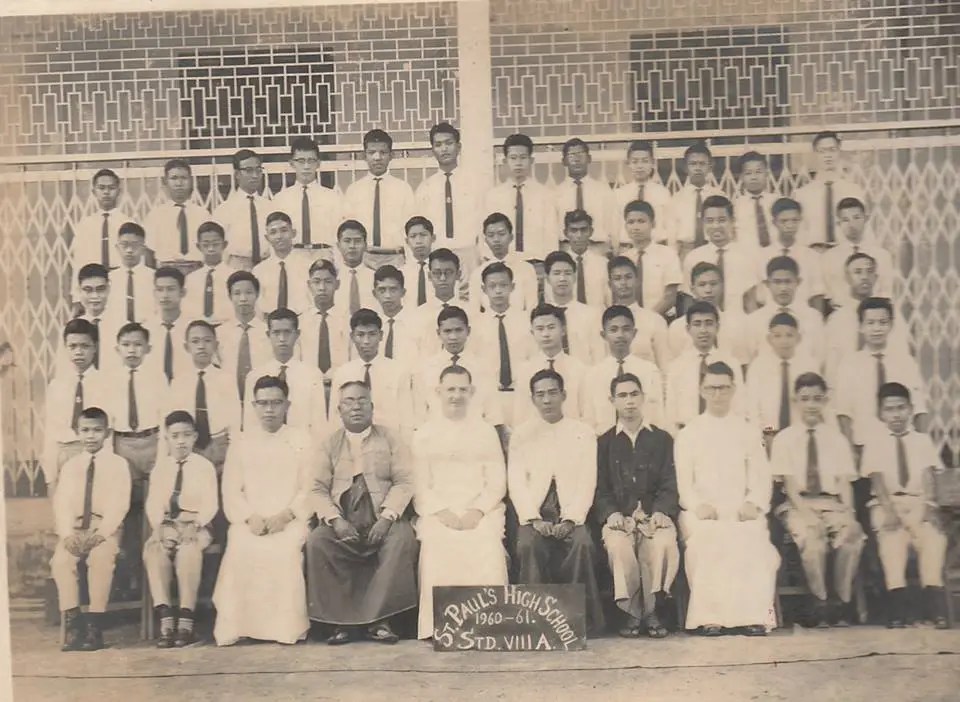
    • St. Paul’s High School (Rangoon)
    • St. Peter’s High School (Mandalay)
    • St. Albert’s High School (Maymyo)
    • St. Columban’s High School (Bhamo)
    • St. Joseph’s High School (Loikaw)
    • De La Salle School (Twante)
    • St. Paul’s celebrated its Centenary during our school days and the Sesquicentennial a few years back.

    Badges & Honor Roll

    St. Paul’s High School used to have an Honor Roll. It disappeared after the nationalization. It was recovered by U Soe Nyunt (Taw Win Hnin Si).

    Ko Richard San Tint is credited for the Badges & Roll of Honor.

    Outstanding Matriculates

    George Chapman (SPHS51), Dr. Nyunt Tin (SPHS52), Koon Yin Chu (SPHS54), U Ye Myint (St.Peter56), Dr. Soe Win (SPHS58), Dr. Frankie Ohn (SPHS59), Dr. Khin Maung U (SPHS63) and Bernard Khaw (SPHS65) stood First in Burma.

    Dr. Myo Tint (TTC52) was third.

    Dr. Harry Wang (Dr. Than Myint, SPHS56) was Joint-3rd. The top three (U Ye Myint, U Thaung Tin and U Khin Maung Than) were from St. Peter’s.

    Dr. Nyan Taw wrote :

    SPHS63 was the best performance in SPHS history having top 5 positions and top 7 positions of the 10 top positions for whole of Burma. We, Paulians are very proud !*

  • Intake of 1st BE in 1964

    400+ students were admitted.

    Some did not report for the classes.

    Some left RIT before graduation.

    120+ are GBNF

    The post is based on the Spreadsheet compiled by U Ohn Khine (M70).

    Ohn Khine

    Feel free to provide corrections and additional information.

    Students

    1. Zaw Min (Nawaday, EP70, MS, USA)

    RIT Luyechun

    Participated in English Debate

    Wrote “RIT Days 1964 – 1970”

    Worked in Electronics Industry

    Retired in Las Vegas, Nevada

    2. Tommy Shwe (GBNF)

    Played Badminton for RIT

    Left before graduation to Taiwan

    Passed away in California, USA

    3. Cho Aye (M70, GBNF, 2018)

    Represented RIT Hiking & Mountaineering in the All Universities & Institutes Expedition to Mount Victoria

    Organizer, Combined 1st BE Intake for 1964 and 1965

    4. Peter Pe (GBNF, 1969, accident)

    Represented RIT in Swimming and Water Polo

    Fell from a horse

    Brother of Saya Nita Pe

    5. Salai Myo Myint (C70)

    —-

    6. Aung Myint (C70, USA)

    7. Myint Myint Sein (Diana, M70, Canada)

    Performed dance at SPZP-2000

    8. Kyaw Win Maung (ChE70)

    RIT Luyechun

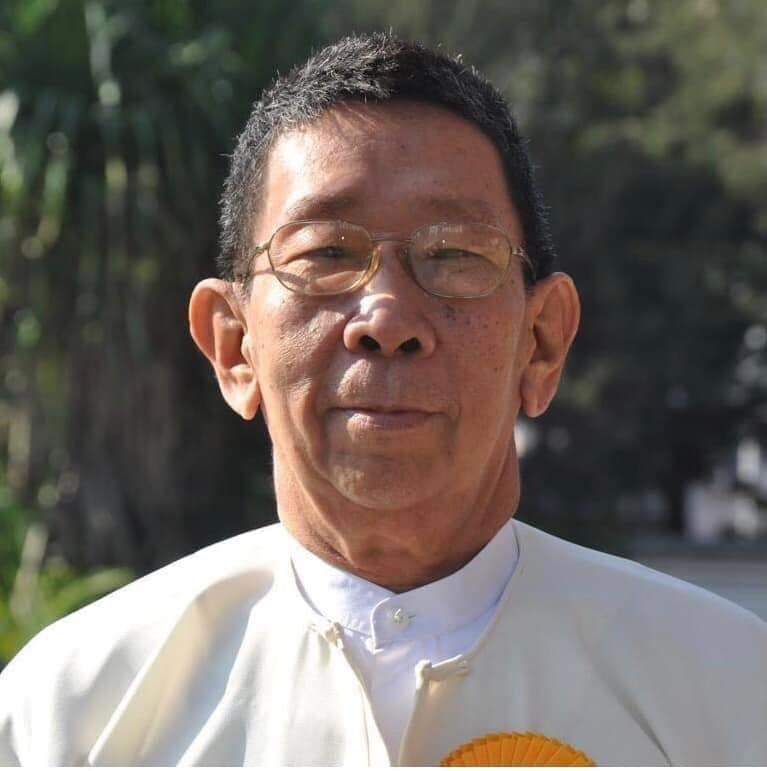
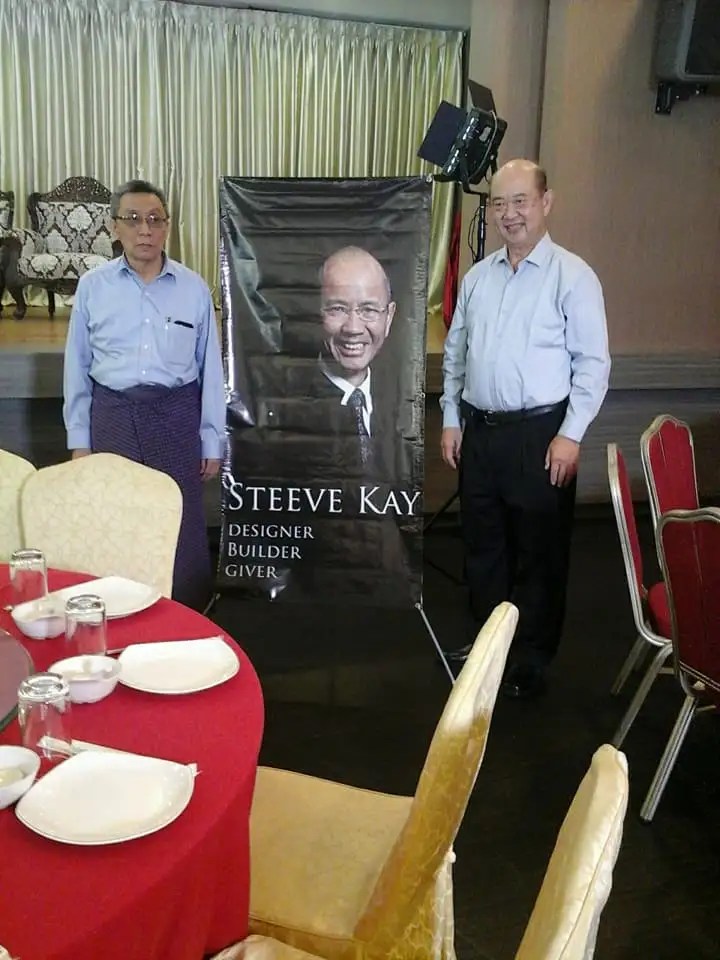
    9. Thaung Sein (Steeve Kay, EC70, USA, GBNF)

    Steeve Kay

    Entrepreneur and Philanthropist

    CEO, Kay Family Foundation

    Donated $200000+ to RIT-related activities

    Passed away in California, USA

    10. Win Maung (M70)

    —-

    11. S Joseph Aung (M70)

    12. Myo Myint (M70)

    13. Maung Maung (M70)

    14. ???

    15. Tin Maung Win (M70, Singapore)

    —-

    16. Win Tint (Patrick Hla Pe, EP70)

    17. Nay Aung (M70)

    18. Thaung Htike (EC70)

    19. Ma Kyin Myint (E 70)

    20. Maung Aung (C70, USA)

    Maung Aung (2nd from Left)

    —-

    21. Johnnie Bott

    22. Htun Kyaw (EC70)

    23. Zaw Win (C70, Australia)

    24. Sai Aung Min (M70)

    25. Than Lwin (EP70)

    —-

    26. Lin Zaw Min (Walter Tan, M70, USA)

    Past BOD, Norcal Ritaa

    Participated in English Debate

    27. Aung Nyein

    28. Kyaw Soe Oo

    29. Aung Htoo

    30. Tin Aye (M70)

    —-

    31. Win Aung (M70)

    32. Kyaw Win

    33. Tin Win

    34. Kyaw Tin

    35. Albert Trutwein

    —-

    36. Kyaw Nyunt

    37. Sonny Yeo (M70)

    38. Ma Hnin Yee (C70)

    39. Khin Maung Lay (Mutu, M71)

    40. Ma Khin Hme (Margaret, M70)

    —-

    41. Maung Maung Gyi (Victor Jones, C70)

    42. Ma Cho Cho Saw (ChE70)

    43. Myo Win Thein (Patrick Fong, C70)

    44. Maung Kaung (M71)

    45. Nay Win (T70)

    —-

    46. Kyaw Phone Myint (Victor Kyaw Phyo, M71, GBNF)

    47. Myo Nyunt

    48. Tin Ohn (M70)

    49. Nyunt Shwe

    50. Myo Myint

    —-

    51. Stanley Lim

    52. Naw Hta Khaw (EP70)

    53. Aung Khin (Lee Wee Kee, C7?)

    54. Naing Win (M70, GBNF)

    55. Sai Aung Hla (M70)

    —-

    56. Yee Yee Myint (C70)

    57. Thein Win (M/Ag70)

    58. Mya Daung (M/Ag71)

    59. Win Htut (C70)

    60. Lay Myint (C7?)

    —-

    61. Ma Win Yee (?7?)

    62. Than Htwe (Mn70)

    63. Ye Chit Pe (M70)

    64. ???

    65. Khin Maung Kyaw (M/Auto70)

    —-

    66. Khin Maung Pun (Pet70)

    67. Hla Htun (M/Ag70)

    68. Myo Thaw (Freddie Thaw)

    69. Tin Aung (EP70)

    70. Than Htun (M70)

    —-

    71. Aung Kyan (M/Auto70)

    72. Ma Khin Phyu Win (C?)

    73. Sai Maung Lin (M/Ag70)

    74. Aung Htun (M7?)

    75. Thet Win (M70, USA)

    —-

    76. Ma Thit Thit Aye (EP7?)

    77. Maung Maung Lwin (C71)

    78. Htun Swe (Terrence Lee, Pet7?)

    79. Win Htay (Walter Cheng Lyan, M70, USA)

    80. Kyaw Min Aung

    —-

    81. Myint Aung (M70)

    82. Hla Min (Pauk Si, E 70, GBNF)

    83. Htay Naing (?)

    84. Ye Myint (ChE70)

    85. Ba Kyaw (C70)

    —-

    86. Aung Lwin (M70)

    87. Han Tha Myint (EC70)

    88. Soe Win (EC70)

    89. Madan Chand (C70, USA)

    90. Ohn Thaung (C70)

    —-

    91. Thaung Htun (Robin Chu, M7?)

    92. Hla Myint (Met7?)

    93. Maung Maung Myint (M7?)

    94. Soe Tint (Nevil Kyi Maung, C7?)

    95. Maung Maung Thaw (EP70)

    —-

    96. Aung Thein (M70)

    97. Maung Maung Than (M/Ag70)

    98. Soe Win (M71)

    99. Nyunt Tin (M70)

    100. Le Le Win (Lillian, M71)

    —-

    101. Win Thein (?)

    102. Nan Lwin (EP70)

    103. Ma Myo Myat Myint (M70)

    104. Myat Khine (M7?)

    105. Thaung Han (?)

    —-

  • Uniform

    • Uniform may stand for “one form”.
    • In Statistics, Uniform Distribution is a type of data distribution.
    • During their university days, Bogyoke Aung San and U Thant had a debate on Uniform.

    Dress Codes

    • A uniform could specify
      (a) short or long pants (e.g. Kakki)
      (b) shirt (e.g. long sleeved white shirt)
      (c) optional : Necktie, Coat, Badge
    • The optional items may be worn at formal functions (e.g. Award Presentation Ceremony).

    Burmese Dress

    Burmese dress for males

    • Pasoe / Longyi
    • [Collarless] Shirt
    • Taik Pon
    • Optional : Gaung Baung

    St. Paul’s High School

    • Some schools may mandate their students to wear uniform on specified days (and may be every day).
    • During our younger days, we had to perform drill at the School Sports and at the Aung San Stadium for specified events (e.g. Education Day Celebration). We had to dress up in uniform.


    UTC

    • Those joining UTC (Universities’ Training Corps) are given two sets of [usually old] uniforms.
    • Most prefer to buy or order their own.
    UTC

    Faculty of Engineering

    • U Ba Hli (first native Dean of Engineering) is seen in photos wearing a uniform.
    U Ba Hli

    Rangoon University Boat Club

    • RUBC (Rangoon University Boat Club) awards Half Green, Full Green and Gold.
    • RUBC specifies Dress Code for the award winners.
    RUBC

    USA Sports

    • In the USA, sports team have at least two sets of uniforms :
      one for playing at Home, and another for playing elsewhere.
  • Books by Tun Tun (Mining)

    ထွန်းထွန်း (သတ္တုတွင်း) ရဲ့ စာအုပ်များ

    စက်မှုတွင်းထွက် ကုန်ကြမ်းများ Industrial Minerals

    မြေရှားတွင်းထွက်များ Rare Earth Minerals

    ရွှေရတု မောင်နှံ GJ Couple

    စက်မှုတက္ကသိုလ် ရောင်းရင်းများ With RIT Alumni