Each tile holds a letter worth one to ten points, or a “blank” (similar to a “joker” or a “wild card” in card games).
Rules
The word must appear in the official set of dictionaries (e.g. Chamber’s Dictionary, Jone’s Pronouncing Dictionary).
A player can challenge the validity of a word. He or she will forfeit a turn if the challenge is unsuccessful.
A bonus of 50 points is given for a word formed with all seven tiles. e.g. MAJESTY
In some contests, adding “s” to a singular to make it plural is disallowed.
Scrabble Tournaments
In our younger days, Scrabble tournaments were held by
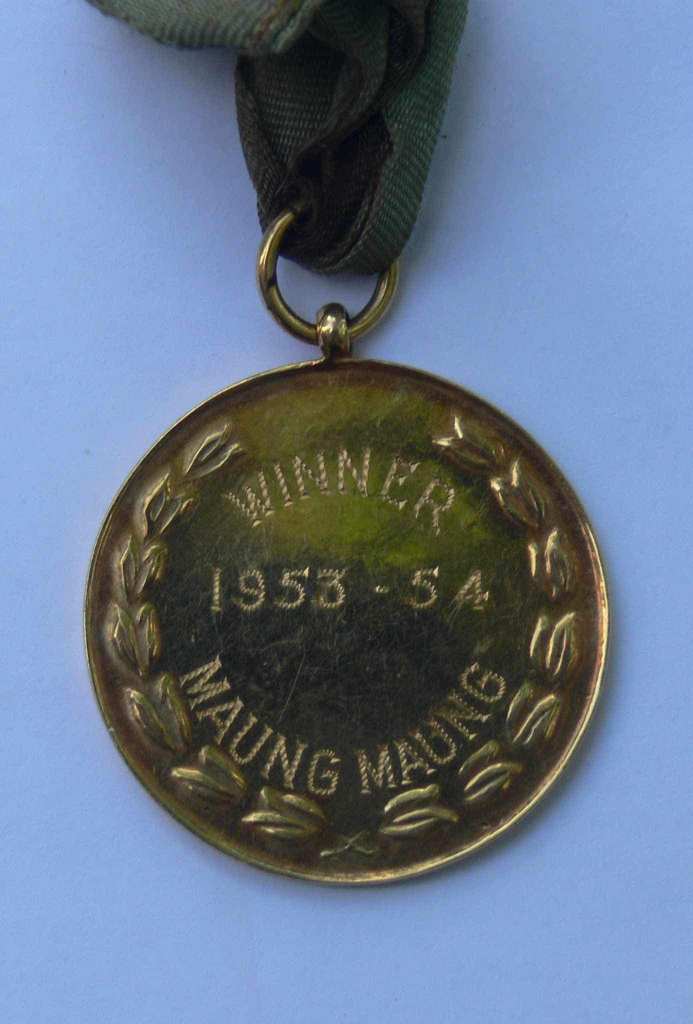
Guardian Newspaper P. Aung Khin (Editor, “Dawlay’s Circle” was a host. There was a “Tiger” Scrabble team with three players. One of the Tigers joined Saya Des Rodgers to play Doubles.
RIT Scrabble Club Saya Des and Saya U Khin were hosts.
YMCA It is known for the Chess Champions (e.g. Saya Dawson). It also hosted Scrabble tournaments.
Saya Des Rodgers won several trophies. Most of the English sayas (e.g. U Khin) and sayamas (e.g. Daw Toni) played Scrabble along with the students such as Ko Myo Tun (Bobby) and Ko Khin Maung Win (Roland). Civil Engineering sayas (e.g. U Tin Win) also frequent the English Department for Scrabble sessions and tournaments.
Saya U Khin has Chamber’s Dictionary and Jone’s Pronouncing Dictionary on his desk for use in the challenges.
Miscellaneous
Saya Des moved to UK and then Canada.
Saya U Khin moved to Taiwan.
Sayama Toni joined her husband (who retired as Ambassador). After his demise, Sayama moved back to Yangon. She reports about the gatherings (sumptuous food and Scrabble) in Yangon.
After retirement, Bobby was ordained as iAshin Pannagavesaka (Pa Auk Tawya monastery in Mawlamyine). He served as a Librarian and Interpreter. He has taught English to monks and youths at various cities. He mentioned that Paul requested him to be a judge at the Guardian Scrabble tournaments, so he could not participate.
Roland retired after working for an Embassy in Yangon.
Stories by U Thein Han (Maryland) Former Systems Engineer, IBM Burma
Long Journey
From March 1, 1929
It’s been a long journey.91 years is long and I made it. I’ve reached the aged barrier 90 and from now on everyday is a bonus for me. My health is the same, no problem. Blood tests results are good. Memory is still sharp. I can drive my car for grocery shopping. I think I will be with you all this year.
I’m living proof that Exercise and Healthy food will keep you in good health and prolong your life. I’ve been doing exercise since I retired in 1994 after I joined HP Senior Center using the Physical Equipment and having lunch at the center. I use light weights (30, 40 lbs) for arm, leg, thigh exercise and walk fast for 1/2 mile (10 minutes) on a Treadmill.
At night before I go to bed, I do Balance exercise 3 times a week given to me by my Physical Therapist.
So Folks, “It’s your life, Exercise, Eat Healthy Food, No Smoking and Drinking, Travel and Enjoy your good life”.
A True Story
When I was working at Montgomery County, Division Of Parking, during my lunch break I took a cab to go to a Chinese Restaurant in Silver Spring [Maryland, USA]. The driver was an African-American from Jamaica. On the way I had a conversation with him and came to know he had a daughter studying at Howard University (African-American University) to be a Lawyer. It happened that my wife was working as a Librarian at Howard University at Washington D.C. so I had a good chat with him. When we arrived at the restaurant I asked him if he had his lunch. He said, “No”. I invited him to have lunch with me. He accepted. I had a long talk with him about Jamaica. After lunch he dropped me at my work.
A few days later while I was walking back from lunch in Silver Spring, it rained heavily. I did not have an umbrella. All of a sudden a car stopped beside me. It was James the Taxi driver that I gave lunch. He told me to hop in and took me to my office. When I asked him, “What is the fare?”, he said, “It’s on the house. No problem”.
I believe in luck
It was in 1948 during my Rangoon University days I did Nation Newspaper Crossword Puzzle and won 2000 Kyats. At that time the value of Kyat was very good. With the money I won I bought a Jeep costing 3000 Kyats.
My next luck was also during my University days when I went to a movie with my friend Ko Sein Lwin. On the return while I was driving my Jeep with my friend beside me, at the corner of Prome Road and Medical College I, we picked up 800 Kyats which was lying on the Road.
When I arrived in Maryland (USA), I went to Safeway Grocery to buy bread. When I took the bread from the shelf I found $20 on the shelf. It was a great help to me when I was penniless.
Another time was when I was walking on Wheaton Avenue with my son, we found $40 on the street.
During our Burmese Christmas Party I won the door prize which was a Television.
At the Thai King’s Birthday party given by our Thai friend, I won Thai Airways luggage for the door prize.
At our Senior Center I won a Cup as a door prize.
While working at Montgomery County, in 1977, I won 2nd prize of the Maryland Lottery which was $2000, because I hit five numbers out of six numbers. At that time $2000 was a lot of money. The 2nd prize is now one million Dollars.
The 1st prize then was one million Dollars. On 25 August 2018 the 1st prize went up to 522 Million and it was won by 11 employees of a bank because they were lucky.
The 13 Thai Cave Footballers survived because of their luck.
My University friend Billy Wu From Maymyo went back home during a holiday, the UBA Dakota plane crashed due to bad weather, but he was lucky and he survived.
Everyone has luck, but we don’t know when we will be lucky.
My Barber
Ko Aye Pe has been my barber since my University days in 1947 till 1971. He also cut the hair of my two sons. He worked at Varsity Hair Dressing Salon in Bogyoke Aung San Market. We were friends till I left for USA in 1971. He was a kind and obliging person and whenever I travel abroad I brought a shirt for him.
On my first visit back to Myanmar in 2005 I wanted to see him and asked my friend U Hla Soe if he knew Ko Aye Pe’s whereabouts. U Hla Soe told me that he has retired and cuts people hair at his home and gave me his address.
Ko San Aung (Sydney Tin, Ko Pyu) and I took a taxi and went to search for him. We found him living in an apartment near the Old Central Jail behind Medical College 1. He was very happy to see me. He told me he’s retired and he’s working at home and the barber chair that I’m sitting on was given by U Hla Soe. I had a long chat with him and returned back to Winner Inn Hotel.
On my next visit to Myanmar two years later, we went to his apartment but was told by his neighbor that he had moved to Ahlone and gave us the address. We went there and found him living with his niece’s family. When we met him he was BLIND. His niece told him there’s someone to see him but did not tell who we were. I sat down next to him and asked him if he knew who I was. He touched my face with his hand to find out who I was. I then told him that I was Ko Charlie and came back to Myanmar for a visit. When he touched my face with his hand my eyes became wet and I was very sad to see him blind, he must be about 75 years then.
It must have been Cataract which could have been treated and cured, maybe no one told him to see an Eye Doctor or that he may not have the cash for the surgery.
Before we left I gave him Kyats 100,000 for being a good friend who was always willing to cut hair for my kids at home. We then said goodbye to him and returned back to Winner Inn Hotel.
Ko Aye Pe was kind to me when I needed his services and his METTA to me. In return I was able to share what I can with him when he needed it.
My Honeymoon
April 23, 1958
It is on this day 23rd April 1958 that I got married to my wife Khin Khin Htway (Flora) at the Strand Hotel. We stayed two nights with her parents and left for our honeymoon to Tokyo, Japan.
April 25, 1958
We arrived Tokyo 0n the 25th and was met at the airport by Mr Fonseka, Ceylon (now Siri Lanka) Ambassador to Japan. He was was a friend of my wife father when he was Ceylon Ambassador to Burma. He took us to a restaurant for lunch and later dropped us at a Hotel near the Imperial Palace.
April 26, 2958
The next day we took the high speed bullet train to Osaka to visit Mr Fukutomi who is a friend and was once an IBM Engineer in Burma. He lived in Takarazuka, a suburb of Osaka. He took us to see the famous Takarazuka Kabuki show performed by women artists only, the men parts were also performed by ladies and not a single men was involved in it.
Trips
We stayed one night in Osaka and then left for our trip to Kyoto, Nara,Yokohama, and Kamakura where there is a Huge BUDDHA sitting statue, it is also a popular beach resort and returned to Tokyo.
Back to Tokyo
In Tokyo we saw a modern topless show at Asakusa Theatre, did some shopping at Diamaru Department store and took a stroll on GINZA street.
We left Japan after three weeks of our memorable honeymoon in Japan.
Hong Kong
From Tokyo we flew to Hong Kong, we stayed at at the famous Peninsular Hotel on Kowloon side where the airport is.
One day while shopping in Hong Kong we met four Burmese gentlemen on the street and they were Executive Members of Rangoon Turf Club, they were in Hong Kong at the invitation of Hong Kong Turf Club. One of them, U Chit Khaing saw my wife in her longyi and came to talk to us, he then invited us for a cruise on the Hong Kong Harbour which the Hong Kong Turf Club had arranged for them in the evening. The cruise was during sunset and it was a beautiful ride relaxing on the boat, breathing the fresh air of Hong Kong Harbour and watching the colored lights of Skyscrapers opened one by one, twinkling on the hill. We returned to Rangoon the next day.
Blessed to be together for 62 years
It is now 62 years since our honeymoon in Japan and we are fortunate to be still together and is able to take care of each other.
Most Senior Centers require members to be 50 years or older. They want young, active seniors. Some volunteers are in their 80s and 90s.
AARP (Association for American Retired Professionals) admits “retirees” who are 50+ years old. This leaves room for marketing to people who are still active.
Some restaurants and shops provide discount to 60+ years and older.
The “official” age recognized by Federal and State Agencies is 65+.
Senior in Myanmar
According to U Tin Htut (Harry, Mon Yu), a Sar Yay Saya has to be 80 years or older to be a recipient of the “Thet Kyee Pu Zaw Pwe“.
MES sets 75 years as a threshold for the “Paying Homage Ceremonies” for Engineers and Architects. They may or may not be sayas.
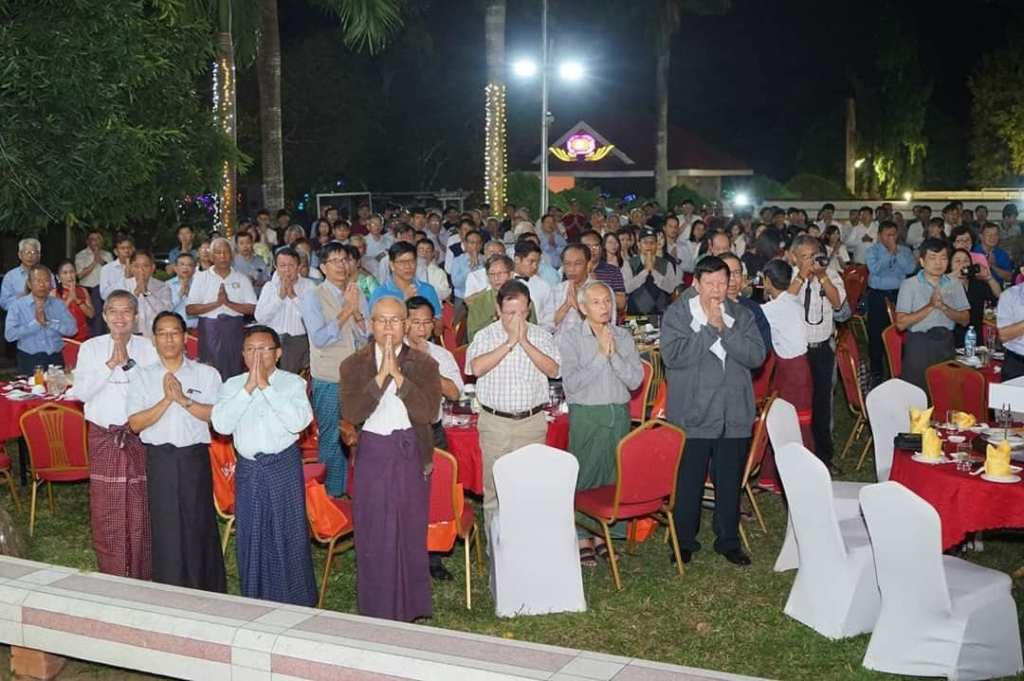
At the All Mechanical Gathering in 2019, engineers who are 80 or more years old were invited on the stage. The attendees paid respect standing.
Seniors and SPZPs
Some seniors are reluctant to attend Saya Pu Zaw Pwes (SPZP). They could not easily find their classmates among the huge crowd. Some are uncomfortable to pay respect to the younger sayas on the stage.
A partial solution was provided at some SPZPs.
The sayas and sayamas were divided into three (or more batches).
The advantage is that Seniors can choose to pay respect to their mentors, and relax when the younger sayas are on stage.
A drawback is that it takes long to get the sayas and sayamas get on and off the stage.
Joke about Seniors
“Uncle, you call you wife Honey. What is her name?” “I forgot her name 30 years ago.”
In Computer Science and applications, a Programming Language is a language used to program (e.g. instruct) computers.
Machine Language
In the early days, computer engineers and selected programmers have to program in Machine Language (with strings of Zeroes and Ones). They are due partly to the choice of Binary Number System as the basis of designing Arithmetic and Logic Unit inside the computer.
On the ICL 1902S computer, we often have to use the 24 keys to enter short pieces of Machine Code. That is history.
Assembly Language
To bridge the human users and the computers, the next step was to use Assembly Languages such as
Simple/Symbolic Assembly Language
Macro Assembly Language.
A Macro Processor translates Macros (a well-defined group of Assembly Language instructions).
An Assembler translates a program in Assembly Language into Machine Language instructions.
History of Programming Languages
The development of the first 11 (or so) programming languages can be found in the first HOPL (History of Programming Languages) Conference.
Currently, there are thousands of programming languages (some for academic purposes) and a limited number used for production.
Evolution of Programming Style
Over the years, the style of programming evolved. The list is not exclusive.
Procedural programming e.g. telling the computer system what to do, emphasis on the “verbs”
Non-procedural programming e.g. telling the computer system what one wants
Object Oriented programming e.g. emphasis on the “nouns”
Functional programming e.g. based on “functions”
Logic programming e.g. based on “Horn logic” and similar logic systems
Top down step wise development
Bottom up & Middle out techniques
Artificial Intelligence (AI) programming
Theoretical model
With each paradigm, there are several programming languages with known advantages and limitations.
There is a theoretical model called “Turing Machine”, which is primitive but has the computational power of modern computers.
The machine was proposed by Alan M. Turing (who has an ACM award named after him that is considered the “Nobel Prize in Computing“).
Alan Perlis, a pioneer Computer Scientist and Programming Language Designer, defined a “Turing Tar Pit, where everything is possible [to compute], but nothing is easy.”
Assistant Lecturers and above are Gazetted Officers.
Details (promotions, transfers, vacation) are recorded in the Gazette.
Changes
CLA was abolished.
New positions and scales were introduced.
A hybrid system (Professor, Associate Professor and Lecturer) was adopted instead of the more common system (Professor, Associate Professor and Assistant Professor)
The pay raises could not keep up with the rising cost of living.
Promotions take considerably longer.
In the early days, engineering graduates joined the Faculty of Engineering as Assistant Lecturers. In the later days, engineering graduates have to serve as Instructors before they become Assistant Lecturers.
In the early days, a Lecturer can get promoted to Professorship. In the later days, a Lecturer gets promoted to Associate Professor.
The Public Services Commission (PSC) took charge of the appointments of government employees.
Observation
In the old days, a University is a collection of Colleges. Most departments have a Professor, who also served as Head of the Department. Some departments were headed by Lecturers and even Assistant Lecturers.
There are now some Universities in Myanmar that do not have multiple Colleges. Some departments have several Professors.
Paritta is usually rendered as “Protective Verse”.
Early Texts
Hanthawaddy and Thudhammawaddy published early Paritta texts edited by Pali experts (e.g. Saya Phyay, U Pan Maung).
Versions
The Ministry of Religious Affairs published the standard version of 11 Pairtta Suttas, and the comprehensive version of 30+ Suttas (including the 11 Paritta Suttas).
The Suttas were approved/re-affirmed at the Sixth Buddhist Council.
Pali and Translation
Paritta texts with Pali and English translation were compiled and /or edited by Sayadaw U Silananda and Sao Htun Hmat Win.
Paritta texts with Pali and Burmese/Myanmar translation were compiled/edited by Sayadaw U Ayethaka, Dhammacariya U Soe Win, and Dhammacariya U Kyaw Lin.
Comprehensive Treatment
Comprehensive treatment of Paritta had been done by Thabyekan Sayadaw, and Sayadaw U Jotilankara.
Mon Version
Used to own a copy of a Pariita (Burmese and Mon version) given by the Dat Paung Zone Aung Min Gaung Sayadaw U Thilawunta.
Based on the Mon manuscripts. One difference is in the “last” Sutta. The Mon version has two major sections: one for chanting in the morning and one for chanting in the evening/night.
Schedule for Recitation
Customary for the Burmese Buddhist monks to recite all the 11 Suttas daily.
A recommendation for the lay people is to break up the 11 Suttas into seven groups, and chant a group per day.
The 11 Suttas will then be covered every week.
Audio
The Paritta verses by the various Sayadaws Mingun Tipitaka Sayadaw, Taung Tan Thatanapyu Sayadaw, U Silananda, Kyar Ni Kan Sayadaw, Aung San Tat Oo Sayadaw, Las Vegas Sayadaw U Zeya) are available as CDs.
Some (if not all) can be found at dhamma web sites such as dhammadownload.com and nibanna.com.
YouTube has a collection of Paritta recited by Myanmar, Sri Lankan, and Thai monks.
Forms of Pali
Pali is rendered in Romanized form (for international use) and in native versions (Myanmar, Sinhali, Thai, …).
Example: Lay people and most monks in Myanmar will say “Git sar mi”. Lay people and most (if not all) monks from Sri Lanka and Thai will say “gacchami”.
The most notable is known as the “Sterling Pound“. The British manufactured the “Silver Penny” made out of pure silver. 240 Silver Pennies presumably weighed one pound. Hence, the name “Sterling Pound”. 1 Pound = 20 shillings = 240 pennies
At one time, the Pound was tied to the “Gold Reserve“. In our younger days, 1 Pound was equivalent to about 13 Kyats.










 HlaMin