Per request of Sayagyi U Pe Maung Tin, the Burmese Department was formed as a Sub-department of the Department of Oriental Studies.
A few years later, Burmese became a separate Department.
Burmese Department
Saya U E Maung Pen name; Maung Thant Sin Saya U E (pronounced “Aye”) Maung served as its first Professor. His compilation “Garland of Kabyars (Poems)” was a prescribed text for my elder siblings. Spouse : Daw Khin Mya Mu is an expert in reading and transcribing Kyauk Sar (Inscription).
U Chan Mya Pen name : Mya Ketu
U Toe Aung Pen name: Kutha
U Hla Maung Taught Abhiddhama Member of Myanmar Sar Ah Phwe
U Sunn Tun (Mandalay) Wrote “Shay Tho” series
U Kyaw Yin Pen name: Kahtika U Kyaw Yin
Outstanding Alumni
Sayagyi U Pe Maung Tin was proud of his students — Theikpan Maung Wa, Zawgyi and Minthuwun — for founding the “Khit San Sar Pay”. He would express Mudita (Altruistic Joy) for their talents and achievements.
ICS U Sein Tin (Theikpan Maung Wa) Sad victim of a botched robbery We had to study his “Wut Htu Saung Par”
U Thein Han (Zawgyi) Laureate Poet Chief Librarian, Rangoon University Central Library
U Wun (Minthuwun) Head of the Translation Department of Rangoon University Compiler of “Myanamr Abhidan” For a short period, served as Professor Visiting Professor at Osaka University for four years Son : U Htin Kyaw (Former President)
Daw Khin Saw Mu Spouse : ICS U Ba Tint Children : Daw Khin Saw Tint (Bilingual writer), U Nay Oke Tint (Nay Oke St. Paul’s)
U Tin Aye (Shan Pyay) Succeeded U Wun as Head of Translation Department
U Kyaw Aung Editor of the Translation Department Author
Burmese Texts
“Kabyar Pan Kone” (Garland of Flowers) compiled by Saya U E Maung (which was prescribed for High School before our days)
“Myanmar Thadda” (Burmese Grammar) by Saya U Pe Maung Tin (which we studied in Middle School)
“U Pon Nya Wutthu Paung Kyote” compiled and annotated by Saya U Wun (which we studied in High School)
Poems by U Kyin U
Selections from Zat Taw Gyi Hse Bwe (e.g. Mahosadha)
Pyazat (e.g. Deva Gomban)
Burmese Language
Spoken language (Myanmar Sagar)
Written language (Myanmar Sar).
The spoken language predates the written language, which first appeared as the fourth and final language of the Mya Zedi Kyauksar (stone inscription).
An early Indo-Tibetan script was used to write Burmese.
Myanmar Sar Ah Phwe
The BSPP Government formed the Myanmar Sar Ah Phwe (Burmese Language Commission)
Bohmu Ba Thaung, Head of Burmese Department at DSA, served as early Head of the Commission
In the 1980s, several History Commission members were assigned to the Myanma Sar Ah Phwe.
Decline of formal Burmese
The Commission revised the Burmese spelling twice. Some revisions were ill-advised.
Authors and publishers were fined ten pyas for each violation of the spelling rules dictated by the Commission.
Many classic texts were ruined when every occurrence of TA had to be replaced with TIT to please the whims of the higher authorities. The rhyme and rhythm of the beloved texts were lost.
The rise of the Internet was sadly accompanied by the decline of Burmese usage and the adoption of slangs and abbreviations in messages, blogs and even articles.
For protection against and getting free from sickness and disease
Reference the three occasions when Venerable Mogallana, Venerable Kassapa, and Lord Buddha felt sick but were cured after listening to and contemplating on the “Seven factors of Enlightenment”
This is one of the Suttas that is not only for chanting but also for practice
Bojjhanga Suttas (in Pali Prose) in the Scriptures
One of the four Bhamaso Taya or Bhama Vihara (along with Karuna, Mudita, and Uppekha)
Practiced as a form of meditation
U Silananda‘s book on Protective Verses has a section on how to practice Loving Kindness Meditation.
Tipitaka Mingun Sayadawgyi recited the Two Methods of sending Metta. As mentioned in Metta Sutta Alternative: 528 “Metta” (13 x 4 x 12) They can be found on YouTube and CDs.
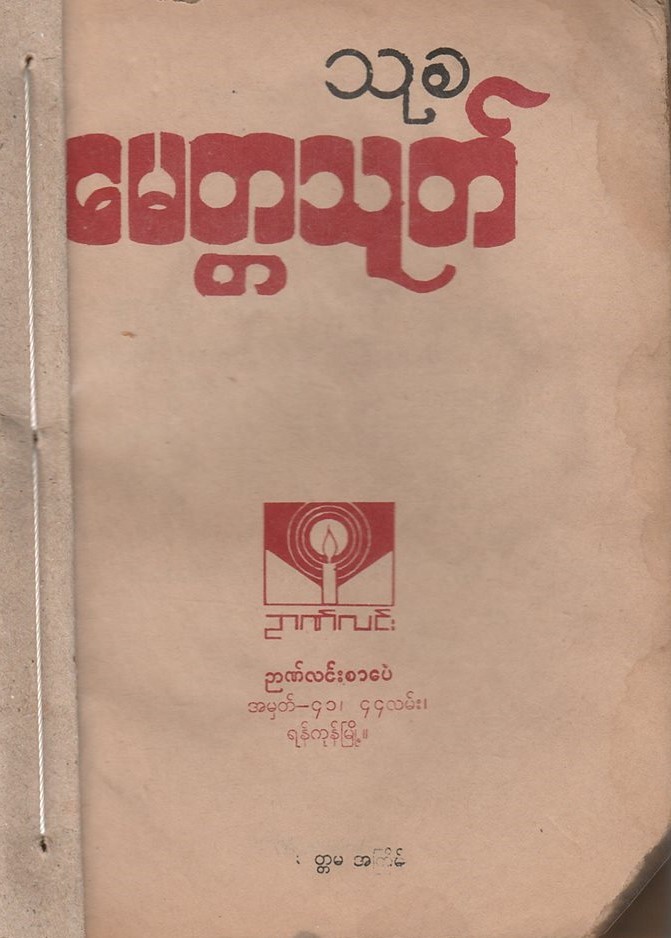
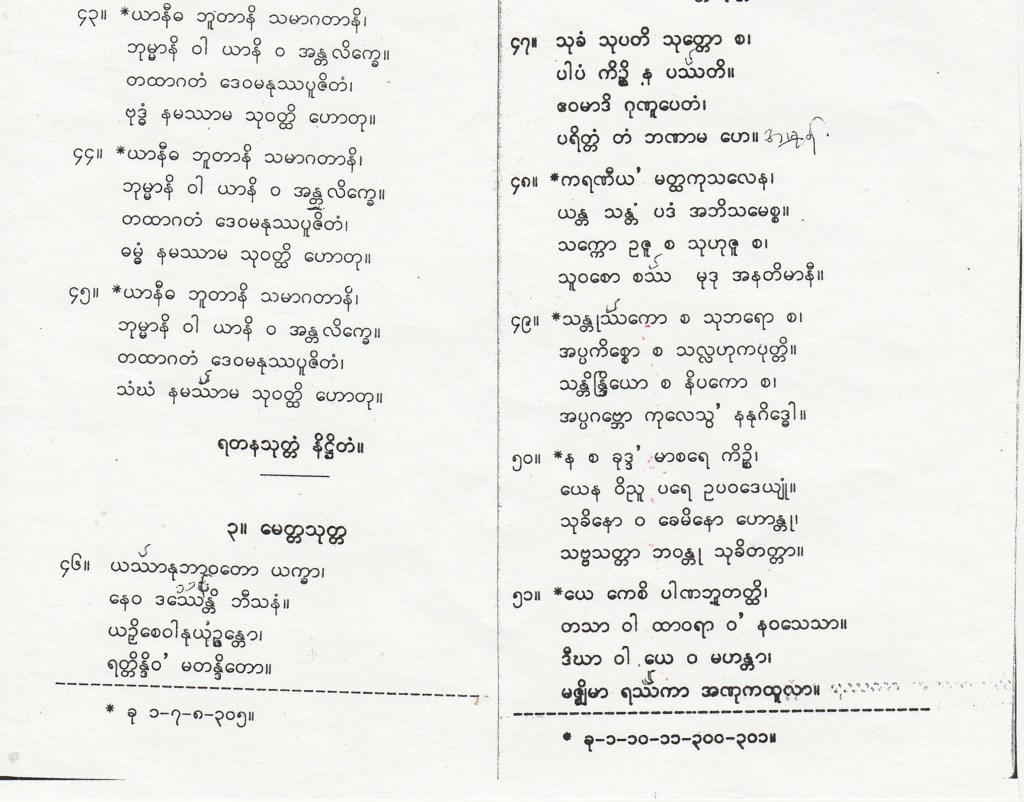
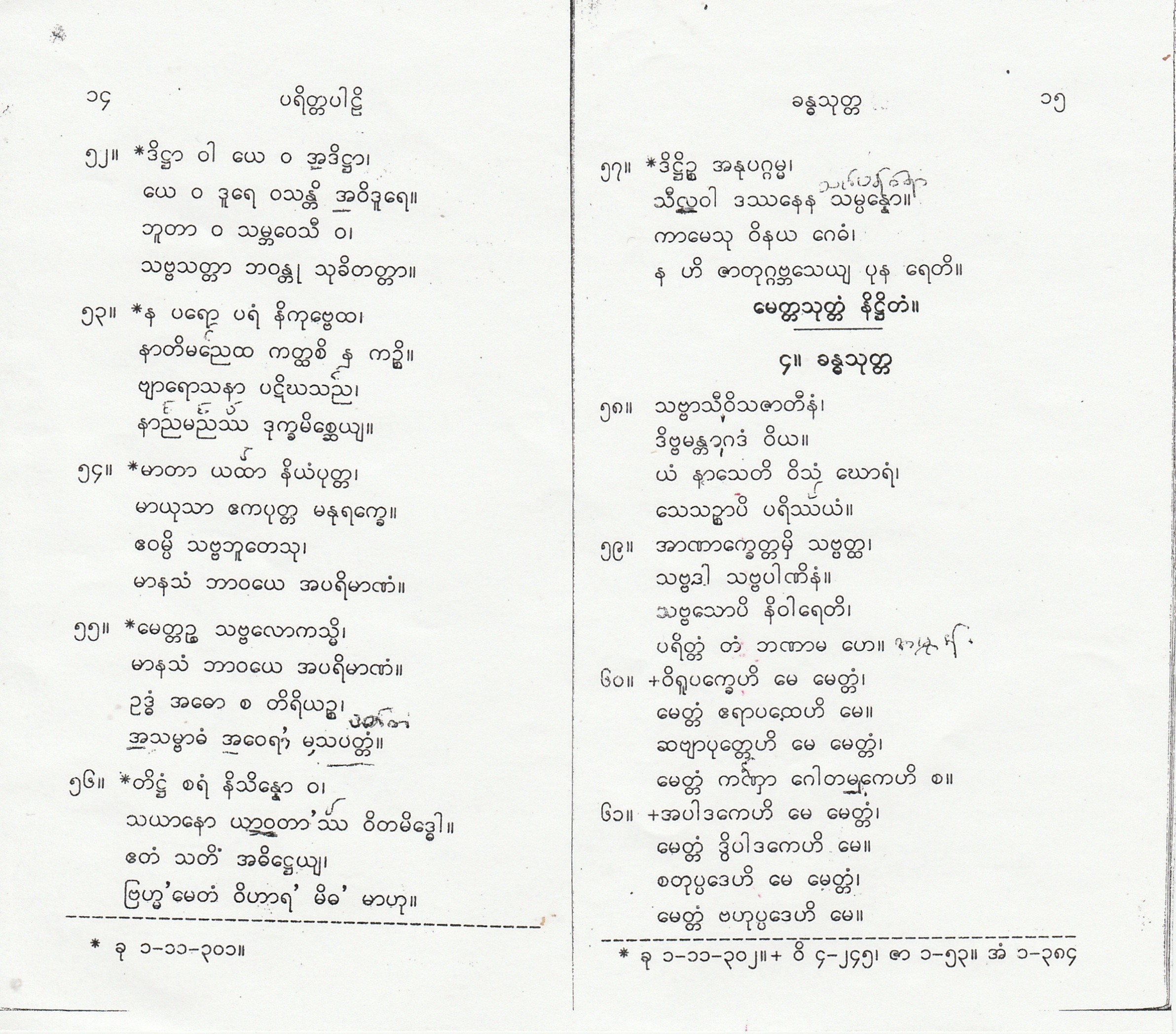
“Metta Sutta” is one of the eleven Suttas in “Paritta Pali” (Protective Verses). Also known as Karaniya Metta Sutta Chanted at most Buddhist ceremonies.
Myitta is covered along with Thitsar (Truth) in Dr. Min Tin Mon‘s book “Myitta and Thitsar“
U Thu Kha wrote a book on Metta Sutta.
U Jotalankara‘s book explains the 528 Metta.
A Physics teacher said, “Myitta So Dar Ah Hlyar Ah Nan Ma Shee Bay Mei Ah Thwar Ah Pyan Shee Bar Thay Dae.”
Metta is also used as a name or part of a name.
Metta is a Myanmar comedian.
Mettananda Vihara is a monastery in Northern California. Moved from Central Avenue, Fremont to Castro Valley.
Metta Vihari is an association that performs Chanting, and also offers food dana at selected gatherings.
Practicing Metta
By Way of LOCATION:
May I be well, happy and peaceful.
May all beings in this house be well, happy and peaceful.
May all beings in this area be well, happy and peaceful.
May all beings in this city be well, happy and peaceful.
May all beings in this country be well, happy and peaceful.
May all beings in this world be well, happy and peaceful.
May all beings in this universe be well, happy and peaceful.
May all beings be well, happy and peaceful.
By Way of PERSONS:
May I be well, happy and peaceful.
May my teachers be well, happy and peaceful.
May my parents be well, happy and peaceful.
May my relatives be well, happy and peaceful.
May my friends be well, happy and peaceful.
May the indifferent persons be well, happy and peaceful.
May the unfriendly persons be well, happy and peaceful.
May all meditators be well, happy and peaceful.
May all beings be well, happy and peaceful.
Metta Sutta
Third sutta in “Paritta Pali”
also referred to as Karaniya Metta Sutta
Desirable qualities of a Practitioner
Loving Kindness Meditation
Formal Translation from Pali into Burmese/Myanmar and English
Informal Books by Saya U Thu Kha and Saya Dr. Mehm Tin Mon
Chanting
Two ways (as per Mingun Tipitaka Sayadawgyi)
Referred in Metta Sutta
528 “Metta” (13 x 4 x 12)
Karuna
Pali term
Rendered as Compassion
One of the four Bhamaso Taya
Buddha is called “The Compassionate One”
Mahayana Buddhists emphasize the importance of Compassion
Sayadaw U Sobhana (GBNF) had four Indonesian siblings as his students. Named one of them Karuna. She was present at Sayadaw’s Last Journey.
U Moe Myint (M76) and several alumni are members of the “Karuna Ah Thinn” in Singapore. One activitiy is to help the needy for the Last Journey of their loved one.
We saw an outpouring of Karuna in the relief efforts for Disaster Recovery (e.g. Cyclone Nargis)
Practicing Karuna
May suffering ones be suffering-free
And the fear-struck fearless be
May the grieving shed all grief
And all beings find relief
Mudita
Pali term.
Rendered as Altruistic Joy or Sympathetic Joy
One of the four Bhamaso Taya
One should feel joyful when one hears good news about others.
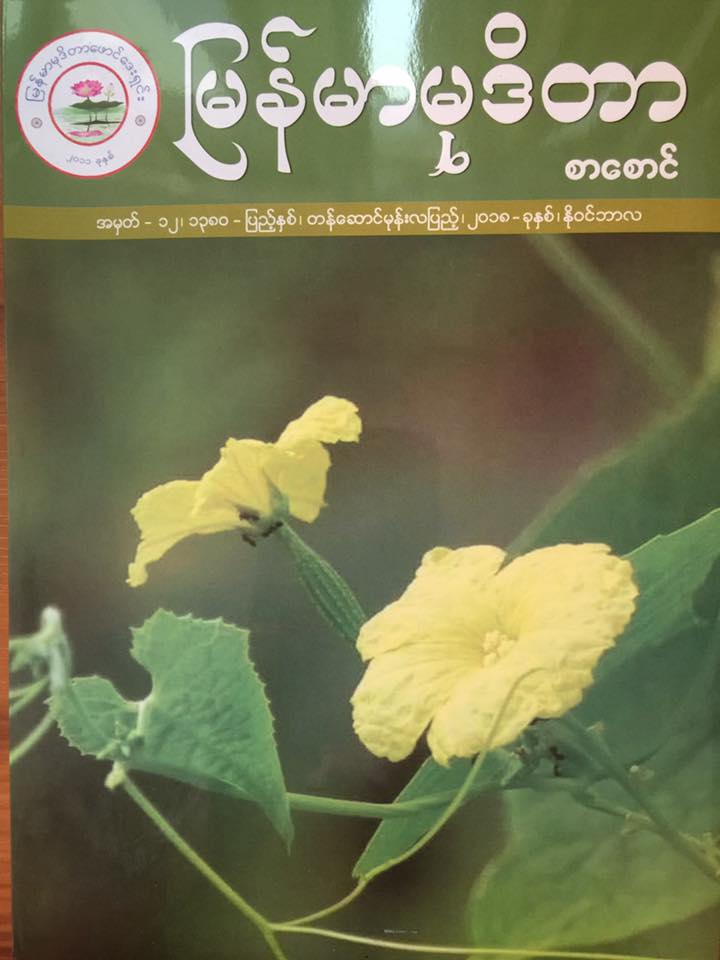
Myanmar Mudita Sar Saung
Saya U Nyunt Htay (Met73) is Chief Editor
Contributor : Tekkatho Moe War (U Moe Aung)
Upekkha
Pali term
Rendered as Neutral [Feeling]
Also translated as Equanimity
One of the four Bhamaso Taya
In a loose usage in Burmese, “Upekkha Shu” means “ignore”. It is not representative of the importance of Upekkha, which provides a balance of life and avoids the two extremes stated in the Dhammacakka Sutta
It is non-trivial to sense Upekkha while practicing Vipassana (Insight) Meditation.
Feelings may be be categorized as
Pleasant Feeling
Unpleasant Feeling
Non-Pleasant and Non-Unpleasant Feeling
Upekkha is synonymous with “Non-Pleasant and Non-Unpleasant Feeling”.
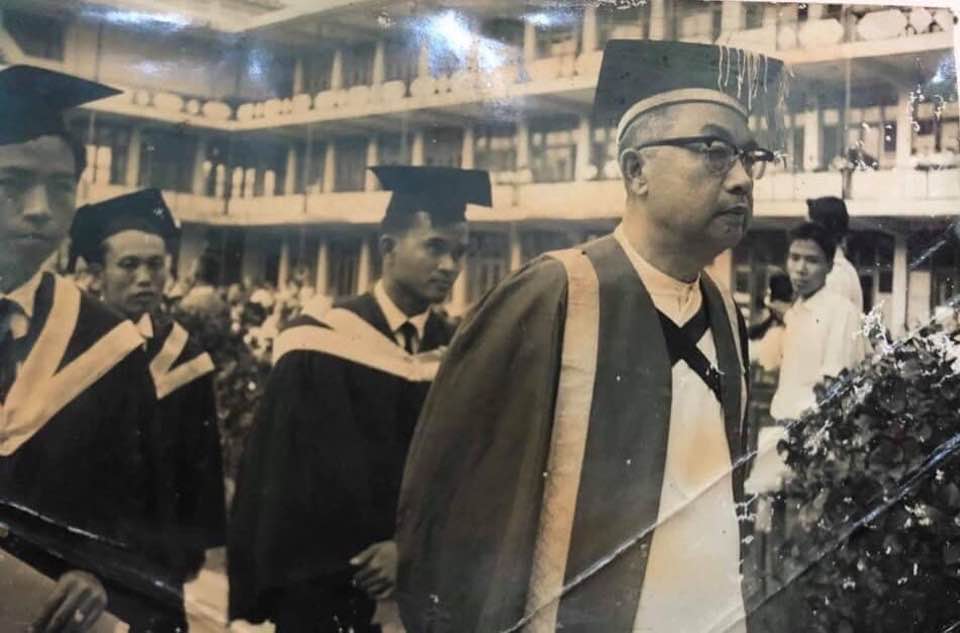
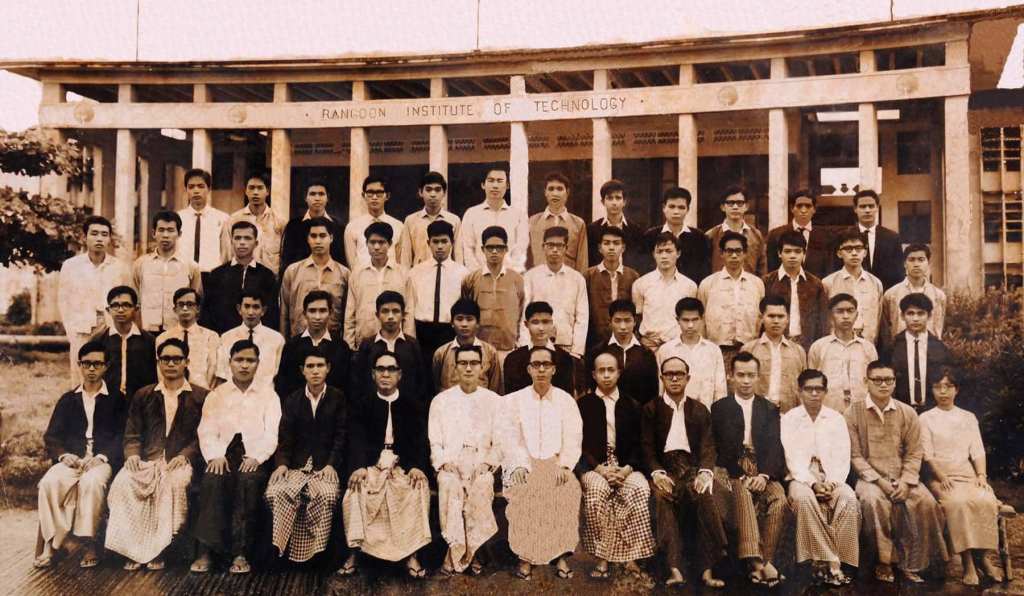
In 1961, the Faculty of Engineering, Rangoon University moved to Gyogone and had a new name Burma Institute of Technology (BIT). U Yone Mo was named Dean.
Under the new Education System, BIT became an autonomous Institute with a new name Rangoon Institute of Technology (RIT). Sayagyi became the Rector.
U Wynn Htain Oo (M72) remembers how his friends were having fun with the “Ye Punn”. Saya U Yone Mo saw them, but did not scold them. He said with a smile, “Young men, you can go to the University Swimming Pool or to the Inya Kan (Lake)”.
Per Saya Allen Htay (C58), Sayagyi established the weekly “Yoke Shin” at the Assembly Hall.
Saya Dr. Aung Gyi (then Professor of Civil Engineering) remembered seeing a letter from U Yone Mo (Rector) sent to U Yone Mo (Parent of a son who happened to visit his gambling friends at the hostel). Saya told the Admin to stow away the letter.
Ko Zaw Min Nawaday knows Sayagyi and his spouse (Daw Elizabeth Yone Mo, High Ranking Nurse at RGH and a close friend of Daw Khin May Than) very well. Sayagyi and Dr. Aung Gyi were in May Myo during one summer. Sayagyi asked Dr. Aung Gyi and Ko Zaw Min to accompany him. They ate Khauk Swe. Sayagyi reminded them gently not to tell about his “Khauk Swe” appetite to Sayagadaw.
Classmate Priests High school and university classmates who became priests Some quite early A few after retirement
1965 – 1969 Spent most of that period at Rangoon Institute of Technology Was active in extra-curricular activities
1920 – 1929 The first decade of Rangoon University Established in December 1920 with Rangoon College and Judson College as constituent Colleges
Myanmar Medical and Dental Professionals Had world wide gatherings (e.g. California, New York)
BMRI / DMR Dr. Mya Tu founded Burma Medical Research Institute He also co-authored “Who’s who in Medicine in Burma?”
Classmate Priests
Edwin David (7th from left in Fourth Row) Bernard Taylor (2nd from right in Second row) Aung Chaw (7th in Third row)
Catholic Priests
Father Edwin David (SPHS, GBNF) served as Priest of the St. Mary’s Cathedral.
Father Bernard Taylor (SPHS) served as a Missionary in some Asian countries. He resettled in Upper Burma.
Sayadaws
Ashin Okkantha
After retirement, U Aung Chaw (Victor, SPHS63, C69) became Ashin Okkantha. Sayadaw’s monastery is in Sagaing.
Uzin Bobby Myo Tun
After retirement, U Myo Tun (Bobby, A69) became Ashin Pannagavesaka. Sayadaw serves as Dhamma Librarian, Editor and Interpreter at Mawlamyaing Pa Auk Monastery.
1965 – 1969
Lu Ye Chun Camp (Summer 1965)
Inlay Lu Ye Chun Camp
The Lu Ye Chun Program was extended to Universities and Institutes. Inlay Khaung Daing Camp was established. The Camp hosted the Lu Ye Chuns from the High Schools, Universities and Institutes.
I was chosen as Lu Ye Chun for 2nd BE in 1965.
Ko Thein Swe was chosen as Lu Ye Chun for 3rd BE in 1966.
Ko Tin Myint was chosen as Lu Ye Chun for 4th BE in 1967.
The RIT Lu Ye Chun list that appeared in HMEE-2012 is not complete. It did not contain Ko Sein Shwe, Ko Hla Min, Ma Khin Than Myint Tin and Ko Zaw Min (Lu Ye Chuns for 1965 Inlay Camp).
Classes at RIT
Except for Architecture students, students from other majors took the same courses (albeit taught in different sections) for 2nd BE. There were 300+ students.
They had to select their major for 3rd BE. There were 80+ EE students.
Some left before graduation. Some decided to take sabbatical.
At the end, there were 40+ EE students left.
The EP students outnumbered the EC students 3 by 1.
We studied EC (Electrical Communications).
Eleven of us graduated in 1969.
Three (Kyaw Soe, Aung Thu Yein, Chit Tin) are now GBNF (Gone But Not Forgotten) at this time.
RIT (General)
With every turmoil (effecting “National Security”), the Classes were suspended.
U Win Thein (M67, GBNF) was a Prime Mover. He co-founded Set Hmu Thadinzin and Mechanical Magazine. He co-organized activities.
Several RIT students excelled at Sports. There were Burma Selected (e.g. Sai Kham Pan, Htay Aung) and All Universities Selected.
Activities
I served as
Treasurer and Vice Captain of Rangoon University Boat Club
Class Representative, Joint Secretary and Secretary of RIT Electrical Engineering Association
Committee Member for “Hlyat Sit Sar Saung”
Editor of the Bulletin published by RIT English Association
Member of UTC, Scrabble, and Chess teams
Free lance writer (articles, poems, translations)
Nationalization
The schools were nationalized.
St. Paul’s High School became No. (6) Botathaung State High School.
Some Brothers left Burma for Malaysia, UK and Germany.
A few indigenous Brothers (e.g. Brother Anthony) remained in Ady Road.
Brother Joseph was ordained as Father Joseph.
U Khin Maung Zaw (KMZ, EC76) wrote :
AFAIK, EC was the hardest and strictest discipline at the RIT in those days as we’ve been told. Some even asked us why we had to go there. Of course, I am not going to mention the easiest discipline there but we joked like, “they had 109 students and 110 passed the exam”. I do not mean any disrespect to Sayas and friends from other majors!! At times, it made us wonder why were we there for god’s sake.
CRAZY TIMES!!! Indeed.
1920 – 1929
1920
Rangoon University was established with Rangoon College and Judson College as constituent colleges.
First Rangoon University Students’ Strike protesting the limited scope of the Rangoon University Act. The event is celebrated as National Day (Ah Myotha Aung Pwe Nay). The movement led to the founding of National Schools.
Saya U Ba Toke is a Phwa Bet Taw of the above events. All took place in December 1920.
1921 and 1922
Rangoon University conducted its own examinations for Arts and Science.
Amendments to the Rangoon University Act were suggested. Some were implemented.
1923
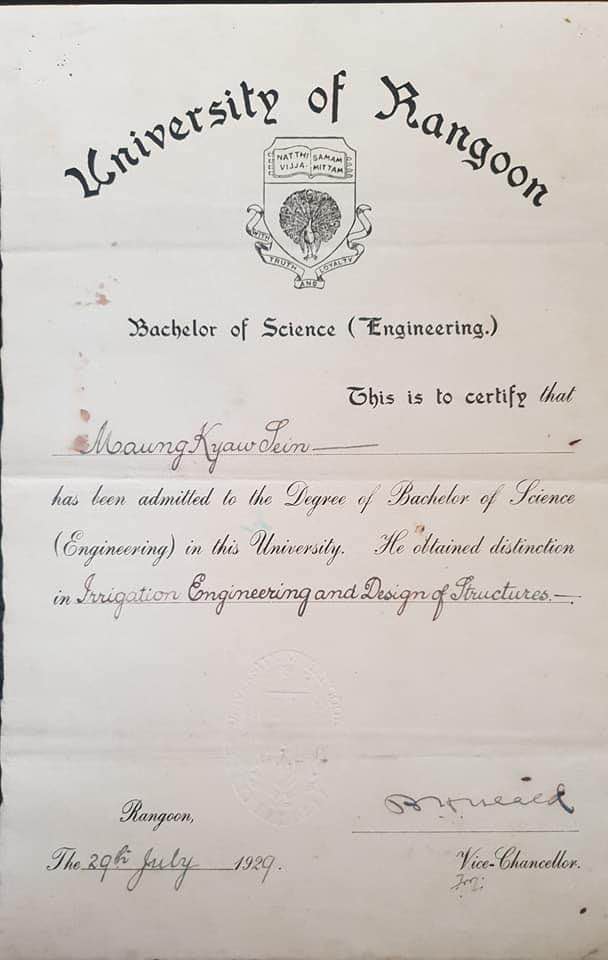
Preparation to add Engineering classes at Rangoon University
Rangoon University Boat Club (RUBC) was founded by Sir Arthur Eggar (Law Professor and member of Cambridge University Rowing Club)
1924
Admitted students with B.Sc. to attend a “condensed” three-year degree course in Engineering
Admitted students with I.Sc. to attend a four-year degree course in Engineering
First year Engineering classes were given for the first time
1925
Second year Engineering classes were given for the first time
1926
Third year Engineering classes were given for the first time
1927
Fourth (Final) year Engineering were given for the first time
The first batch of Engineering graduates (those who already had B.Sc.)
1928
The second batch of Engineering graduates (those who joined after passing I.Sc.)
U Hla Maung wrote in the RU Golden Jubilee Magazine.
U Hla Maung’s article was referred in HMEE-2012 book.
1929
The third batch of Engineering graduates
Suggested Reading
Magazine published in 1970 to commemorate the Golden Jubilee of Rangoon University
Literature on “Ah Myo Thar Aung Pwe Nay”
HMEE-2012 by Saya U Aung Hla Tun and team
HMEE-2012 Section One (Translated by U Ohn Khine and revised by Saya U Soe Paing)
Book published by Dr Khin Maung Swe (Maung Thin Char) for the 80th Birthday of Saya U Ba Toke
[1963] 40th Anniversary of RUBC (compiled by Sithu U Tin, U Po Zon and U Tin Htoon)
[2013] 90th Anniversary of RUBC : U Tin Htoon (Chair), U Myo Myint (Vice Chair), U “Henry” Htaik San (Secretary) and several members. I volunteered as a Contributing Editor and wrote Prelude for all sections and three articles.
Myanmar Medical and Dental Professionals
There have been five Global Reunions for Myanmar Medical & Dental Professionals.
Los Angeles, California, USA in 2009
Sydney, Australia in 2012
Yangon, Myanmar in 2014
London, United Kingdom in 2016
New York, USA in 2018
BMRI / DMR
During the early days of UCC, I was invited to give guest lectures at BMRI (Burma Medical Research Institute).
Dr. Mya Tu founded BMRI. He passed away at the age of 91 in Australia.
His successors include Dr. Aung Than Ba Tu, Dr. Khin Maung Tin, Dr. May May Yi, Dr. Than Swe and Dr. Paing Soe.
BMRI later became DMR (Directorate of Medical Research).
Dr. Nyunt Wai added :
The founder Dr. Mya Tu was a physiologist. One of his successors was a physiologist (Dr. May May Yee), another was a microbiologist (Than Swe), and the rest were physicians. Dr. Khin Maung Tin, who specialized in liver diseases passed away the earliest (heard it was a heart attack); survived by Dr. Daw Htay Kyi, a TB specialist. Dr. Aung Than Ba Tu, around 90 years of age, is still active, giving talks and participating in the editorial team of a certain journal.











 HlaMin